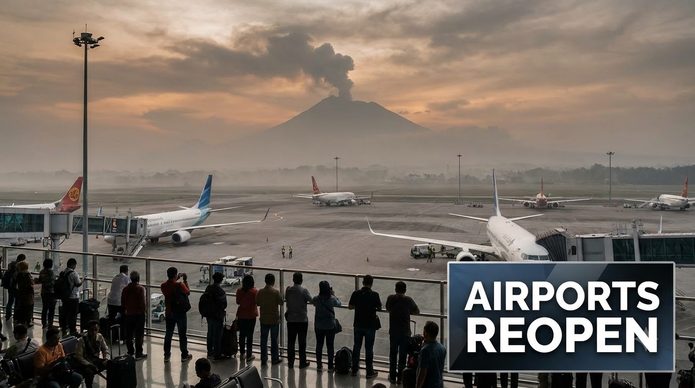
Six Indonesian airports had reopened by early Tuesday, September 8, after volcanic ash from Anak Krakatau forced widespread flight suspensions across Java and Sumatra. Jakarta’s main Soekarno-Hatta International Airport was among the airports returning to service, giving thousands of stranded passengers their first realistic route home after days of cancellations.
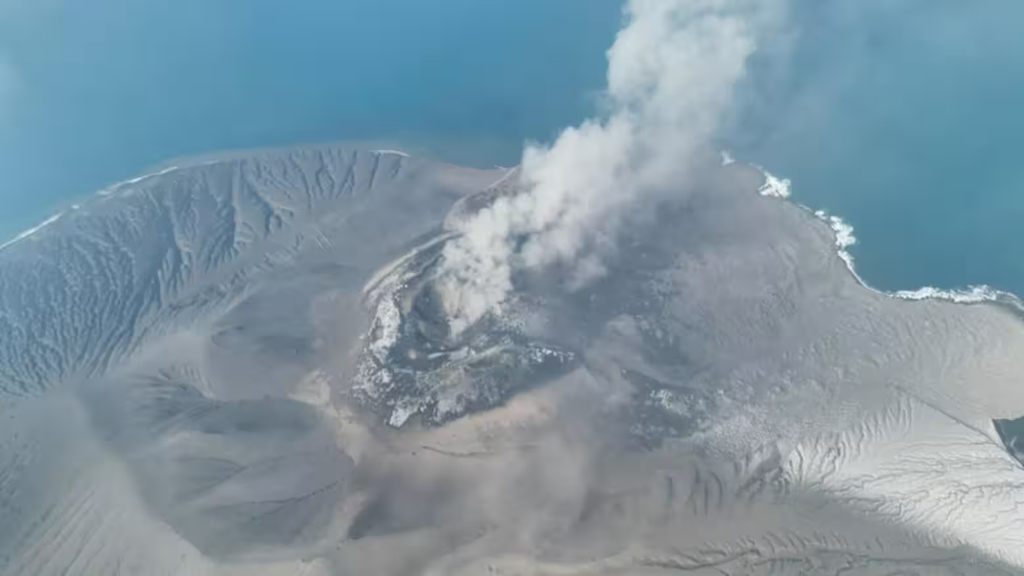
But reopening an airport does not mean flight schedules immediately return to normal.
Indonesia’s Ministry of Transportation said Soekarno-Hatta, Halim Perdanakusuma and Husein Sastranegara airports were cleared to resume operations shortly after midnight on September 8. Budiarto and Pondok Cabe followed in the early hours, while Pagar Alam/Atung Bungsu had already reopened on September 7.
For passengers, the practical message is simple: the runway may be open while your individual flight is still delayed, cancelled or waiting for an aircraft safety inspection.
Which Indonesian airports reopened after the Anak Krakatau eruption?
Six airports were listed as operational in an early September 8 AirNav update. Their reopening times were not identical because each airport was assessed separately through aviation safety information, local conditions and volcanic-ash checks.
| Airport | Location | Early reopening status |
|---|---|---|
| Soekarno-Hatta International Airport | Tangerang/Jakarta region | Reopened from about 00:30 WIB, Sept. 8 |
| Halim Perdanakusuma Airport | Jakarta | Reopened from about 00:40 WIB |
| Husein Sastranegara Airport | Bandung | Reopened from about 00:42 WIB |
| Budiarto Airport | Tangerang | Reopened from about 01:25 WIB |
| Pondok Cabe Airport | South Tangerang | Reopened from about 01:28 WIB |
| Pagar Alam/Atung Bungsu Airport | South Sumatra | Had reopened Sept. 7 |
AirNav’s NOTAM information also warned pilots that volcanic ash could remain within the wider flight information region even after an individual airport reopened, meaning crews still had to exercise caution during arrivals and departures.
That distinction matters. An airport being declared operational means conditions at the airport meet the required safety threshold; it does not mean the volcanic event itself is over.
Which airports were still closed on September 8?
Three airports remained closed in the early-morning update: Radin Inten II, Muhammad Taufiq Kiemas and Salakanagara Tanjung Lesung. Their closures were initially listed through approximately 10:00 WIB while authorities continued monitoring conditions.
The three were:
- Radin Inten II Airport in Lampung
- Muhammad Taufiq Kiemas Airport
- Salakanagara Tanjung Lesung Airport in Pandeglang
Important update: the situation changed later Tuesday
The “six reopened, three closed” figure was a morning snapshot rather than the final status for September 8.
Later updates from Indonesia’s meteorological authority showed conditions improving further. BMKG reported that paper tests at affected airports were negative for volcanic-ash contamination, while subsequent NOTAMs allowed more airports to reopen. Radin Inten II resumed operations later Tuesday, and reporting based on the updated aviation notices showed Muhammad Taufiq Kiemas and Salakanagara Tanjung Lesung reopening as well.
This is exactly why travelers should check the timestamp on any Anak Krakatau airport update rather than relying only on a headline shared earlier in the day.
Also read – 10 Top Countries for Cultural Experiences in Less Budget
Is Jakarta’s Soekarno-Hatta Airport open now?
Yes, Soekarno-Hatta International Airport reopened early on September 8 after being temporarily closed because of volcanic ash.
Indonesia’s Transportation Minister Dudy Purwagandhi confirmed that operations could resume after safety assessments of the airport and surrounding airspace. The reopening followed repeated extensions of the closure while winds and ash dispersion remained difficult to predict.
Reuters reported that the volcanic disruption affected around 341,000 travelers and nearly 3,000 flights, demonstrating why reopening the runway does not instantly clear the backlog.
Think of the airport after a large volcanic disruption like a motorway reopening after a major accident: traffic can move again, but the queue built during the closure still has to work its way through the system.
For aviation, that recovery is even more complicated because aircraft, crews and passengers may all have ended up in the wrong cities.
Why can flights remain delayed after Jakarta Airport reopens?
Aircraft inspections, displaced crews, cancelled rotations and passenger backlogs can keep flights disrupted for hours after an airport officially reopens.
Transportation officials said aircraft that had been exposed to the disruption required checks before returning to service. Reuters also reported that authorities were assessing the airworthiness of grounded aircraft as operations restarted.
Travelers should therefore expect several possible problems:
- Your airport may be open but your aircraft may not be ready.
- The inbound aircraft operating your flight may still be delayed elsewhere.
- Cabin crew may have exceeded permitted duty hours.
- A previous flight cancellation may push passengers onto later services.
- Fresh volcanic activity can trigger another route change or suspension.
The most useful detail to check is not simply “Is CGK open?” but “Is my exact flight number operating?”
That question saves travelers from making an unnecessary journey to the terminal based solely on an airport reopening announcement.
Is Anak Krakatau still erupting after the airports reopened?
Yes, Anak Krakatau remained active, so the reopening did not mean the volcanic risk had disappeared.
Reuters reported fresh eruptions on Tuesday after airport operations resumed, while Indonesian authorities continued monitoring the movement of volcanic ash.
BMKG said volcanic ash observed on September 8 was generally present up to around 7,000 feet, moving toward the south-southwest. Monitoring included satellite imagery, aviation meteorology data and physical “paper tests” at airports to detect ash contamination.
This explains what can appear confusing to passengers:
A volcano can still be erupting while an airport remains open.
Airport decisions depend heavily on where the ash is moving, its altitude and whether it threatens the airspace or surfaces used by aircraft.
Why is volcanic ash dangerous for airplanes?
Volcanic ash can damage aircraft engines and critical systems, which is why authorities close airports even when the weather may look normal from the terminal window.
Ash is not the same as soft fireplace ash. Volcanic material contains extremely fine fragments of rock and glass.
An aircraft flying through a concentrated ash cloud can face risks involving:
- jet engines,
- windscreens,
- navigation equipment,
- external sensors,
- ventilation systems,
- aircraft surfaces.
That is why “I can see blue sky outside” is not a reliable way to judge whether a flight should operate.
Aviation authorities rely on atmospheric monitoring and aircraft-safety data that passengers simply cannot see from ground level.
What should travelers flying through Jakarta do now?
Check your individual flight before leaving for the airport, even if Soekarno-Hatta is officially open.
A useful recovery-day routine is:
1. Check the airline app first.
Look specifically at your flight number rather than the general airport status.
2. Check the aircraft’s previous sector when possible.
If the plane scheduled to operate your flight has not yet arrived in Jakarta, a departure marked “scheduled” may still move later.
3. Do not rush to the airport simply because the airport reopened.
During mass disruptions, terminals can fill rapidly with passengers from earlier cancelled flights.
4. Keep screenshots of cancellation and delay notices.
They can be useful for airline rebooking, insurance claims and hotel reimbursement requests.
5. Keep medication, chargers and one change of clothes in hand luggage.
During a disruption involving thousands of flights, checked baggage can sometimes travel on a different timeline from its owner.
AirAsia, for example, said it had resumed affected Jakarta services after Soekarno-Hatta reopened but still listed exceptions on September 8, including Jakarta–Bandar Lampung flights.
That is a useful real-world example of why “airport open” and “every route operating” are two different things.
Should passengers rebook immediately or wait?
Rebook quickly if you have a time-critical connection, but avoid abandoning a protected airline itinerary without understanding the consequences.
For travelers connecting internationally, buying a completely separate replacement ticket can sometimes create a second problem: your original airline may treat later sectors differently if you fail to take an earlier leg.
Before purchasing an expensive replacement flight:
- ask whether the airline can reroute you,
- check whether your full booking remains protected,
- confirm whether baggage will be transferred,
- ask for written confirmation of cancellations,
- check the relevant travel-insurance terms.
If you do buy a replacement ticket yourself, keep every receipt.
Hotel nights, meals, airport transfers and alternative transportation can become significant expenses during a multi-day disruption.
Will Anak Krakatau cause more Indonesia flight cancellations?
Further disruption remains possible because volcanic ash movements can change rapidly with new eruptions and shifting winds.
Indonesia’s authorities repeatedly extended airport closures before reopening them precisely because wind direction remained dynamic. The Transportation Ministry said aviation safety would determine when airports could operate rather than a fixed reopening target.
BMKG has continued monitoring ash movement and aviation conditions around the clock.
For travelers, that means tomorrow’s flight should not be judged entirely by today’s improvement.
Check again:
- the evening before departure,
- before leaving for the airport,
- and immediately before a long transfer to the terminal.
How large was the Anak Krakatau flight disruption?
The eruption became one of Indonesia’s largest aviation disruptions of the period, affecting roughly 341,000 passengers and close to 3,000 flights.
At the height of the disruption, airports including both major Jakarta gateways were closed as volcanic ash spread across parts of Java and Sumatra.
BMKG reported on September 7 that ash was being detected at different atmospheric levels, with some material extending from the surface to around 15,000 feet and higher-level ash detected up to approximately 50,000 feet in the wider region.
The scale explains the slow recovery.
Even once the skies above an airport are safe again, airlines must rebuild schedules involving hundreds of aircraft movements, thousands of crew assignments and hundreds of thousands of passengers.
What travelers should remember about the Indonesia airport reopening
The good news is that Indonesia’s major affected airports progressively returned to operation on September 8. The caution is that flight disruption can continue long after an airport physically reopens.
The early-morning picture showed six airports operating and three still closed. Later Tuesday, improving tests and new aviation notices allowed additional airports to resume operations.
For anyone traveling through Jakarta, Lampung, Bandung or nearby airports, three checks matter more than any headline:
- Is the airport currently open?
- Is my exact flight operating?
- Has my airline confirmed the departure time?
Treat those as three separate questions.
That simple habit is particularly valuable during volcanic events because conditions can improve—or deteriorate—within hours.
Trusted sources for continuing Anak Krakatau updates
For the most reliable live information, travelers should prioritize:
- Indonesia Ministry of Transportation for airport and transportation announcements. Ministry of Transportation reopening update
- BMKG for volcanic-ash movement, weather and aviation meteorology. BMKG September 8 volcanic-ash update
- Your airline’s own flight-status page for the final operating status of a specific flight.
- AirAsia’s operational update, where relevant, for affected services. AirAsia Anak Krakatau flight update

