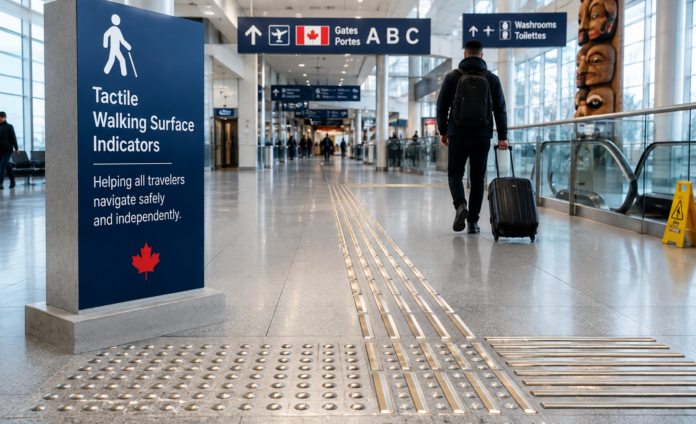
For many people moving through Toronto, the raised bumps and bars underfoot at crossings, stations and building entrances barely register. For a traveller who is blind or has low vision, however, those textured surfaces can communicate something critical: stop here, a hazard is ahead, or follow this route.
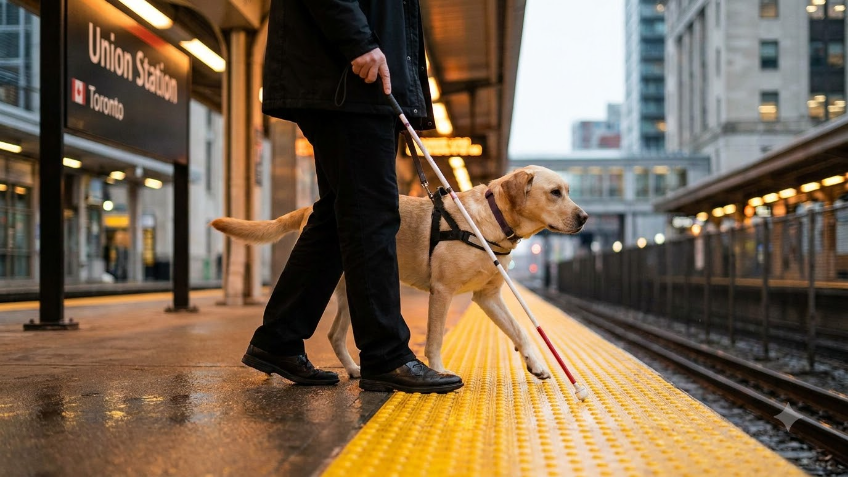
Known as tactile walking surface indicators, or TWSIs, these surfaces are designed to be detected underfoot or with a long white cane. In Toronto, they appear at places such as curb ramps and depressed curbs, while broader accessibility standards also address their use at decision points, hazards and routes where ordinary environmental cues are not enough. The City of Toronto explains that its indicators are intended to warn people with low or no vision about hazards such as moving traffic and must contrast strongly with the surrounding pavement.
That makes TWSIs far more than textured flooring. For travellers, they are part of the navigation system of the city.
What Are Tactile Walking Surface Indicators in Canada?
Tactile walking surface indicators are raised floor or pavement patterns that communicate information through touch and visual contrast.
Canada’s current CSA/ASC B651:23 Accessible Design for the Built Environment standard covers accessible design for buildings and facilities and includes requirements relating to tactile direction indicators and luminance contrast. Accessibility Standards Canada says the standard is referenced by the National Building Code and by legislation in different parts of Canada.
There is an important distinction travellers and property owners should understand:
| Question | Clear answer |
|---|---|
| Are TWSIs used across Canada? | Yes. They are part of Canadian accessibility design standards and are widely used in public infrastructure. |
| Is one identical rule enforced everywhere in Canada? | No. Requirements can depend on the province, municipality, building type and type of construction or renovation. |
| Are they used in Toronto streets? | Yes. Toronto installs them at locations including curb ramps and depressed curbs. |
| Are they only useful for blind travellers? | They are designed primarily to support people with low or no vision, but clearer hazard marking can improve awareness for many pedestrians. |
| Do colour and contrast matter? | Yes. Tactile information works together with strong visual or luminance contrast for people who retain some useful vision. |
Ontario’s Building Code includes tactile walking surface indicators within its accessibility requirements for many newly constructed buildings and extensive renovations. Ontario also requires barrier-free paths of travel in many building types.
How Do Tactile Walking Surfaces Help Blind and Low-Vision Travellers?
They turn parts of the floor into information that can be felt rather than seen.
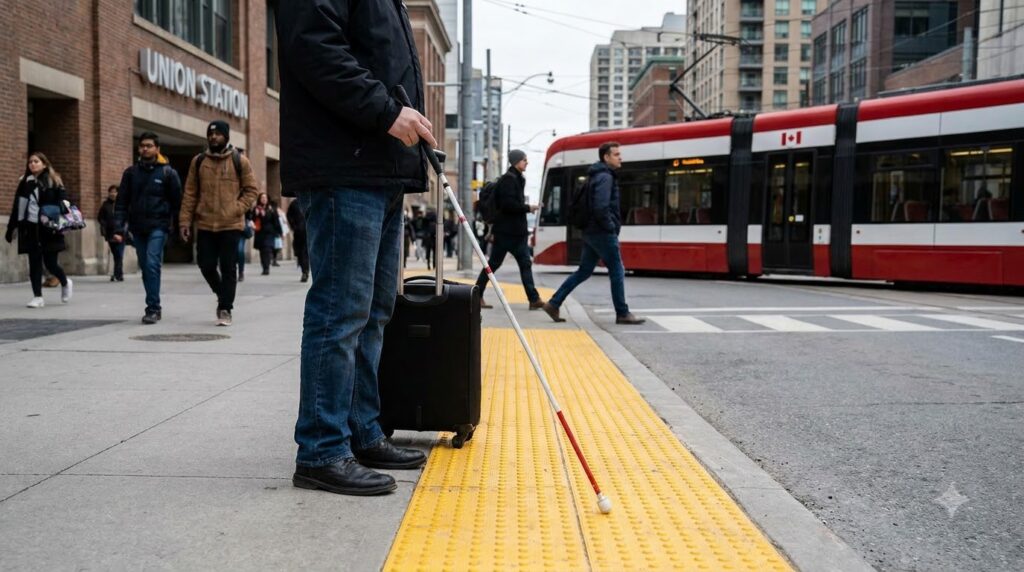
Consider a traveller arriving in downtown Toronto for the first time. They leave a building, follow the sidewalk toward an intersection and approach a curb ramp. Street noise may make it difficult to judge exactly where the pedestrian area ends and vehicle space begins.
A tactile attention surface gives an additional physical cue before that transition.
The benefit is not that the surface tells a traveller everything about the intersection. It does something more specific and reliable: it tells them that the environment is changing and deserves attention.
That distinction matters.
Accessibility Standards Canada’s current wayfinding guidance says TWSIs should be used in places without sufficient natural or built navigation cues and arranged around intersections, decision points and potential hazards. It also emphasizes that tactile indicators should not be used to compensate for poor overall design.
In practical terms, a well-designed journey combines:
- Tactile information that can be felt by foot or cane.
- Strong visual contrast for people with partial vision.
- Clear paths of travel without confusing obstructions.
- Accessible signs, lighting and signals where appropriate.
- Consistent placement, so travellers do not have to relearn the meaning of a surface at every block.
The best accessibility system therefore does not depend on one feature. TWSIs work as one part of a larger wayfinding environment.
What Is the Difference Between Warning Domes and Directional Tactile Bars?
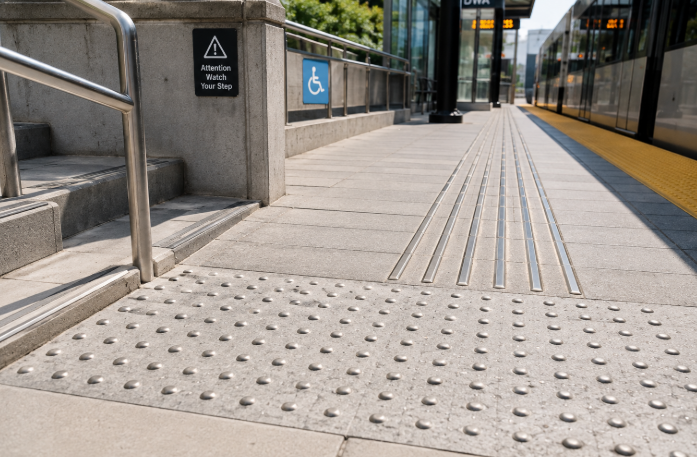
Raised domes generally communicate attention or warning, while raised linear bars can provide directional guidance.
This is one of the most useful distinctions for travellers to know.
Tactile attention indicators: “Something changes here”
Attention indicators typically use a recognizable raised-dot or truncated-dome pattern.
Their role is to draw attention to a hazard, transition or decision point.
A traveller may encounter attention surfaces near locations such as:
- curb ramps and depressed curbs;
- stairs or significant changes in level;
- platform or unprotected edges where applicable;
- pedestrian areas that meet vehicular routes;
- other places where a clear warning cue is needed.
Toronto’s accessibility design guidance identifies tactile attention indicators for situations including changes in elevation, platform areas, pool decks, stairs, escalators, curb ramps and locations where pedestrian paths meet roadways without a conventional curb.
Tactile direction indicators: “Follow this route”
Directional indicators use elongated raised bars that point along the intended path.
They become especially useful in large open environments where a traveller cannot rely on a wall, curb, landscaping edge or another continuous landmark for orientation.
Think of a large station concourse, broad lobby or open public plaza. Without a detectable edge, somebody navigating with a cane may have fewer clues about where the useful walking route continues.
Directional tactile surfaces can help create that missing line of travel.
Accessibility Standards Canada’s wayfinding standard says tactile systems should have clearly defined starting and ending points and should connect logically with natural or constructed navigation cues.
Why Toronto Travellers Notice Tactile Indicators More Often at Crossings
Toronto specifically uses tactile walking surface indicators at pedestrian crossings to make the transition into vehicle space easier to identify.
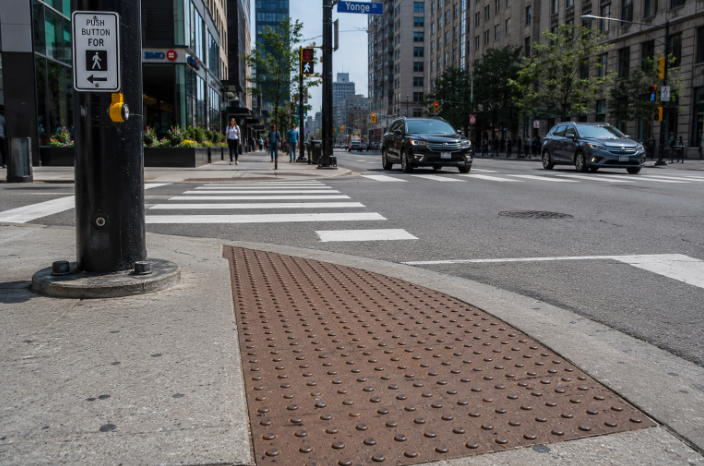
Under Ontario’s Design of Public Spaces requirements, new or redeveloped pedestrian crossings with curb ramps or depressed curbs require raised-profile tactile walking surface indicators that contrast with the surrounding surface. Toronto states that these requirements have shaped its own street accessibility work.
Toronto also uses cast-iron tactile indicators in its streetscape. According to the city, newly installed cast iron initially develops a reddish rust colour before forming a natural patina; that surface continues to provide tonal contrast with adjacent sidewalk material.
For a visitor, the important point is simpler:
When you encounter a field of raised dots at the end of a Toronto sidewalk, treat it as meaningful infrastructure rather than decorative paving.
Do not stop on it unnecessarily with luggage, bicycles, rental scooters or other belongings. Keeping the tactile field clear preserves the information it was designed to provide.
How Tactile Surfaces Help Travellers Inside Toronto Transit
Tactile indicators also form part of the TTC’s wider accessibility upgrades.
When Glencairn Station became the TTC’s 56th fully accessible subway station in November 2025, its accessibility improvements included elevators, improved wayfinding, accessible fare gates, better entrance lighting and tactile walking surface indicators.
That example shows why it is misleading to think of tactile flooring in isolation.
A traveller navigating a station may need several layers of information during one short journey:
| Stage of trip | Useful accessibility feature |
| Entering the station | Step-free entrance, clear signage and detectable route |
| Moving through the concourse | Directional wayfinding and uncluttered paths |
| Changing levels | Elevators, stairs, tactile warnings and lighting |
| Finding the platform | Clear signs plus consistent tactile information |
| Boarding | Accessible train design and predictable stopping locations |
As of the end of 2024, the TTC reported elevator access at 55 of its then 70 subway stations; subsequent accessibility projects have continued to expand the network.
For visitors who depend on step-free access, it remains sensible to check the TTC’s current accessibility and elevator information before travelling because construction and elevator outages can change the usable route on a particular day.
How Do Tactile Indicators Help in Toronto Condos, Hotels and Amenity Areas?
Tactile design becomes particularly valuable when a building contains large, unfamiliar or potentially hazardous shared spaces.
This can include condo lobbies, gyms, rooftop terraces, swimming pools, party rooms, co-working lounges and hotel common areas.
Imagine arriving at a rental apartment in a Toronto high-rise. The lobby is wide and polished. The elevator bank sits well away from the entrance. Beyond it are several nearly identical corridors leading to the gym, pool, terrace and residential towers.
For a sighted guest, overhead signs may solve the problem instantly.
For somebody navigating with limited vision, the building needs information that works closer to body level: consistent floor cues, detectable hazards, accessible signs, lighting and a logical route.
That is where good tactile planning becomes useful.
Accessibility Standards Canada also advises that walking surfaces along indoor and outdoor paths should be firm, stable and slip-resistant and should avoid visually confusing patterns. At important navigation points, designers can reinforce the route using lighting, contrast and tactile elements.
Wet areas need special attention
Pools and rooftop amenities create a different problem from a dry lobby.
The walking surface itself must remain safe when exposed to moisture, and tactile information must remain detectable without creating a new trip hazard.
A useful rule for travellers and property managers is:
Accessibility features should remain functional under the real conditions in which people use the space — including rain, water, snow, salt and winter footwear.
That point is particularly relevant in Toronto, where freeze-thaw cycles, road salt and snow clearing can affect outdoor surfaces.
Accessibility Standards Canada’s outdoor-spaces work specifically recognizes maintenance and weather management, including plans for clearing ice, snow and water from accessible outdoor environments.
The Toronto Winter Problem: A Tactile Surface Is Useless Under Ice
Good tactile infrastructure depends on maintenance just as much as installation.
A technically correct warning surface loses much of its value if it is covered by packed snow, hidden under a temporary sign or surrounded by broken pavement.
Travellers should watch for three common problems during winter:
- snowbanks covering curb-ramp tactile fields;
- ice filling the spaces between raised profiles;
- temporary construction equipment or street furniture blocking the accessible path.
Property managers should treat tactile routes as priority walking infrastructure rather than ordinary decorative flooring.
That means clearing them fully, checking whether individual elements are loose or damaged and making sure nearby mats, planters and furniture have not migrated into the route.
Toronto’s own temporary-ramp guidance makes the same broader point about accessible pathways: ramps must remain stable, slip-resistant, visually contrasting and positioned so that they do not obstruct pedestrian clearways.
What Travellers Should Do When They See Tactile Paving in Toronto
The simplest rule is to keep the surface clear and recognize that its pattern carries information.
For travellers who do not personally use tactile wayfinding:
- Do not place luggage on raised tactile fields at crossings or station platforms.
- Do not park bicycles or scooters across detectable routes.
- Avoid standing directly on a warning surface when there is clear space nearby.
- Keep guide-dog routes unobstructed, particularly around doors, elevators and curb ramps.
- Report damaged or blocked accessibility infrastructure to the relevant transit operator, building manager or municipality.
These small choices matter more than they appear. An obstruction that a sighted pedestrian can casually walk around may interrupt the precise route another traveller is using for orientation.
Are All Raised Bumps on Canadian Sidewalks Tactile Indicators?
No. Travellers should not assume every textured paving treatment has an accessibility function.
Decorative brick, drainage textures, utility covers and patterned plazas may also feel different underfoot.
A properly planned TWSI should be distinguishable, predictable and connected to a real navigation purpose.
This is why current Canadian wayfinding guidance stresses consistency. Tactile surfaces should mark meaningful hazards, intersections or decisions rather than appearing randomly.
The principle is simple: if every floor texture feels like a warning, a genuine warning becomes harder to recognize.
Are Tactile Walking Surface Indicators Mandatory Everywhere in Canada?
No. Requirements vary by jurisdiction and project type, so a national accessibility standard should not be confused with a single nationwide building law.
This distinction is particularly important for condo boards, hotel operators, developers and contractors.
In Ontario, the 2024 Building Code governs accessibility requirements for most new construction and extensive renovations. The province says these requirements include tactile walking surface indicators as part of barrier-free paths of travel. Existing buildings are not automatically forced to meet every new-construction provision unless qualifying renovation work is undertaken.
Separately, Ontario’s Design of Public Spaces Standard applies accessibility requirements to newly constructed or redeveloped public-space elements, including pedestrian crossings. Toronto implements those requirements in its streets and infrastructure.
Meanwhile, CSA/ASC B651:23 provides a major Canadian benchmark for accessible built-environment design and is referenced by building codes and legislation in different jurisdictions.
For a renovation or construction project, the safe approach is therefore to check:
- the applicable provincial or territorial building code;
- local municipal standards;
- the project’s occupancy and building type;
- whether the work is new construction, redevelopment or renovation;
- current referenced accessibility standards.
Why Good Tactile Design Helps More Than Compliance
The real value of tactile infrastructure is independence.
A traveller who can identify the edge of the pedestrian realm, find a route through an unfamiliar lobby or recognize a change in level without asking another person for help gains more than physical safety.
They gain control over the journey.
That is the better way to evaluate accessibility.
Instead of asking only, “Does this building contain tactile tiles?”, ask:
Can somebody who cannot rely on visual signs understand where to go, recognize hazards and complete the trip with as little outside assistance as possible?
That is also why Accessibility Standards Canada’s wayfinding guidance says tactile indicators must not be treated as a substitute for poor design.
A disconnected strip of tactile flooring leading nowhere does not create an accessible journey. A coherent system does.
Frequently Asked Questions About Tactile Walking Surfaces in Toronto
What are the raised bumps at Toronto crosswalks?
They are tactile attention indicators designed to warn travellers with low or no vision that they are approaching a transition or hazard, particularly the boundary between the sidewalk and roadway. Toronto installs raised-profile tactile walking surface indicators at curb ramps and depressed curbs.
Why are tactile walking surface indicators different colours?
Visual contrast helps people with partial vision distinguish the tactile area from surrounding pavement. Toronto requires strong tonal contrast, while Canadian accessibility standards more broadly address luminance contrast as an important accessible-design feature.
What do tactile directional bars mean?
Raised directional bars indicate the direction of an accessible route where other navigation cues may be insufficient. They are different from attention indicators, which primarily signal a hazard or decision point.
Do tactile indicators help tourists who are blind?
Yes. Consistent tactile information is particularly valuable in unfamiliar environments because a visitor cannot rely on memorized landmarks. The system can reinforce where a route continues and where extra caution is required.
Where should travellers expect tactile surfaces in Toronto?
Common locations include pedestrian crossings, transit environments and accessibility-sensitive areas within public or shared buildings. Exact placement depends on the applicable design requirement and location.
Can luggage or scooters block tactile indicators?
Yes, and they should be kept clear. A suitcase or parked scooter positioned across a tactile route can remove the physical cue another traveller relies on.
What Toronto Travellers Should Remember
Tactile walking surface indicators make parts of Toronto readable through touch.
At an intersection, they can mark the edge of the pedestrian environment. In a station or large building, directional cues can reinforce the route. Around stairs, platforms and other hazards, tactile attention indicators provide another layer of warning.
The most useful way to think about them is not as accessibility accessories but as physical information.
For travellers without vision loss, the responsibility is straightforward: recognize the purpose of the surface and keep it clear.
For cities, transit agencies and property owners, the standard should be higher: install tactile features in the correct places, provide strong contrast, maintain them through Canada’s difficult weather and connect them to an accessible journey that makes sense from beginning to end.
For a traveller who depends on those cues, that difference can determine whether an unfamiliar destination feels confusing — or independently navigable.

