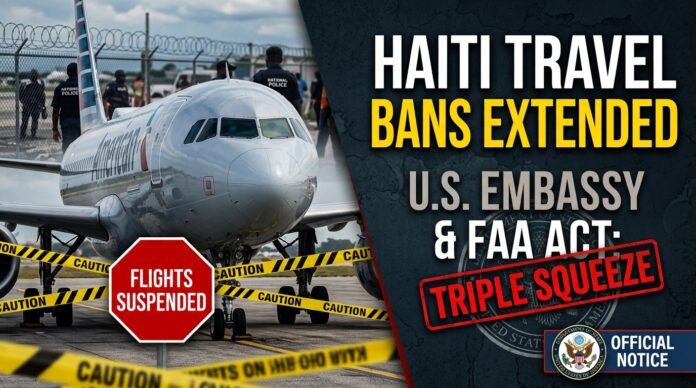
If you are trying to reach family in Haiti or attempting to coordinate an exit strategy, you need to understand that standard international safety nets are currently gone. In July, the U.S. government officially updated its Level 4 “Do Not Travel” advisory to confirm a massive restriction on embassy mobility. Combined with an ongoing federal flight ban, travelers are facing a brutal “triple squeeze” on their lifelines.
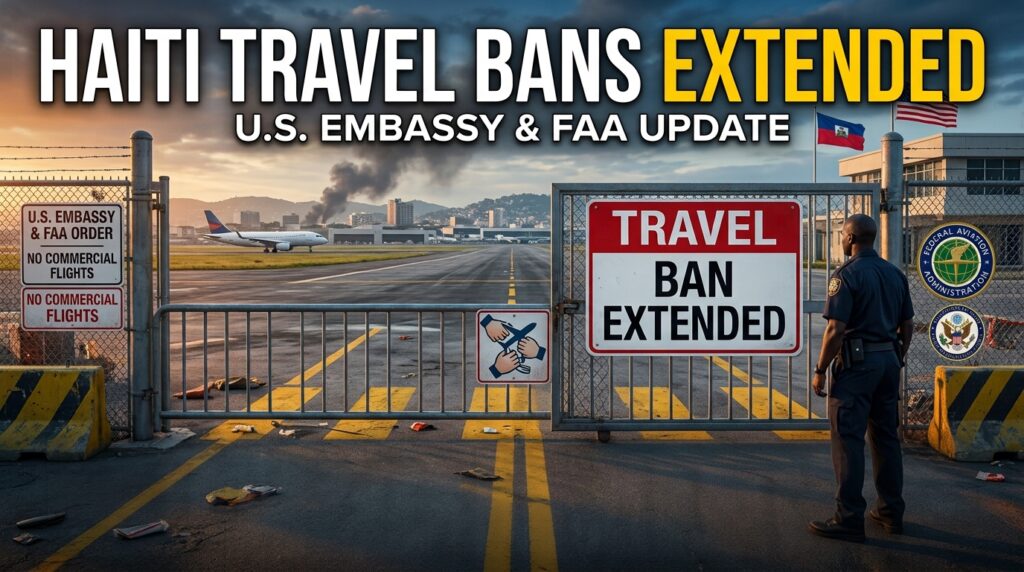
Here is exactly what is happening on the ground right now, why commercial airlines are legally barred from landing in Port-au-Prince, and the critical steps you must take if you or your loved ones need to navigate this crisis.
The FAA Flight Ban: Why Planes Are Staying Away
You cannot book a standard commercial flight into Haiti’s capital right now because the U.S. government has legally forbidden it.
The Federal Aviation Administration (FAA) recently extended its strict Notice to Airmen (NOTAM), banning all U.S. air carriers from operating in Port-au-Prince until at least September 3, 2026. This is not a weather delay or a temporary airline strike. It is a direct response to coordinated small-arms fire from armed groups targeting civil aircraft at low altitudes.
The danger is also spreading. The FAA has actively expanded the no-fly zone beyond the capital to include the Artibonite and Centre departments. If you are looking at old itineraries or third-party booking sites that claim they can get you on a Spirit, JetBlue, or American Airlines flight into Toussaint Louverture International Airport this week, that information is dangerously outdated.
Also read – US State Travel Department Fresh Warning for Caibbean …
The Embassy Lockdown: Why You Cannot Rely on a Rescue
The most critical update for American citizens is the severe restriction on the U.S. Embassy itself.
Currently, U.S. government employees are under strict lockdown and are not permitted to leave the embassy compound in Port-au-Prince for nonessential travel. In plain terms: the U.S. government has an extremely limited ability to provide emergency services. If you are trapped in a hotel or a residential neighborhood, embassy staff cannot dispatch a vehicle to rescue you or escort you to safety.
According to the official State Department Haiti Advisory, crimes involving firearms, kidnappings, and neighborhood barricades are actively preventing local law enforcement from responding to emergencies. You are entirely responsible for your own physical security.
A Quick Summary of Current Travel Restrictions
If you are managing logistics from abroad, here is the current reality of Haiti’s transport and diplomatic infrastructure:
| Restriction Type | Current Status |
|---|---|
| U.S. Commercial Flights | Banned at Port-au-Prince until Sept 3, 2026 |
| Embassy Support | Extremely limited; staff restricted to compound |
| State Dept. Advisory | Level 4: Do Not Travel |
| Safe Airport Alternative | Cap-Haïtien (requires separate ground safety check) |
What to Do (and What Not to Do) Right Now
If you have essential personnel or family currently inside Haiti, standard travel advice no longer applies. You must shift to crisis management immediately.
What to Do:
- Build a privately funded exit plan. Because U.S. commercial flights are grounded, you must secure private charter arrangements or verify safe overland routes to operational regional airports like Cap-Haïtien. Confirm the exact departure point and security escort before moving.
- Establish a proof-of-life protocol. Choose one family member to serve as the main point of contact. Agree on specific, unique questions and answers that only your loved one would know. If they are detained or kidnapped, this allows you to quickly verify they are alive.
- Carry hard copies of everything. Do not rely on cloud storage. Print copies of passports, medical insurance, emergency contacts, and private evacuation contracts. Keep these separate from the original documents.
What Not to Do:
- Do not assume Cap-Haïtien is a guaranteed escape route. While Cap-Haïtien International Airport currently sits outside the FAA’s strictest risk zone, the ground travel required to reach it from Port-au-Prince is incredibly dangerous. Never attempt this drive without professional, verified security.
- Do not wait for a government evacuation flight. The State Department has made it explicitly clear that travelers should not depend on U.S. government assistance to leave the country.
If you are considering a trip to Haiti for any reason this month, postpone it. If you are already there, shelter in place until you have a verified, professional security plan to reach an active departure point.

