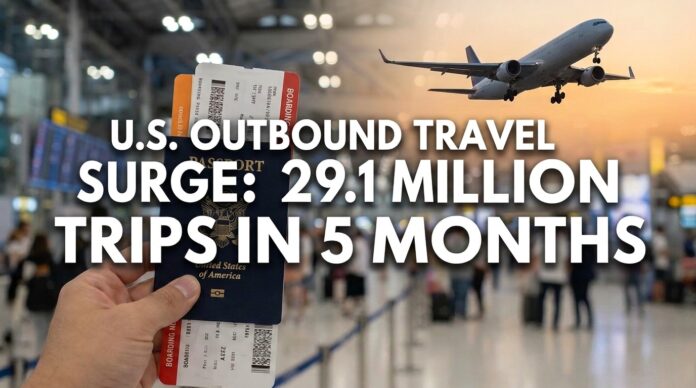
Americans made 29.1 million international air trips between January and May 2026, putting outbound travel 23% above the same five-month period in 2019.

The headline number tells only part of the story. Europe, Mexico and the Caribbean still receive most American trips, but faster growth is coming from Africa, Asia, Central America, South America and the Pacific. Those less traditional regions collectively attracted 7.85 million U.S. departures, 37.2% more than in 2019.
The figures come from an analysis of the National Travel and Tourism Office’s international air-departure data. The NTTO collects U.S. citizen departure information through airline passenger records supplied to U.S. Customs and Border Protection.
What Does 29.1 Million International Trips Actually Mean?
The figure represents trips taken by U.S. citizens, not 29.1 million different people.
One frequent traveler taking four international flights during the period may appear four times in the departure total. The data also measures outbound air departures rather than completed vacations, hotel stays or destination arrivals.
This distinction matters because the total does not include every way Americans leave the country. Land-border travel, particularly to Canada and Mexico, can be understated because the analysis concentrates on air departures. Cruises and other sea departures are not fully represented either.
In practical terms, the figure should be read as a measure of international air-travel demand, not as a complete count of Americans who took a vacation abroad.
Also read – US State Travel Department Fresh Warning for Caibbean …
Where Are Americans Traveling Internationally in 2026?
Europe remains the largest destination region, while Mexico and the Caribbean continue to attract millions of shorter international trips.
Europe, Mexico and the Caribbean together accounted for approximately 63.5% of outbound air departures from January through May. That means nearly two out of every three international air trips went to one of these three established markets.
| Destination region | U.S. departures, Jan-May 2026 | Change from 2019 | Change from 2025 |
|---|---|---|---|
| Europe | 7.97 million | +24.6% | +3.9% |
| Mexico | 5.54 million | +26.9% | -9.1% |
| Caribbean | 4.93 million | +16.0% | -1.5% |
| Asia | 3.39 million | +25.4% | +9.8% |
| Middle East | 1.06 million | +9.4% | Not specified |
| Africa | 338,000 | +66.6% | Not specified |
Europe held a 27.4% share of outbound departures, followed by Mexico at 19.1%, the Caribbean at 17%, Asia at 11.6%, Central America at 8.1%, Canada at 5.9% and South America at 4.6%.

Which International Destinations Are Growing Fastest?
Africa recorded the fastest percentage growth, but Europe still received far more American travelers.
U.S. departures to Africa increased 66.6% compared with the same months of 2019. That is a striking rate, but it came from a much smaller starting point. Africa received about 338,000 departures, while Europe received nearly eight million.
This is an important lesson when reading travel headlines: the fastest-growing market is not always the largest market.
A traveler may hear that Africa is “surging” and assume flights are becoming as frequent as those to Europe. In reality, many African routes still operate only a few times per week and may require longer connections. A cancelled flight on a thin route can therefore be more disruptive than a cancellation between major U.S. and European hubs, where several replacement services may operate each day.
Asia presents a different picture. It attracted 3.39 million U.S. departures, 25.4% more than in 2019 and 9.8% more than in 2025. That combination of scale and recent growth makes Asia one of the strongest long-haul markets in the data.
Also read – EU Parliament Approves Free Cabin Luggage & Delay Policy …
Are Americans Replacing Europe With More Unusual Destinations?
No. The data suggests Americans are adding different trips rather than abandoning familiar destinations.
Europe continued to grow and remained the largest region. At the same time, Asia, Africa, Central America, South America and the Pacific collectively gained 2.7 percentage points of market share compared with 2019. These regions now represent roughly 27% of U.S. outbound departures, almost the same share as Europe alone.
The pattern looks less like a simple switch from Paris to Panama or Rome to Rwanda. It points to a broader international travel market in which Americans continue visiting familiar places while adding less traditional destinations to future trip plans.
A family might still take its regular summer trip to Europe but choose Costa Rica, Japan or South Africa for a second journey. The departure data cannot track individual motives, but it clearly shows that growth is becoming less concentrated.
Why Did U.S. Outbound Travel Reach a New High?
The data confirms stronger demand, but it does not prove a single reason behind the increase.
It would be easy to credit cheaper flights, remote work, social media or a renewed interest in bucket-list travel. However, the departure dataset does not measure why travelers booked, how long they stayed or how they selected a destination.
What it does prove is that outbound air travel has moved well beyond its pre-pandemic level. Monthly departures recovered sharply after 2020 and have repeatedly reached levels above those recorded in 2019.
Any explanation of the causes should therefore be treated separately from the measured result.
How Much Are Americans Spending on International Travel?
The official travel-services import figure reached $16.526 billion in May 2026.
The Federal Reserve Bank of St. Louis travel-services series, using figures from the U.S. Census Bureau and Bureau of Economic Analysis, reported a seasonally adjusted value of $16.526 billion for May. The comparable April figure was $16.538 billion.
However, this number should not be treated as leisure spending alone. The series covers travel for all purposes, including education-related travel.
It would also be misleading to divide the monthly spending figure by the 29.1 million departure total to calculate an “average vacation cost.” The two figures cover different time periods and broader categories, and the departure count includes repeat trips.
What Does the Travel Surge Mean for People Booking a Trip?
Travelers should plan for stronger demand without assuming every destination will become more expensive.
The departure data does not track airfares or hotel prices, so it cannot prove that a particular trip will cost more. It does, however, show where traveler interest is concentrated and where demand is expanding quickly.
Use the trend intelligently:
- Compare more than one international gateway. A long-haul ticket from a nearby airport may be expensive, while positioning to a larger hub can open more flight choices.
- Check how often the connecting route operates. A cheaper itinerary is less attractive when a missed connection means waiting two days for the next flight.
- Price the complete journey. Add visas, airport transfers, baggage, insurance, local transportation and mobile data before deciding that a less familiar destination is inexpensive.
- Leave room for a backup plan. Flexible accommodation and an emergency spending buffer matter more on routes with limited service.
- Review entry and safety information before paying. Destination rules can change, so check the U.S. Department of State’s current travel advisories rather than relying on an old blog post or social media video
Also read – United Airlines Fake Window Seat Lawsuit: Facts & Real …
How Early Should Americans Apply for a Passport in 2026?
Routine passport processing currently takes four to six weeks, and mailing can add up to two more weeks.
The Department of State says expedited processing takes two to three weeks, excluding mailing time, and requires an additional $60 fee. Travelers with urgent international plans may need an appointment at a passport agency, but appointments are not guaranteed.
A practical rule is to check the passport before researching flights. An attractive fare is not useful when a passport has expired, contains insufficient blank pages or fails a destination’s validity requirement.
Also check every traveler’s document separately. Children’s U.S. passports are generally valid for a shorter period than adult passports, making them easier to overlook when a family travels infrequently.
What Should Travelers Not Assume From the 29.1 Million Figure?
The statistics describe past demand, not what will happen during the rest of 2026.
The analysis does not measure:
- The number of unique travelers
- International trips made mainly by land or sea
- Average airfare or hotel rates
- Length of stay
- Visitor spending by destination
- Reasons for choosing a country
- Satisfaction with the trip
- Future bookings or confirmed forecasts
The underlying report specifically describes its findings as historical rather than predictive. It also advises readers to validate figures before making major financial or operational decisions.
The Bottom Line on U.S. Outbound Travel in 2026
American international travel is not simply recovering. It is spreading across a wider range of destinations.
Europe, Mexico and the Caribbean remain the foundation of the outbound market, attracting almost two-thirds of U.S. air departures. Yet the fastest growth is occurring beyond those familiar choices, particularly across Africa, Central America, South America and Asia.
For travelers, the most useful takeaway is not that everyone should rush toward the fastest-growing destination. It is that more options are entering the mainstream. The best trip will still depend on flight frequency, entry rules, season, total cost and the amount of disruption a traveler can comfortably handle.
The 29.1 million-trip milestone shows a larger and more varied outbound market. It does not remove the need for careful planning.

