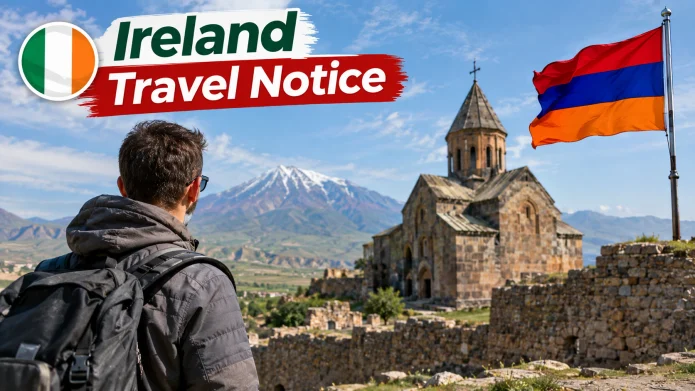
The Irish Department of Foreign Affairs (DFA) recently updated its official travel guidance for citizens heading to Armenia, applying a general “High Degree of Caution” across the entire country. However, specific eastern border regions now carry a strict “Do Not Travel” warning due to volatile military tensions. Travelers planning to visit the Caucasus must immediately review their overland itineraries and secure comprehensive medical insurance, especially since Ireland does not maintain a physical embassy within Armenian borders.
Why Did the DFA Issue a Strict “Do Not Travel” Border Warning?
Irish authorities issued this severe restriction because military clashes and unpredictable security incidents frequently occur along the eastern frontier shared with Azerbaijan. The DFA explicitly advises all Irish nationals to completely avoid the provinces of Syunik, Vayots Dzor, and the eastern section of Gegharkunik. Furthermore, attempting to cross into or visit the Nagorno-Karabakh region remains completely prohibited for civilian safety.
Military roadblocks can appear without any advance notice in these areas, trapping tourists in dangerous crossfire zones. If you ignore this federal directive and travel into a designated red zone, your travel insurance policy instantly becomes legally void, leaving you to pay out of pocket for any emergency medical helicopter evacuations.
Which Armenian Regions Carry the Highest Security Risks?
Understanding the regional map is critical before you rent a car or hire a local driver. The Department of Foreign Affairs Ireland clearly delineates safety zones to keep foreign tourists out of immediate physical danger.
| Region or Border Zone | Irish DFA Advisory Level | Specific Civilian Security Threat |
| Syunik Province | Do Not Travel | Extreme risk of sudden military confrontation. |
| Vayots Dzor Province | Do Not Travel | High risk of unpredictable border skirmishes. |
| Eastern Gegharkunik | Do Not Travel | Dangerous proximity to active conflict zones. |
| Nagorno-Karabakh | Do Not Travel | Severe military and political instability. |
| Central Yerevan | High Degree of Caution | Frequent risk of sudden political demonstrations. |
How Can Tourists Navigate Closed Borders and Road Conditions?
Armenia currently operates with completely closed land borders to both the east and the west. You cannot drive a rental car or take a passenger bus across the borders into Azerbaijan or Turkey under any circumstances. If your vacation itinerary involves crossing into neighboring countries, you must exclusively route your overland travel through the open northern border with Georgia or the southern crossing into Iran.
Road conditions outside the capital city of Yerevan deteriorate rapidly once you enter the mountainous terrain. Rural highways lack proper lighting, guardrails, and clear signage, making night travel exceptionally dangerous. Tourists should hire an experienced local driver rather than attempting to navigate unfamiliar regional mountain passes independently.
Also read – The 2026 Visa-Free Country List for US Passport Holders …
Who Provides Consular Assistance if Ireland Has No Embassy?
Ireland does not operate a fully functioning embassy stationed in Armenia. If you lose your passport, become the victim of a violent crime, or face a severe medical emergency, you must rely on the Honorary Consul located in Yerevan. For higher-level official consular assistance, citizens must directly contact the Irish Embassy based in Sofia, Bulgaria. Because on-the-ground diplomatic support is extremely limited, personal preparation is your only reliable safety net.
Mandatory Fixes for Irish Citizens Traveling to Armenia
Securing your safety in the Caucasus requires aggressive pre-planning before you ever arrive at Zvartnots International Airport. Local hospitals will refuse to treat foreign tourists unless they receive upfront cash payments, and standard EU health cards hold no value outside the European Union.
Follow these strict fixes to ensure a safe journey:
- Register with the government: Enter your exact dates into the official DFA Citizens’ Registration facility online so the Irish government knows exactly where you are if a regional crisis erupts.
- Buy robust medical insurance: Verify that your purchased policy explicitly covers emergency medical repatriation flights back to Ireland.
- Check passport validity rules: Border guards mandate that your Irish passport remains valid for at least three months beyond your entry date, though carrying a passport with six months of validity prevents unwanted entry disputes.
- Download offline regional maps: Rural border regions frequently experience dropped cellular signals and GPS navigation failures. Save all route maps to your phone’s internal storage before leaving your hotel Wi-Fi network.
What Are the Visa Rules and Guidelines for Handling Protests?
Irish passport holders do not need to apply for a tourist visa to enter Armenia for short visits. You can remain in the country for up to 180 days within a single year strictly for tourism or business purposes. However, if you plan to stay continuously for more than 90 days, local law requires you to physically register your presence with the Administration Department for Passports and Visas (OVIR) located on Mashtots Avenue in central Yerevan.
While rural borders face military threats, the capital city experiences frequent, sudden political demonstrations. These protests typically concentrate around major landmarks like Opera Square. Even gatherings intended to be peaceful can turn confrontational without warning. If you encounter a street protest, turn around immediately. Never attempt to photograph riot police or military installations.
Keep these official emergency numbers saved on your phone at all times: dial 101 for the Police, 102 for the Fire Brigade, 103 for an Ambulance, or the general 911 dispatch.

