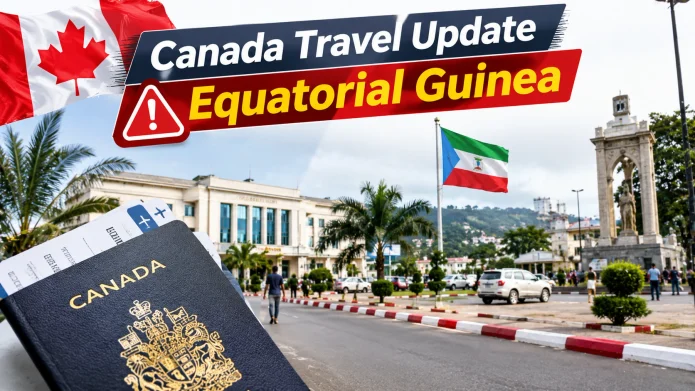
Global Affairs Canada officially issued updated travel advice for Equatorial Guinea, urging all Canadian citizens to exercise a high degree of caution when visiting the Central African nation. This revised guidance highlights increasing risks associated with arbitrary military checkpoints, severe photography restrictions, and limited medical infrastructure. Travelers planning a business trip or vacation to Malabo or Bata must immediately review their entry documents and health certificates before boarding their flights.
Why Did Canada Update Its Travel Advisory for Equatorial Guinea?
The Canadian government updated its travel advisory primarily to warn citizens about the unpredictable nature of local law enforcement and the increasing frequency of military roadblocks. While Equatorial Guinea offers a unique blend of Spanish and African heritage, the country operates under strict administrative controls. Tourists frequently face harassment or demands for bribes if they cannot instantly produce the correct paperwork when stopped by uniformed officers on the street.
Global Affairs Canada also highlighted petty and violent crime as a serious concern, especially after dark in major urban centers like Bata and Malabo. Because local police lack the resources to respond quickly to emergency calls, foreign travelers must take proactive measures to secure their physical safety. The federal advisory clearly states that visitors must remain vigilant, keep a low profile, and avoid walking alone at night.
Also read – Canada Warns of Scopolamine Drugging in Medellin Clubs
What Are the Strict Identification and Checkpoint Rules?
You must carry your original, physical passport containing a valid Equatorial Guinea visa at all times while moving through the country. Local police and military forces set up sudden, unannounced checkpoints along major highways and inside city limits.
If an officer stops your taxi or rental car, you must immediately present your identification and calmly explain your reason for being in that specific area. Failure to produce the correct documents can result in immediate arrest and arbitrary detention.
If a police officer or military guard demands a cash bribe at a checkpoint, Global Affairs Canada strongly advises against paying it. Instead, you should politely request an official written citation that you can pay later at a local municipal court.
Photography Bans: What Tourists Must Never Photograph
Equatorial Guinea strictly enforces severe laws regarding civilian photography, and ignoring these rules guarantees a harsh police response. You cannot treat Malabo like a typical European tourist destination where you can freely snap photos of architecture and infrastructure.
The national government explicitly prohibits the photography of all sensitive sites. If security forces catch you taking pictures of these locations, they will confiscate your camera equipment and likely detain you for questioning.
| Restricted Location | Security Threat Level | Consequence of Photographing |
| Presidential Palaces | Extreme | Immediate arrest and detention |
| Military Installations | Extreme | Equipment confiscation and arrest |
| Government Buildings | High | Detainment and forced deletion of files |
| Airports and Seaports | High | Harassment and equipment seizure |
Essential International Health Certificates and Medical Prep
You cannot enter Equatorial Guinea without presenting an International Certificate of Vaccination or Prophylaxis proving you received the yellow fever vaccine. Border control agents enforce this health rule strictly; if you arrive without the yellow booklet, immigration officers will deny your entry and force you onto the next flight out of the country.
Beyond yellow fever, the country presents a high risk for malaria, dengue, and waterborne diseases. Because local medical facilities lack advanced trauma response capabilities and basic prescription medications, you must pack a comprehensive medical kit. Bring enough over-the-counter and prescription drugs to last your entire trip, as pharmacies in Malabo frequently experience severe supply shortages.
How to Access Canadian Consular Support in an Emergency
Canada does not maintain a physical embassy or consulate within Equatorial Guinea. If you lose your passport, become a victim of a violent crime, or face a medical emergency, you cannot walk into a local Canadian diplomatic office for immediate help.
Instead, consular assistance for Equatorial Guinea is coordinated entirely through the High Commission of Canada located in Abuja, Nigeria. Because on-the-ground support is virtually non-existent, Canadian travelers must rely heavily on their own preparation. You must secure a robust travel insurance policy that explicitly includes emergency medical evacuation coverage before you depart. In the event of a catastrophic injury, an expensive medical airlift to Europe or South Africa remains your only viable survival option.
4 Immediate Fixes for Safe Travel in Equatorial Guinea
Traveling through a country with strict security protocols requires aggressive pre-planning. You must eliminate logistical variables before you land at Malabo International Airport.
Follow these specific fixes to ensure a secure visit:
- Pre-book reliable transport: Never hail a random taxi off the street, as unlicensed drivers frequently target foreigners for coordinated robberies. Ask your hotel concierge to arrange a vetted, private driver for all your movements.
- Register your itinerary: Sign up for the Registration of Canadians Abroad (ROCA) service so the government can track your location and send you emergency SMS alerts.
- Carry employer documentation: If you are traveling outside the main cities of Bata and Malabo, you must carry a formal letter from your employer or host organization explicitly stating the purpose of your regional travel.
- Prepare offline copies: Internet connectivity is highly unreliable. Print physical copies of your flight itinerary, hotel booking, e-visa confirmation, and medical insurance policy to present to suspicious border guards.

