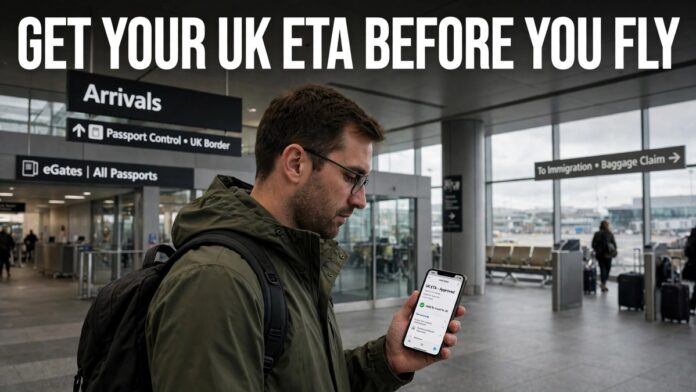
UK ETA is the digital permission most visa-free visitors now need before travelling to the United Kingdom. It costs £20 in 2026, lasts for two years or until the passport it is linked to expires, whichever comes first, and it has been strictly enforced since 25 February 2026.
An ETA is not a visa. It is advance permission to travel, linked electronically to a passport. Airlines check it before boarding, and a traveller without one can be refused boarding. The permission to enter the UK itself is still decided at the border, and an ETA does not guarantee entry.
The most expensive mistake is using the wrong fee. Many guides still quote £16, and some still quote the original £10. Both are out of date. The official GOV.UK page states the fee plainly: an ETA costs £20, and no refund is given after applying. This guide uses the current official figures throughout, with the source and year stated for every number.
UK ETA Quick Facts: Fee, Validity and What It Allows
The essentials fit in one table. Read this first, then use the sections below for the detail that applies to a specific trip.
| UK ETA fact | Current position (GOV.UK, 2026) |
|---|---|
| Fee | £20 per person, non-refundable |
| Validity | 2 years, or until the linked passport expires — whichever is sooner |
| Trips allowed | Multiple journeys while the ETA is valid |
| Maximum stay per visit | Up to 6 months |
| Where it applies | UK, Jersey, Guernsey and the Isle of Man |
| Decision time | Usually by email within a day; up to 3 working days |
| Who needs one | Visitors from 85 visa-free nationalities, including babies and children |
| Enforced since | 25 February 2026 |
Every traveller needs their own ETA, including babies and children. There is no family application and no discount for children. One person can apply on behalf of others, which makes a family application manageable, but each person still pays the full £20.
Who Needs a UK ETA in 2026?
A UK ETA is needed by visitors who do not need a visa to visit the UK. That group is called non-visa nationals, and it covers nationals of 85 countries and territories, according to the UK government. The list includes the United States, Canada, Australia, New Zealand, Japan, South Korea, Singapore, Israel, Brazil, Mexico and every EU country, plus Switzerland, Norway, Iceland and the Gulf states.
The scheme was rolled out in stages, and the dates still matter for checking eligibility. Gulf nationals were covered first, from November 2023 and February 2024. Nationals of the United States, Canada, Australia and most other non-European visa-free countries were added for travel on or after 8 January 2025. European nationals, including all EU citizens, were added for travel on or after 2 April 2025. The full list, with each start date, sits in the Immigration Rules Appendix ETA National List.
Nationality decides the requirement, not where the journey starts. A United States passport holder flying from New York needs an ETA. A French passport holder flying from Paris needs one too. A traveller whose nationality needs a visa for the UK cannot get an ETA at all and must apply for a visa instead. That distinction catches out Indian, Chinese, Pakistani, Bangladeshi, Filipino, Indonesian, Thai, Vietnamese, South African and Turkish passport holders, among others, who need a Standard Visitor visa rather than an ETA.
The purpose of the visit matters as well. An ETA covers tourism, visiting family and friends, business trips and short-term study of up to six months. It also covers coming to the UK for up to three months on the Creative Worker visa concession and for a permitted paid engagement. Travellers coming for any other reason should check whether they need a visa instead.
Who Does Not Need a UK ETA?
British and Irish citizens do not need an ETA. That exemption is absolute, and it includes dual citizens. A dual British or American citizen cannot get an ETA at all and must travel on a valid British passport, a valid Irish passport, or another valid passport carrying a certificate of entitlement proving the right of abode in the UK.
Travellers who already hold UK immigration permission do not need one either. That includes anyone with a UK visa, permission to live, work or study in the UK, settled or pre-settled status under the EU Settlement Scheme, or the right of abode. The same applies to permission to live, work or study in Jersey, Guernsey or the Isle of Man.
Airside transit is exempt, but landside transit is not. A traveller who connects through a UK airport without passing through border control does not need an ETA. A traveller who passes through border control to catch an onward flight does need one. Anyone unsure which applies should check with the airline before travelling, because the difference is decided by the airport layout and the ticket, not by the traveller’s preference.
People who live in Ireland and travel to the UK from Ireland, Guernsey, Jersey or the Isle of Man do not need an ETA. That exemption applies to non-visa nationals who are legally resident in Ireland, and travellers aged 16 or over should carry one of the listed Irish documents proving residence, such as an Irish driving licence, Irish Residence Permit or medical card. Children travelling on the France–UK school trip travel information form are also exempt, as are British overseas territories citizens and British National (Overseas) passport holders.
UK ETA Fee: Why £20, Not £16 or £10
The UK ETA fee has risen twice since the scheme launched, and old prices still dominate search results. The fee was £10 when the ETA launched in November 2023. It rose to £16 in April 2025. It rose again to £20 for applications made on or after 8 April 2026, and that is the fee GOV.UK states today. Any guide quoting £16 as the current price is at least seven months out of date.
The fee is non-refundable, even if the application is rejected. GOV.UK states this twice on the same page, and it is worth taking seriously. A rejected applicant who applies again pays another £20. That makes it worth getting the application right the first time, especially the passport photo and the face photo.
Other websites may charge more to apply. GOV.UK warns travellers to avoid websites that imitate government services, and states plainly that no other website or app can deliver a faster decision. The only official channels are the GOV.UK ETA page and the official UK ETA app. A third-party site charging £40 or £60 is adding its own fee on top of the government’s £20.
The fee is kept under review. The Home Office says in its April 2026 ETA factsheet that, as with all its fees, the cost of an ETA is kept under review. Travellers should always check the current fee on GOV.UK before applying, rather than relying on a guide written months earlier.
How to Apply for a UK ETA: Step by Step
Applying takes minutes when the documents are ready, and the app is the fastest route. The steps below follow the GOV.UK application guidance exactly, in the order a traveller actually does them.
- Use the official channel only. Apply online through GOV.UK or download the official UK ETA app from Google Play or the App Store. Do not use a third-party site.
- Have the passport ready. The ETA is linked to the passport used in the application, so use the passport that will be carried on the trip. A new passport means a new ETA.
- Have an email address and a payment method ready. Payment is by credit card, debit card, Apple Pay or Google Pay. The confirmation email goes to the address given.
- Scan the passport and take a face photo. The app uses the phone camera to scan the passport chip and take the photo. Applying online needs a photo of the passport and a photo of the face that meets the GOV.UK digital photo rules.
- Answer the suitability and criminality questions. The application asks a set of questions about the traveller’s background. Answer them honestly, because a wrong answer is worse than a slow one.
- Pay £20 and submit. The fee is paid during the application. There is no way to pay later, and no refund after applying.
- Wait for the confirmation email before travelling. The email contains a 16-digit ETA reference number. The ETA is linked to the passport, so nothing needs to be printed or shown beyond the passport itself.
One person can apply for someone else. On the app, the other person must be present. If the person being applied for is not present, the application must be made online, using a photo of their passport and a photo of their face. Families should apply together so that everyone’s decision arrives before the travel date.
UK ETA Processing Time: How Long Does a Decision Take?
Most applicants get a decision quickly, but the official window is longer. GOV.UK says a decision usually arrives by email within a day, but it can take up to three working days. The Home Office adds that most applicants using the UK ETA app currently get an automatic decision in minutes, and recommends applying at least three working days before travel to allow for the small number of cases that need further review.
The safe rule is simple: apply as soon as the trip is booked. An ETA lasts two years, so there is no advantage in waiting. Applying early costs nothing extra and removes the one risk that can cancel a trip at the last minute. Travellers who apply the night before a flight are gambling on an automatic decision.
If no decision arrives after three working days, check the spam or junk folder first. GOV.UK gives that advice before suggesting contact with UK Visas and Immigration, which cannot help with ETA enquiries by phone. Help is available through webchat instead.
Decisions for people applied for together can arrive at different times. One family member’s ETA can be approved while another’s is still being checked. Nobody in the group should travel until every traveller has received a confirmation email.
What Happens If a UK ETA Is Refused?
A rejected ETA cannot be appealed, and the fee is not refunded. GOV.UK states that if an application is rejected, or if the details in it need changing, the traveller must apply again and pay again. That is the whole process. There is no correction step and no faster route on a second attempt.
A refusal does not always mean the trip is over. GOV.UK says travellers with a criminal record, or who were previously refused entry into the UK, may want to apply for a Standard Visitor visa instead. A visa application is a fuller process with a human decision, and it is the right route for travellers whose history makes an automatic ETA unlikely.
Common reasons for delay or refusal are avoidable. A face photo that does not meet the digital photo rules can delay or reject an application. A passport that is about to expire shortens the ETA’s life, because the ETA ends when the passport does. A mistake in the passport number creates a mismatch that the airline will spot at check-in. Each of these is fixed before applying, not after.
An approved ETA still does not guarantee entry. Border officers decide permission to enter on arrival. An ETA authorises travel to the UK; it does not promise admission. Travellers should still carry evidence of their plans, such as return tickets and accommodation details, for the border check.
UK ETA Mistakes That Catch Travellers Out: A Checklist
Most UK ETA problems are not about eligibility. They are about timing, passports and copycat websites. The checklist below covers the errors that cause the most missed flights.
- Assuming a visa means no ETA is needed, or the reverse. Visa holders do not need an ETA. Visa-free nationals do. Travellers from visa-required countries cannot get an ETA at all.
- Forgetting children need their own ETA. Every traveller needs one, including newborn babies, and each one costs the full £20.
- Applying on a copycat website. Only GOV.UK and the official UK ETA app are official. Any other site charges extra and cannot speed up the decision.
- Using a passport that is about to expire. The ETA ends when the passport ends, so a passport with six months left gives an ETA with six months left.
- Getting a new passport after the ETA is granted. The ETA is linked to the old passport and does not transfer. A new passport needs a new ETA and another £20.
- Assuming airside transit never needs an ETA. Airside transit is exempt. Landside transit, passing through border control, is not. Check with the airline.
- Travelling before the confirmation email arrives. The ETA must be confirmed before travel. Boarding without it risks being refused at check-in.
- Booking a trip for more than six months. An ETA allows stays of up to six months per visit. Longer stays need a visa, and living in the UK through frequent or successive visits is not allowed on an ETA.
UK ETA and Other Travel Permissions: How It Compares
The UK ETA works like the United States ESTA and Canada’s eTA, and travellers who have used either will recognise the pattern. All three are electronic permissions linked to a passport, applied for online before travel, and checked by the airline before boarding. The UK version is cheaper than some and dearer than others, but the logic is identical: permission is sorted before departure, not at the border.
The comparison that confuses travellers most is with the EU’s ETIAS, which is a different system for a different destination. ETIAS covers travel to the Schengen area, not the UK, and the two permissions are not interchangeable. A traveller visiting both London and Paris needs to satisfy each system separately.
Canada’s eTA is the closest cousin. It costs CAD $7, lasts up to five years, and follows the same passport-linked model. Travellers who have used a Canada eTA will find the UK process familiar, but the fee, validity and exemptions are different and should not be assumed. Also read: Canada eTA: Who Needs One, Fee and How to Apply Guide
UK ETA in 2026: The Bottom Line for Travellers
The UK ETA is now a routine part of visiting Britain, not an exception. Since enforcement began on 25 February 2026, visitors from 85 nationalities cannot board transport to the UK without one. The government’s own announcement of that enforcement made the point bluntly: non-visa nationals who try to enter without an ETA will be barred.
The cost of getting it right is £20 and a few minutes. The cost of getting it wrong is a missed flight, a second £20 fee, or a visa application made under pressure. Apply through GOV.UK or the official app, apply as soon as the trip is booked, check that every traveller including children has their own ETA, and confirm the decision email before heading to the airport.
Check the official page before every trip, even for repeat visits. Fees and rules are updated periodically, and the £16-to-£20 change proves that last year’s guide can be wrong this year. The GOV.UK ETA page is the only source that matters on the day of travel, and it takes less than a minute to confirm the fee, the validity and the exemptions before applying.
Also read: India New Visa Rules: Visitor Visa V1 and V2 Guide

