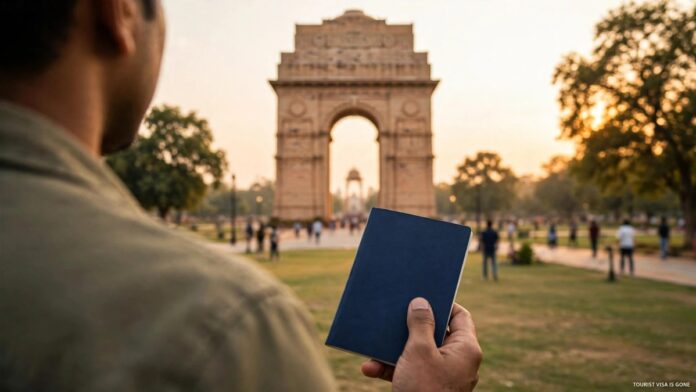
India new visa rules mean the tourist visa is gone. The familiar label millions of visitors applied for has been replaced by a broader Visitor Visa, and the framework around it has been rebuilt. The Ministry of Home Affairs has cut the main visa categories from 13 to nine and the subcategories from 49 to 23, while application forms lose up to 70% of their fields. For travellers, the question is now simpler: short-stay visitor, long-stay visitor, patient, student or business traveller?
The changes were decided on 27 August 2026 and explained in detail in a Press Information Bureau release on 11 November 2026. The government is updating its IT systems now, and visas will be granted under the new framework by the end of 2026. No exact switch-over date has been announced, so travellers should check the official portal before applying.
India New Visa Rules: What Has Actually Changed
The scale of the change is the first thing to grasp. India has been simplifying its visa system in stages. An earlier round in October 2025 cut the main categories from 22 to 13; the August 2026 decision takes the system down to nine main categories and 23 subcategories. The aim is a system that is compact, coherent and responsive to what foreign nationals actually travel to India for.
The practical change most travellers will notice is the form itself. Application forms will see up to a 70% reduction in required fields, which should cut the time an application takes and the number of places where a small mistake can stall it. The reform is aimed at boosting foreign tourist arrivals, medical value travel and foreign student arrivals, with clearer, purpose-built routes for short-stay visitors, medical travellers and students.
One thing has not changed. The e-Visa facility continues, serving citizens of 172 countries online and issuing an Electronic Travel Authorisation before arrival. The categories inside the e-Visa system are being updated to match the new structure.
Visitor Visa V-1 vs V-2: Which India Visa Do You Need Now?
The heart of the new system is the Visitor Visa, which replaces the old tourist visa entirely. The name change matters because the old label no longer describes what people actually do in India. A visitor may arrive for sightseeing, but the same trip may also include a business meeting, a medical consultation, a wellness retreat or a short course. The new category is built around that reality, and it comes in two versions.
| Visa | Validity | Who it is for | Key activities covered |
|---|---|---|---|
| V-1 | 30 days, multiple entry | Short-stay visitors | Tourism, short business meetings, medical consultations, wellness retreats, short-term courses in Indian languages, music, art or craft |
| V-2 | 1, 5 or 10 years, as specified | Long-term visitors | All V-1 activities, plus mountaineering, with a dedicated six-month multiple-entry clause for expeditions |
| M-1 | 1 year, multiple entry | Patients seeking modern medical treatment | Modern medicine, including short-duration medical treatment |
| M-3 | 1 year, multiple entry | Patients seeking AYUSH treatment | Ayurveda, Yoga, Unani, Siddha and Homoeopathy |
| S-1 | Course duration | Degree students | Study at recognised Indian schools and universities for degree courses |
| S-2 | As specified | Researchers and exchange visitors | Research scholars, exchange students, academic interns and temporary faculty |
| e-S1 | Up to 5 years or course duration | Students via Study in India portal | Degree study applied for through the official Study in India portal |
The V-1 visa is the short-stay option. It is granted for 30 days with multiple entries, and it covers short business meetings, medical consultations, wellness retreats and short-term courses in local languages, music, arts or crafts, alongside ordinary tourism.
The V-2 visa is the long-term option, with validity of one, five or ten years, as specified. It covers everything the V-1 covers and adds mountaineering expeditions, which carry a dedicated six-month multiple-entry clause. Regular visitors to India are the natural audience for the five-year and ten-year versions.
India Medical Visa Rules: M-1, M-2, M-3 and M-4 Explained
Medical travel is the second big winner from the overhaul. The framework now draws a clear line between modern clinical treatment and traditional medical systems, and each side gets its own visa. The M-1 visa applies to patients seeking modern medicine, while the M-3 visa targets patients seeking care under AYUSH, the umbrella for Ayurveda, Yoga, Unani, Siddha and Homoeopathy. Both offer a one-year, multiple-entry validity.
The split is practical: a surgery patient needs a hospital admission letter and a treatment plan, while an Ayurvedic treatment patient needs a recognised wellness centre, so the documents requested now match the treatment being sought.
Accompanying family members are covered too. Medical attendants travelling with a modern-medicine patient receive M-2 visas, while attendants of AYUSH patients receive M-4 visas. That pairing keeps the patient and the attendant in the same system, which matters at immigration when a family arrives together.
India Student Visa Changes: S-1, S-2 and e-S1
Student visas have been consolidated into three main paths, a sharp simplification for anyone applying from abroad. The S-1 visa covers foreign students enrolled in recognised Indian schools and universities for degree courses. The S-2 visa caters to research scholars, exchange students, academic interns and temporary faculty. The e-S1 visa serves students applying through the official Study in India portal, and it is valid for up to five years or the duration of the course.
The e-S1 route deserves attention because it ties the visa to the admissions portal itself. A student who applies through Study in India can hold a visa that runs for the full length of a degree, up to five years, instead of renewing a shorter visa part-way through a course.
Research scholars and exchange students fall under S-2, which covers a group that previously had to find its way through categories designed for other purposes. An exchange student on a semester abroad, a research scholar on a funded project and a temporary faculty member on a teaching visit now share a single, clearly labelled route.
Business, Work and Other India Visa Categories After the Overhaul
Business visas are split into two. The long-term B-1 visa covers establishing commercial ventures, while the short-term B-2 visa covers contractual activities, sports, film shoots and conferences. Technical staff, engineers and specialists deployed by foreign firms to maintain machinery, IT systems or supply chains will operate under a dedicated Production Investment Business Visa within the B-2 classification, applied for through the e-Visa platform.
The remaining categories complete the nine. Diplomatic visas cover diplomats, including United Nations diplomats assigned to or visiting India, and their dependants. Official visas cover government representatives. Work visas cover long-term employment and non-governmental work. Journalist visas cover media personnel. The Miscellaneous visa covers persons of Indian origin without OCI cards, spouses and children of foreign residents, property owners, adoption proceedings, foreign members of intentional communities such as Auroville, and long-term stay provisions for neighbouring nationalities.
How to Apply for an India Visa Under the New Rules
The application process is being simplified alongside the categories, and the shorter forms are the most visible part of that. The steps below reflect the process as it stands, and they should be checked against the live portal before an application is submitted, because the IT systems are being updated to support the new structure through the end of 2026.
1. Identify the purpose of the trip first. Match the main purpose to one of the nine categories, then to the subcategory in the table above. A holiday with a business meeting is a Visitor Visa, not a Business Visa. A hospital stay is a Medical Visa, not a Visitor Visa.
2. Check whether the e-Visa route is open for the category. The e-Visa facility serves citizens of 172 countries online. Confirm on the official e-Visa portal that the category and subcategory needed are available through the online route, and that the nationality in question is eligible.
3. Gather the supporting documents for that specific category. A V-1 application, a hospital letter for M-1, an admission letter for S-1 and a business invitation for B-2 each need different papers.
4. Complete the form and check every field before submitting. Names, passport numbers and dates should match the passport exactly, because a mismatch is still the most common reason for delay.
5. Wait for the Electronic Travel Authorisation before travelling. E-Visa applicants receive an ETA before arrival.
Three checks matter before money is spent on flights and hotels. The first is the implementation date: visas will be granted under the new framework by the end of 2026, but no exact launch date has been announced, so applicants should confirm on the official portal which categories are open. The second is existing visas: the announcements do not spell out how pending applications and visas already granted will be treated. The third is the conditions on the grant: a V-2 visa valid for ten years is not the same as a ten-year stay.
Also read: Malaysia visa for Indians: 2027 rules and MyVisa guide
Also read: South Korea K-ETA exemption for 22 countries in 2027
Nine categories replace thirteen, 23 subcategories replace 49, forms lose up to 70% of their fields, and the tourist visa becomes a Visitor Visa with a 30-day option and a one, five or ten-year option. The system is being rolled out through the end of 2026: pick the category from the table above, confirm it on the official portal, and apply with the documents that category asks for.

