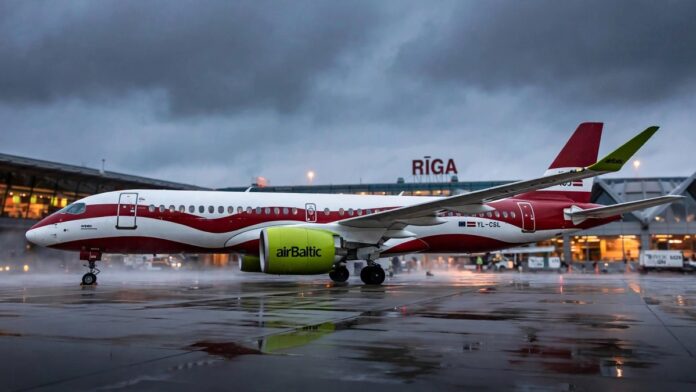
Latvia’s parliament has approved a state guarantee of up to €175 million for airBaltic, clearing the way for the airline to draw a further €125 million in private financing under its United States Chapter 11 restructuring.
The Saeima voted 77–19 on November 26, 2026, to amend the law on financial stabilisation measures for airBaltic, authorising the government to stand behind the airline’s obligations. The guarantee still needs European Commission approval, and the money itself comes from private lenders, not directly from the Latvian budget.
Without the second tranche of financing, airBaltic could run out of cash in the first half of December 2026. Transport Minister Krišs Lipšāns told reporters the airline might have to cease operations in mid-December if the funding did not arrive.
The vote and what it authorises
The amendments passed in a fast-track procedure. The Saeima’s Budget and Finance Committee had backed the plan 9–2 the day before, and the government had given its conceptual approval on November 24.
The law now allows the state to act as guarantor for airBaltic. The guarantee covers up to €175 million: the €125 million second tranche of private financing, plus up to €50 million in associated interest exposure. If airBaltic cannot meet its obligations, the state must honour the sum.
That distinction matters. The vote does not hand airBaltic €175 million in cash. It promises lenders that Latvia will pay if the airline defaults, which is what the lenders required before releasing the money.
Latvia’s national news agency LETA reported the Saeima’s approval of the €175 million state guarantee, including the 77–19 vote and the warning that the airline could stop flying in mid-December without the funding. Airways Magazine confirmed the vote cleared a hurdle for the airline to draw private financing, while noting the measure did not itself issue the guarantee or release the funds.
How the €350 million rescue financing is structured
The rescue rests on a debtor-in-possession (DIP) facility of up to €350 million arranged by Strategic Value Partners, with funding commitments from Barclays, Hayfin Capital Management, Morgan Stanley, Oaktree Capital Management and Strategic Value Partners. DIP financing gives a Chapter 11 debtor court-supervised liquidity to keep operating while it restructures.
The facility is split into three tranches, and only the first has been fully available so far.
| Tranche | Amount | Status |
|---|---|---|
| Tranche 1 | €175 million | Already available after U.S. bankruptcy court approval; used to maintain operations and acquire eight Airbus A220 aircraft and seven Pratt & Whitney engines. |
| Tranche 2 | Up to €125 million | Unlocked by the new €175 million state guarantee; still needs European Commission approval and U.S. court steps. |
| Tranche 3 | Up to €50 million | Subject to further agreement and court approvals. |
The U.S. Bankruptcy Court for the Southern District of New York gave final approval to the DIP financing structure on October 19, 2026. Remaining disbursements depend on further conditions, including the DIP lenders’ security priority relative to existing creditors. In a November 16 court filing, airBaltic warned it would face liquidation without access to the remaining two tranches.
Why the rescue financing costs so much
The price of the DIP facility has become the central argument in Latvia’s debate over the rescue. The headline interest rate is SOFR plus 8 percentage points, roughly 12% when the facility was announced in September 2026. Interest is payable in kind, meaning it is added to the principal balance, unless paid in cash.
Fees add up to a further €52.5 million: a 5% commitment fee, a 5% upfront fee and a 5% exit premium. Opposition MPs argued during the November 26 debate that, once all fees are counted, the effective annualised burden approaches 39%. That figure is disputed and is not the contractual interest rate, but it shows why critics call the financing expensive.
Supporters of the guarantee answer that the alternative is worse. A shutdown in December would strand passengers, cut Riga’s connections across Europe and leave the state with an airline worth far less in liquidation. The guarantee buys time; it does not fix the underlying business.
How airBaltic reached this point
airBaltic entered Chapter 11 voluntarily in September 2026 to negotiate with creditors, restructure debt and revise its business model without immediate liquidation. The airline’s own announcement said flights and customer services would continue as normal during the process.
The crisis built up over several years, and no single event caused it.
- Expansion before the pandemic. Under former chief executive Martin Gauss, airBaltic aimed to turn Riga into a regional hub with up to 100 Airbus A220-300 aircraft, relying on connecting traffic between Western and Eastern Europe.
- Pandemic and war. Covid-19 disrupted travel and required state support. Russia’s invasion of Ukraine in 2022 then removed routes to Russia, Ukraine and Belarus, weakening Riga’s hub role. The airline expanded wet-lease operations to diversify.
- Engine groundings. Pratt & Whitney GTF engine availability problems forced aircraft groundings and thousands of flight cancellations during summer 2025.
- Losses despite revenue growth. airBaltic recorded €779.3 million in revenue in 2025 but still posted a net loss of €44.3 million, alongside heavy debt and lease commitments.
- The 2026 fuel shock. Jet fuel prices spiked from budgeted levels of about $685 per tonne to about $2,000 per tonne during the early 2026 U.S.–Iran conflict. With about 90% of fuel unhedged, every $100 per tonne increase added roughly $16.5 million in costs.
Restructuring goals now include fleet reduction, lease renegotiation, cost cuts and improved operating margins.
What happens next: approvals, investors and the spring deadline
Three hurdles remain before the rescue is secure.
First, the European Commission must approve the guarantee under EU state aid rules. State support for airlines has a long history of Commission scrutiny: an earlier European Commission decision on alleged aid to airBaltic shows how closely Brussels has examined Latvian support for the carrier in the past. The guarantee can only be issued after the Commission’s approval is received.
Second, the U.S. bankruptcy court must still rule on giving the new DIP lenders priority over holders of airBaltic’s bonds due in 2029. That question was unresolved at the time of the parliamentary vote.
Third, airBaltic must show progress by spring 2027 on attracting a strategic investor and refinancing its debt on better terms. Lufthansa Group, which acquired a 10% minority stake in 2025 while the Latvian state retained 88.37%, has taken on no responsibility for airBaltic’s debt or the state guarantee.
| Date | Event |
|---|---|
| September 14, 2026 | airBaltic files for Chapter 11 protection in the United States. |
| October 19, 2026 | U.S. bankruptcy court gives final approval to the €350 million DIP facility. |
| November 16, 2026 | airBaltic warns in a court filing it faces liquidation without the remaining tranches. |
| November 24, 2026 | Latvian government gives conceptual approval to the guarantee. |
| November 26, 2026 | Saeima approves the €175 million guarantee, 77–19. |
| Mid-December 2026 | Deadline by which the guarantee must be signed and filed with the U.S. court. |
| Spring 2027 | Deadline to show progress on a strategic investor and refinancing. |
What the airBaltic rescue means for passengers
For now, tickets and reservations remain valid, and airBaltic says it plans to continue its published schedule. The guarantee vote removes one obstacle, but passengers booking for December and beyond should still watch the next steps.
The practical advice is simple. Book directly with the airline where possible, keep booking confirmations and receipts, and check the flight status before travelling. If the European Commission approval or the U.S. court ruling slips, the December cash deadline comes back into focus quickly.
Latvia views airBaltic as a critical national asset supporting regional connectivity, tourism, employment and Riga Airport’s hub status. The €175 million guarantee buys the airline essential time. Whether that time is enough depends on finding an investor and a business that can pay its own way without further state support.

