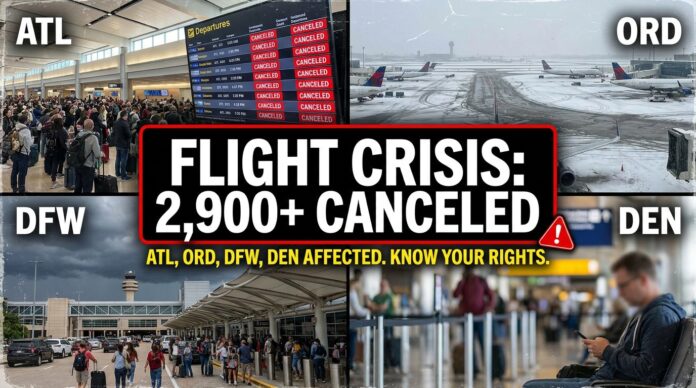
U.S. air travel is under heavy pressure after 2,918 flights were delayed or canceled across key hubs including Atlanta, Chicago, Dallas, and Denver. The disruption wave hit on Monday, June 22, 2026, and travelers should expect the impact to spill into Tuesday, June 23, especially on early departures, tight connections, and flights using aircraft or crews stuck in the wrong city.
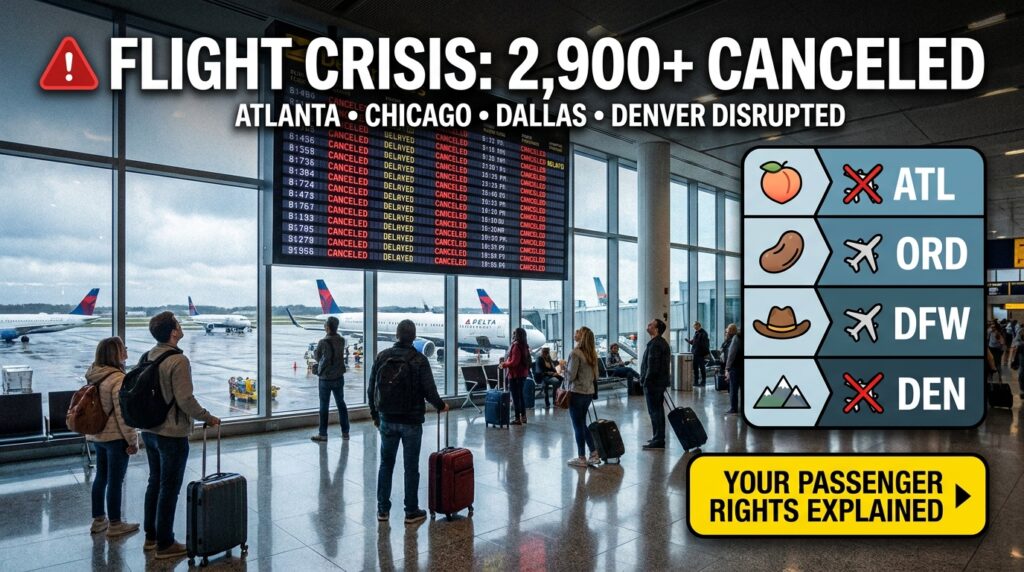
By midday Monday, the disruption count stood at 2,826 delayed flights and 92 cancellations, with the hardest-hit airports including Hartsfield-Jackson Atlanta International Airport, Chicago O’Hare International Airport, Dallas/Fort Worth International Airport, and Denver International Airport.
The short answer for travelers is simple: check your inbound aircraft, avoid tight connections, do not leave the airport without written confirmation from your airline, and know when a refund is better than a rebooking.
Why Are So Many U.S. Flights Delayed Today?
The delays are being driven by a bad mix of thunderstorms, air traffic control limits, crowded hub airports, and crew-positioning problems. When storms slow arrivals into one major airport, the effect does not stay local. The aircraft that was supposed to fly Atlanta to Denver may still be stuck in Chicago. The crew assigned to your evening departure may be timing out at Dallas/Fort Worth.
That is why this disruption feels bigger than a normal weather delay.
The FAA’s National Airspace System Status is the first page travelers should check when delays are spreading across regions. It shows ground delay programs, ground stops, and traffic management actions that can slow flights even when the weather at your departure airport looks fine.
Also read – Google Flights Best vs Cheapest: Which to Pick?
The Four Airport Hubs Travelers Should Watch Closely
Atlanta, Chicago O’Hare, Dallas/Fort Worth, and Denver matter because they connect huge parts of the domestic network. A delay at one of these airports can break a connection two states away.
| Airport | Why It Matters Today | Smart Traveler Move |
|---|---|---|
| Atlanta ATL | Huge Delta hub with heavy connecting traffic | Check connection time before boarding your first flight |
| Chicago O’Hare ORD | Weather and congestion can quickly slow arrivals | Avoid last-flight-of-the-night itineraries |
| Dallas/Fort Worth DFW | Major American Airlines hub with long terminal transfers | Ask for rebooking before your connection is officially missed |
| Denver DEN | Weather, altitude, and hub traffic can create rolling delays | Track your inbound plane before leaving for the airport |
What Airlines Are Affected Most?
Delta, United, JetBlue, PSA Airlines, and Hawaiian Airlines were among the carriers listed with the largest disruption counts. That does not mean every flight on those airlines is in trouble. It means travelers should be more alert if their route touches one of the affected hubs.
A practical example: a passenger flying Nashville to Phoenix through Denver may not see bad weather at either end. But if the Denver aircraft arrives 90 minutes late from Chicago, the whole trip can slide.
That is why the best question is not only “Is my flight delayed?” It is also:
“Where is my aircraft coming from?”
Most airline apps show this under “incoming aircraft” or “where is my plane.” Flight trackers such as FlightAware can also help you see whether the plane assigned to your flight is already behind schedule.
Will Delays Continue Into Tomorrow?
Yes, delays can continue into the next day when crews and aircraft are out of position. This is the part many travelers miss. Thunderstorms may move out in the evening, but the airline still has to rebuild the schedule.
The biggest risk is usually on:
- Early morning departures using aircraft that arrived late the night before
- Tight connections under 60 minutes at ATL, ORD, DFW, or DEN
- Regional flights that depend on smaller crew pools
- Last flights of the day, because there may be no backup option if they cancel
If your flight is tomorrow morning, do not wait until you reach the airport. Check the airline app tonight and again before leaving home.
Also read – How to Set Price Alerts on Google Hotels to Find Cheap Deals
What Should Travelers Do Right Now?
Travelers should act before the airport line gets long. The people who recover fastest during mass delays are usually the ones who use the airline app, phone support, and gate agent at the same time.
Use this order:
- Open the airline app first. Rebooking options often appear there before an agent can help.
- Check the inbound aircraft. If it has not left the previous city, your delay may grow.
- Screenshot every delay notice. Keep times, reasons, and cancellation messages.
- Ask for written confirmation. If the airline says “weather” or “ATC,” ask them to note it in your booking.
- Look at nearby airports. For example, Chicago travelers may compare ORD and MDW, while Dallas travelers may check DFW and DAL.
- Do not accept a voucher too quickly. A voucher can block your refund option if you later decide not to travel.
What Not To Do During a Major Flight Delay
Do not leave the airport unless the airline confirms your next step in writing. A gate agent may verbally say, “Come back tomorrow,” but your reservation may still show you as active on the original trip.
Avoid these mistakes:
- Do not book a hotel before asking the airline what it will cover
- Do not cancel your own ticket unless you understand the refund impact
- Do not rely only on airport screens
- Do not check a bag if your connection is already at risk
- Do not accept a later flight without checking whether it arrives too late for your plans
A real-world tip: if you are standing in a 70-person service line, call the airline’s international support number or use chat support inside the app. Many travelers get rebooked before reaching the front of the line.
Can You Get Compensation for Weather or FAA Delays?
Cash compensation is usually unlikely when the cause is severe weather or air traffic control restrictions. These are generally treated as events outside the airline’s control.
But that does not mean you have no rights.
Under the U.S. Department of Transportation’s refund rules, travelers are entitled to a refund if the airline cancels a flight and the passenger chooses not to travel. A refund may also apply when a flight is significantly delayed or changed and the traveler rejects the new option.
For U.S. domestic trips, DOT defines a significant delay around the three-hour mark. For international trips, it is generally six hours.
Refund, Rebook, or Wait: Which Choice Is Better?
Choose a refund only if the new airline option no longer works for your trip. If you still need to travel, a rebooking is usually more useful than cash back, especially when same-day fares are expensive.
| Situation | Best Move |
| Flight canceled and trip no longer needed | Request a refund |
| Flight delayed but still useful | Stay booked and monitor updates |
| Connection will be missed | Ask for rebooking before landing |
| Overnight delay away from home | Ask about hotel and transport help |
| Delay caused by airline-controlled issue | Check the DOT Cancellation and Delay Dashboard |
Why Thunderstorms Create Bigger Airport Problems Than Rain
Thunderstorms reduce how many planes can safely take off and land. Rain alone may slow an airport, but storms can force aircraft to avoid certain airspace, delay fueling, stop ramp workers from loading bags, and trigger ground stops.
The National Weather Service explains that aviation weather support includes real-time updates for air traffic controllers and close coordination with the FAA through aviation weather teams. Travelers can monitor broad aviation weather conditions through the Aviation Weather Center.
This matters because your delay may be caused by weather near the route, not only weather at your airport.
Also read – How to Filter Out Basic Economy on Google Flights
The Best Airport Survival Plan for Today
Pack as if your two-hour delay could turn into an overnight stay. That sounds dramatic, but it is the difference between being annoyed and being stranded without medication, chargers, or baby supplies.
Keep these in your personal item:
- Phone charger and power bank
- Prescription medication
- Toothbrush and basic toiletries
- A clean shirt
- Snacks
- Refillable water bottle
- Any documents needed for international travel
- A screenshot of your full itinerary
One small move helps a lot: sit near your gate, but not inside the crowd around the podium. Gate agents often make quiet announcements before the airport screens update.
Bottom Line: Travelers Should Expect Rolling Delays, Not One Clean Reset
The U.S. flight disruption is not just a Monday problem. With 2,918 flights already affected across major hubs, the real trouble is the second wave: late aircraft, misplaced crews, missed connections, and overnight recovery schedules.
If you are flying through Atlanta, Chicago O’Hare, Dallas/Fort Worth, or Denver, treat your trip as fragile until your aircraft is at the gate and boarding has started.
The smartest move is to check your flight early, track your inbound plane, keep proof of every delay, and decide quickly whether a rebooking or refund protects your trip better.

