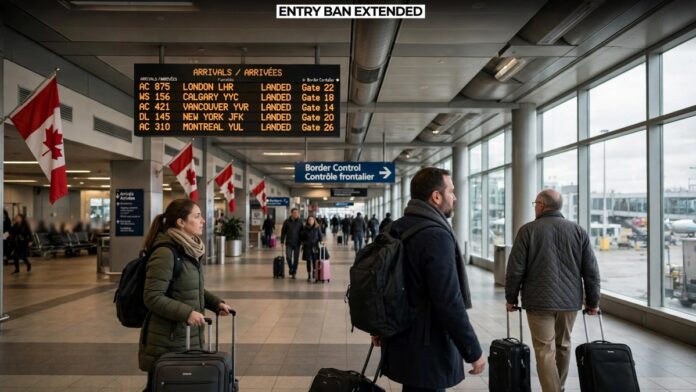
Canada Ebola travel ban February 2027 is the new end date travellers and visa applicants need to know: Canada has extended its Ebola-related immigration and travel restrictions for another 90 days, until midnight Eastern Time on 25 February 2027.
The extension was announced by the Canadian government on 27 November 2026. It keeps visa and permit suspensions in force for foreign nationals who were living in the Democratic Republic of the Congo (DRC), Uganda or South Sudan when they applied — and it keeps the entry ban for anyone who has been in the DRC in the previous 21 days. The difference between a resident, a recent visitor and a returning Canadian matters enormously — and most coverage blurs it.
Canada Ebola Travel Ban February 2027: What Changed on 27 November 2026
The measures were extended, not introduced. IRCC first put them in place at 23:59:59 ET on 27 May 2026, and this is the third extension — earlier ones followed in August and September 2026.
The Government of Canada notice issued on 27 November 2026 says IRCC has again extended its temporary immigration measures for 90 days, until 25 February 2027 at 23:59:59 ET, as a precaution while it monitors the outbreak in the DRC and neighbouring countries.
The extension has two separate halves, working on different tests. The immigration measures suspend documents and freeze final decisions, based on the country of residence listed on the application. The border and public health measures, made under the Quarantine Act, control who can physically enter Canada, based on where the person has actually been in the previous 21 days.
The border measures sit in a renewed federal order — the Minimizing the Risk of Exposure to Ebola Disease in Canada Order, 2026, No. 4 — in effect from 28 November 2026.
The DRC remains at the centre of the outbreak. The country’s National Institute of Public Health reported 12,021 confirmed cases and 5,904 deaths as of 24 November 2026, according to The Economic Times — a Bundibugyo virus disease outbreak declared in the DRC in May 2026, and the reason the measures were introduced. Each extension has run for 90 days, so 25 February 2027 is not a guaranteed reopening date: the DRC figures will decide whether a fourth extension follows.
Who Is Affected by the Canada Ebola Travel Ban
Residence on the application, not citizenship, decides who is caught: the measures are applied based on the last country of residence in the application — so a citizen of one of the three countries who was living elsewhere when they applied is not affected.
| Who you are | What happens until 25 February 2027 |
|---|---|
| Foreign national outside Canada who listed the DRC, Uganda or South Sudan as country of residence when applying | Documents suspended; applications processed but not finalised |
| Foreign national who has been in the DRC in the previous 21 days | Barred from entering or transiting, subject to limited exemptions |
| Foreign national who has been in Uganda or South Sudan in the previous 21 days | No blanket ban; usual immigration requirements apply, and a 21-day quarantine may follow arrival |
| Canadian citizen, permanent resident or person registered under the Indian Act | Can still enter; health assessment on arrival, and 21-day quarantine or isolation in a medical facility if symptoms appear |
| Person already inside Canada when the measures began | Status unaffected; can stay for the authorised period |
| Citizen of an affected country who lived elsewhere when applying | Not affected; the test is residence, not citizenship |
The sharpest line in the whole extension is between the DRC and the other two countries. A foreign national who has been in the DRC within the previous 21 days remains prohibited from entering or transiting through Canada, subject to limited exemptions. One who has been in Uganda or South Sudan in the same window faces no blanket ban — but must still meet the usual immigration requirements and may have to complete a 21-day quarantine after arrival unless exempt.
That distinction decides whether a journey is possible at all. A traveller who spent the last three weeks in Kampala and one who spent them in Kinshasa are treated very differently at the Canadian border, even though both countries sit on the same IRCC list. A detailed breakdown of the border measures confirms the DRC entry prohibition applies to foreign nationals, not to Canadian citizens, permanent residents or people registered under the Indian Act.
Canada Ebola Travel Ban: Which Visas, Permits and eTAs Stay Suspended
Four kinds of already-issued document are suspended: temporary resident visas, electronic travel authorizations (eTAs), temporary resident permit counterfoils and permanent resident visas, according to IRCC’s Ebola measures page — held by foreign nationals who listed the DRC, South Sudan or Uganda as their country of residence when they applied.
A suspended document is temporarily invalid and cannot be used to travel to Canada right now, even though it was previously approved.
IRCC will continue processing new and existing applications from residents of the three countries, but will not finalise them while the measures remain in effect. Affected applicants receive email notifications, and documents will be automatically reactivated once the measures end.
One detail catches people out: the suspension does not extend the expiry date printed on the document. If a visa or eTA expires while suspended, the holder needs to apply for another document to travel to Canada in the future — waiting for 25 February 2027 and then finding the document expired in January means losing the trip, not just the wait.
Applicants who receive a passport request letter while affected should not send their passport to a visa application centre until the measures have ended. Centres cannot process these submissions or hold a passport — a submitted passport will be returned, and the applicant may need to pay additional fees.

What to Do If Your Canada Visa or eTA Is Suspended
Do not book travel on a suspended document, and do not assume the suspension lifts early. The measures run to 23:59:59 ET on 25 February 2027 — plan around that date, not around an earlier reopening.
- Check the email address on the application. IRCC notifies affected applicants by email, so make sure the address on file is current — update it through IRCC if it has changed.
- Confirm which document is suspended and when it expires — suspension does not pause expiry.
- Do not send a passport to a visa application centre. If a passport request letter arrives, hold the passport until the measures end — a premature submission will be returned and may cost extra fees.
- Keep the application alive. Respond to any request for information promptly, even though final decisions are withheld.
- Consider an exemption request if the case is urgent. IRCC considers exemption requests case by case through its crisis web form, weighing the public-health risk, steps taken to lower it, and humanitarian or compassionate reasons. Evidence matters: proof of being outside the affected countries for at least 21 days, medical notes, or proof of self-isolation all help. Practical guidance on the extended measures explains how to submit one with supporting documents.
- Plan travel around the 21-day rule and re-check before rebooking. Count the days from the last day in the country, not from the flight date, and read the IRCC page again before buying a new ticket — the end date and the exemptions are the two things most likely to change.
Returning to Canada: Health Assessment and 21-Day Quarantine Rules
Canadian citizens, permanent residents and people registered under the Indian Act can still enter Canada, even after time in the DRC, Uganda or South Sudan — the entry prohibition applies to foreign nationals, not to them — but entry comes with conditions.
Anyone who has been in or transited through any of the three affected countries faces border and public health measures on arrival, including a mandatory health assessment when directed by a quarantine officer — and a 21-day quarantine or isolation in a medical facility if symptoms appear. Travellers from Uganda or South Sudan within the previous 21 days may be allowed to travel to Canada but may have to complete a 21-day quarantine after arrival unless exempt.
Travellers returning to Canada should also expect to disclose their travel history at the entry point. The health measures are separate from the immigration measures and are administered under the Quarantine Act rather than by IRCC — which is why a person can hold a perfectly valid Canadian passport and still face a health assessment, while a foreign national with a valid visa can be turned away entirely.
Also read: Australia Visa Condition 8503 Now Mandatory on Visitor Visas
Also read: US Visa Integrity Fee Not Being Collected Yet
Canada Ebola Travel Ban February 2027 FAQs
Does the ban apply to Canadian citizens? No. They can still enter Canada, but face a mandatory health assessment on arrival and a 21-day quarantine or isolation in a medical facility if they show symptoms.
Is a visa suspended or cancelled? Suspended. It cannot be used to travel right now, but IRCC says it will be automatically reactivated when the measures end — unless it has expired in the meantime.
Can new applications still be made? Yes. IRCC keeps processing them, but final decisions are withheld until the restrictions are lifted.
Note: This article is general information about Canada’s temporary Ebola measures as announced on 27 November 2026, not immigration advice. Check the IRCC Ebola measures page before travelling, and seek advice from a licensed immigration consultant or lawyer for complicated cases.

