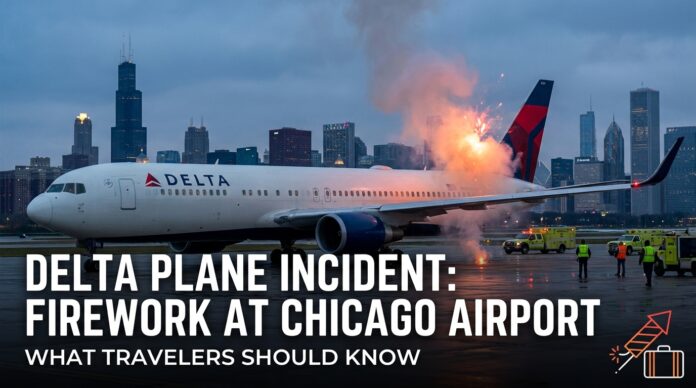
A Delta Air Lines plane made contact with a firework while landing at Chicago Midway International Airport on July 4, and everyone onboard landed safely. The incident involved Delta Flight 1076 from Atlanta to Chicago, carrying 52 passengers and six crew members, and the FAA is investigating what happened.
For readers searching “Delta plane hit by firework Chicago”, the clear answer is this: the pilot reported a loud bang during final approach, the aircraft continued landing, no one was hurt, and Delta later said a post-flight inspection showed no aircraft damage. CBS Chicago also reported that Chicago police described minor paint damage, so the safest wording is: no injuries were reported, Delta said no damage was found, and local police reports mentioned minor paint damage while the aircraft was evaluated.
What Happened to Delta Flight 1076 at Chicago Midway?
Delta Flight 1076 was landing at Midway around 8:30 p.m. local time when the crew reported that a firework appeared to hit the plane. NBC Chicago reported the flight left Atlanta at 7:36 p.m. ET and landed at Midway at 8:38 p.m. CT, while air traffic audio captured the crew saying they heard a bang and would inspect the aircraft at the gate.
The Associated Press reported that the aircraft was at about 200 to 250 feet when the incident happened. That matters because this is the final part of landing, when pilots are focused on runway alignment, speed, wind, and safe touchdown.
| Key question | Clear answer |
|---|---|
| Which flight was hit by a firework? | Delta Flight 1076 |
| Where did it happen? | Chicago Midway International Airport |
| Where was the flight coming from? | Hartsfield-Jackson Atlanta International Airport |
| When did it happen? | July 4, 2026, just before landing |
| Was anyone hurt? | No injuries were reported |
| Did the plane make an emergency landing? | No, it landed safely and taxied to the gate |
| Who is investigating? | The Federal Aviation Administration |
Was This an Emergency Landing?
No, this was not reported as an emergency landing. The aircraft continued to land safely, and airline officials said the incident did not result in an emergency landing.
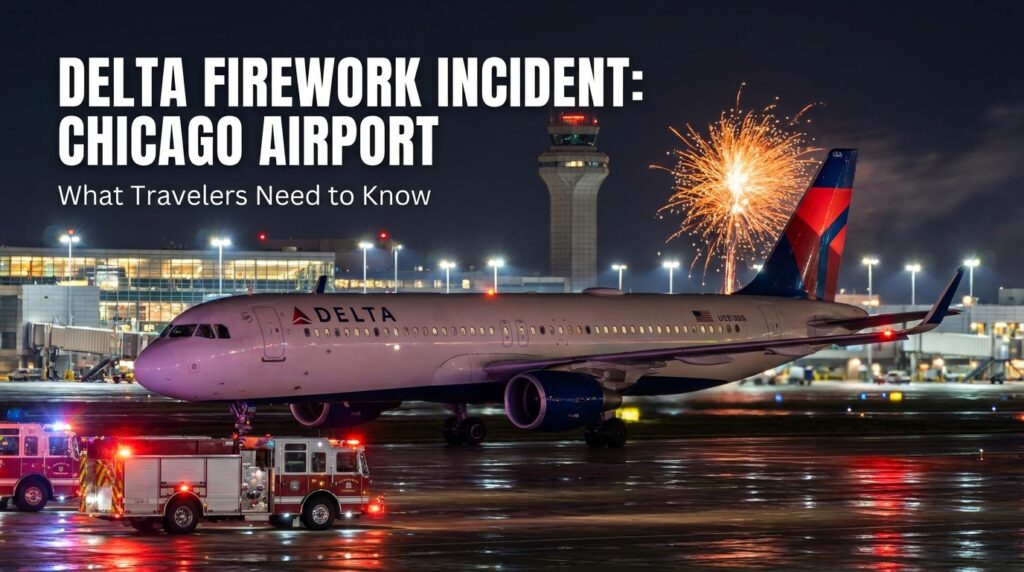
That detail is important for travelers. A loud bang near landing sounds frightening, but pilots train to keep the aircraft stable first, communicate with air traffic control, and inspect the aircraft after landing when it is safe to do so. For passengers, the best move in this kind of moment is simple: stay seated, keep your seatbelt fastened, listen to crew instructions, and avoid crowding the aisle after arrival.
Also read – What is The Best US Airline Carrier? List from Top to Bottom
Why Fireworks Near an Airport Are a Serious Problem
Fireworks near an airport are dangerous because aircraft are low, slow, and close to homes during takeoff and landing. At Midway, that risk feels more visible because the airport sits inside a dense urban area, and the Chicago Department of Aviation lists Midway as a compact airport with four active runways, including air carrier runways of 6,445 feet and 6,522 feet.
CBS Chicago reported that residents near 63rd and Central Avenue, close to the airport perimeter, described nonstop fireworks on the night of July 4. The same report quoted a transportation and aviation expert saying Midway approaches are already demanding because of short runways, dense traffic, and surrounding neighborhoods.
For the search query “are fireworks dangerous for planes landing”, the answer is yes. The danger is not only a direct hit. It can also be sudden light, smoke, debris, noise, or a pilot distraction at the worst possible moment.
Are Fireworks Legal in Chicago or Illinois?
Most consumer fireworks are illegal to sell, possess, or use in Illinois, including mortars, bottle rockets, Roman candles, aerial shells, and firecrackers. Illinois Legal Aid Online notes that buying fireworks legally in another state does not make them legal once brought into Illinois.
Chicago can be stricter. Illinois Legal Aid also notes that Chicago prohibits sparklers, even though some novelty items may be allowed under state law elsewhere.
For permitted public displays, Chicago’s municipal code requires approval and safety standards. The city code says fireworks displays must be filed with the fire commissioner and cannot be permitted between 11 p.m. and 6 a.m.
What Travelers Should Do If Fireworks Are Seen Near a Flight Path
Travelers should not panic if they see fireworks near an airport, but they should take safety cues seriously. If you are on a plane, your job is not to investigate. Your job is to stay calm and let the crew manage the situation.
Do this:
- Keep your seatbelt on during approach and taxi.
- Do not stand up after a sudden noise unless crew members say it is safe.
- Avoid filming crew members in a way that blocks aisles or delays instructions.
- Report useful details after landing if you clearly saw something outside.
- Check your airline app before connecting flights, especially if the aircraft needs inspection.
Do not do this:
- Do not open overhead bins until the aircraft is parked.
- Do not spread unverified claims online from inside the cabin.
- Do not assume “no emergency” means “not serious.”
- Do not approach airport fences, runways, or restricted areas to watch fireworks.
What Residents Near Airports Should Know Before Lighting Fireworks
Residents near airports should treat every low-flying aircraft as a reason not to launch fireworks. Even a small backyard mortar can rise into the same low-altitude space used by landing aircraft.
The FAA already warns people not to fly drones near fireworks, over people, or near airports, and it reminds passengers that fireworks are not allowed in carry-on or checked baggage. The same practical logic applies at home: if you are close enough to hear landing gear or see a plane’s windows, you are too close to add explosives into the air.
A simple neighborhood rule works better than a long legal lecture:
- If planes are low overhead, do not launch anything upward.
- If you are near an airport fence line, skip backyard fireworks completely.
- If you want fireworks, use official public displays with permits and safety planning.
Chicago’s Navy Pier show, for example, was a scheduled public display with security rules, a set time, and fireworks prohibited among guest items.
Also read – How to Use Google Flights to Find Cheap Layover Routes
The Hidden Safety Lesson From the Chicago Firework Plane Incident
The bigger lesson is that holiday celebrations can create aviation risks far away from the official fireworks show. Official displays are planned, permitted, timed, and located with safety in mind. The danger often comes from random neighborhood fireworks launched near homes, streets, and airport approach paths.
The U.S. Consumer Product Safety Commission reported 15 fireworks-related deaths and about 13,000 emergency department-treated injuries in 2025, including about 1,300 injuries involving sparklers alone. It also says many severe incidents involve misuse, malfunction, or fireworks used too close to people.
That makes this Chicago case more than an unusual aviation story. It is a reminder that fireworks can become a public safety issue in seconds, especially around airports.
Bottom Line for Travelers
The Delta firework incident at Chicago Midway ended safely, but it should not be treated as harmless. A commercial aircraft on final approach reportedly made contact with a firework, the crew felt a loud bang, the plane landed safely, and the FAA is investigating.
For travelers, the practical takeaway is reassuring: aircraft crews are trained for unexpected events, and the safest place to be during final approach is seated with your belt fastened.
For residents, the takeaway is stronger: never launch fireworks near an airport, flight path, or low-flying aircraft. The celebration is not worth risking a plane, a neighborhood, or a life.

