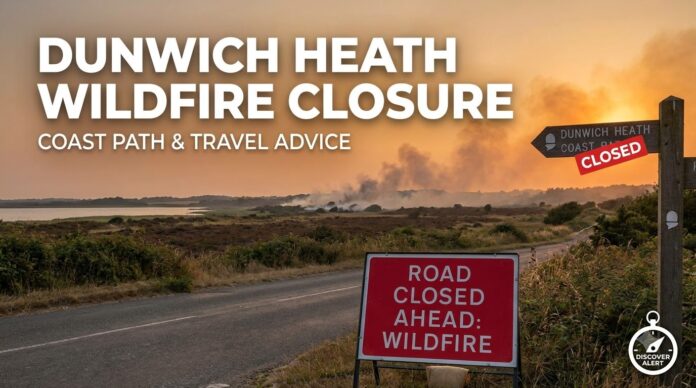
Travellers should not visit Dunwich Heath after a major wildfire forced the closure of part of the King Charles III England Coast Path and several surrounding rights of way.
Public access to the affected Open Access land, England Coast Path and coastal margin is excluded until 22 August 2026 for safety reasons. Firefighters remain at the scene monitoring hotspots, and Suffolk Fire and Rescue Service continues to tell walkers, cyclists, dog owners and sightseers to stay away.
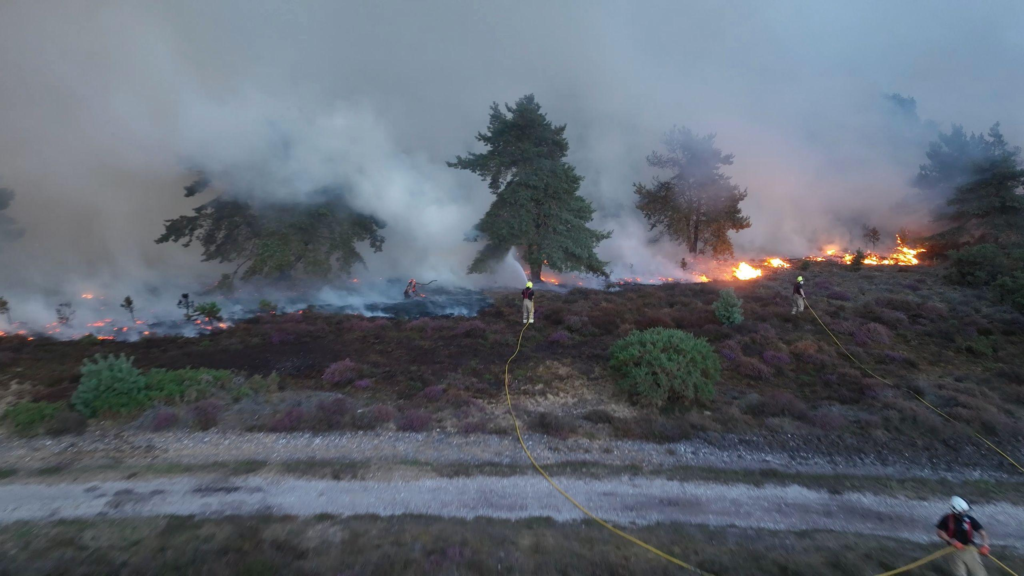
The key point is simple: a stable wildfire site is not necessarily a safe visitor site. Burnt ground can conceal extreme heat, unstable soil and smouldering material below the surface.
Dunwich Wildfire Closure: Essential Details
| Question | Latest confirmed information |
|---|---|
| Where is the closure? | Dunwich Heath and surrounding land in Suffolk |
| Which national trail is affected? | King Charles III England Coast Path |
| When did the wildfire begin? | 29 July 2026 |
| How much land was affected? | Around 150 hectares |
| Is the incident over? | No. It remains an ongoing incident |
| When is access scheduled to return? | After 22 August, subject to official confirmation |
| Are nearby visitor sites affected? | Dunwich Heath and RSPB Minsmere are currently closed |
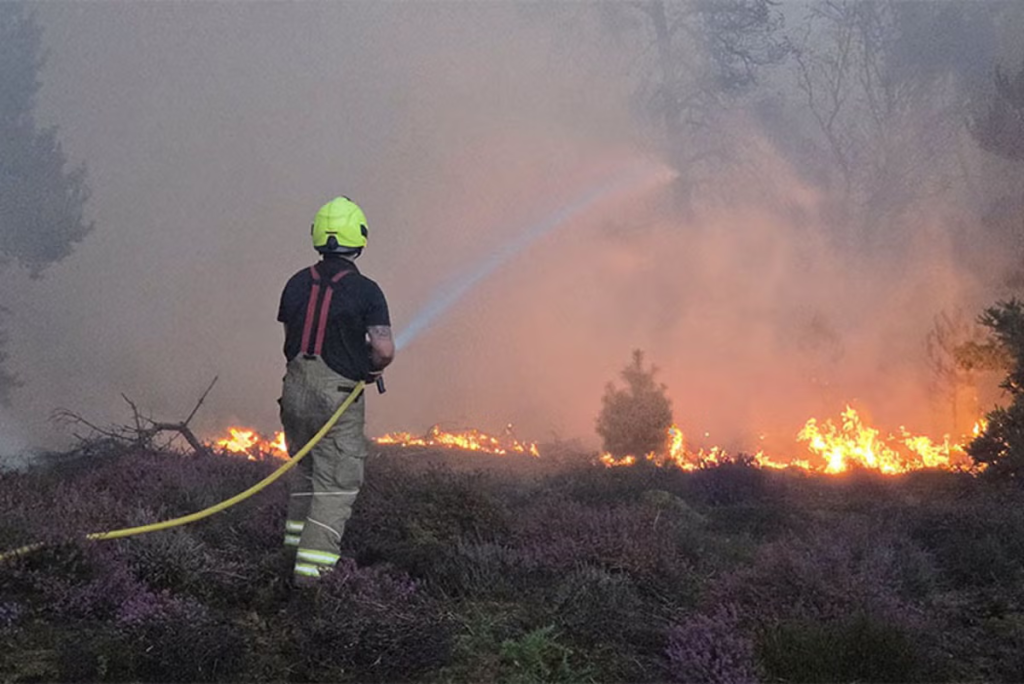
The fire had expanded to approximately 150 hectares by 30 July, while continuing changes in wind direction made its behaviour difficult to predict. Fire crews, specialist vehicles, drones and aerial support have all been used during the response.
Is the England Coast Path Closed at Dunwich?
Yes. The affected Dunwich section of the King Charles III England Coast Path is closed, along with surrounding coastal land, footpaths and bridleways.
Two official notices use slightly different starting dates because they cover different types of access:
- The Suffolk County Council rights-of-way notice lists multiple Dunwich and Westleton paths as closed from 30 July for 21 days.
- The Suffolk & Essex Coast & Heaths National Landscape notice excludes public access from the England Coast Path, coastal margin and Open Access land from 3 to 22 August.
Travellers should treat 22 August as the earliest scheduled end date, not a guaranteed reopening date. That is an inference from the temporary notice: access could remain restricted if safety inspections find continuing hazards. Check the official notice immediately before travelling.
Also read – UK Airport eGate Rules Change: Children Can Now Skip Lines …
Why Is Dunwich Heath Still Dangerous After the Flames Have Reduced?
Heat and fire remain hidden beneath apparently blackened or extinguished ground.
Suffolk Fire and Rescue Service reports that some surface areas have remained above 60°C, with significantly higher temperatures only a few inches underground. Smouldering tree roots, scorched soil and animal burrows can create hazards that are impossible to identify by sight.
The landscape has also changed enough to disorient people familiar with the area. Firefighters have already had to escort dog walkers and other visitors out after they entered restricted locations or became lost.
A Realistic Mistake Walkers Must Avoid
A walker may have an old route saved on a phone or GPS device. The digital map still shows a continuous trail, while the signs on the ground point to a closure.
The closure sign takes priority over the app.
Stepping around a barrier to reconnect with the saved route can place the walker over hot roots, weakened ground or an active hotspot. It can also divert firefighters from the operation to conduct another escort or rescue.
Is Dunwich Heath Open to Visitors?
No. Dunwich Heath remains closed while the emergency response continues.
The National Trust’s Dunwich Heath page directs visitors to avoid the area. The organisation says the wildfire destroyed important lowland-heath habitat used by species including nightjars, skylarks, Dartford warblers, adders and lizards.
The closure applies to more than a single marked trail. Visitors should not attempt to enter from another car park, beach approach, woodland track or unofficial footpath.
Is RSPB Minsmere Open After the Wildfire?
RSPB Minsmere is also currently closed, including its car park, visitor centre, café, shop, toilets and nature reserve.
The reserve’s official opening information lists all visitor facilities as closed through at least 12 August. Travellers should check the RSPB Minsmere opening-times page before making a later visit because the reopening date may change.
Do not drive to the entrance simply to check whether it looks accessible. Additional vehicles can obstruct narrow local roads and emergency access.
Can Travellers Still Visit the Suffolk Coast?
Yes, but plans should be moved well away from Dunwich Heath, Minsmere and the active emergency area.
This is a local closure rather than a warning against visiting the entire Suffolk coast. However, travellers should not create their own nearby diversion through Westleton or surrounding heathland without confirming that the route is open.
Before leaving accommodation:
- Check the Suffolk Fire and Rescue live incident page.
- Check the official rights-of-way closure list.
- Contact the intended attraction directly.
- Confirm the complete driving route rather than only the destination.
- Choose an alternative outside the affected area when access information is unclear.
Earlier emergency updates included restrictions around Minsmere Road, Westleton Road and several approaches towards Dunwich. Road arrangements can change during an incident, so an old screenshot or social-media post should not be treated as live navigation advice.
What Should You Do If You Encounter Wildfire Smoke?
Move away from the affected area and keep smoke outside your vehicle or accommodation.
Suffolk Fire and Rescue Service advises people affected by smoke to:
- Keep windows and doors closed
- Remain indoors where possible
- Keep hydrated
- Carry prescribed inhalers
- Contact a GP or NHS 111 for persistent or severe symptoms
Wildfire smoke can irritate the eyes, skin and airways and may cause coughing, wheezing, breathlessness or chest discomfort. It can also worsen conditions such as asthma.
When driving through unexpected smoke, close the windows, switch the ventilation system to recirculation and turn back when it is safe. Do not stop on a narrow road to take photographs.
What Should You Do If You See Flames or a New Hotspot?
Move to a safe location and call 999 immediately.
Do not approach the fire to confirm its size. Wind can change its direction rapidly, while embers can ignite vegetation ahead of the visible flames.
Give the emergency operator:
- Your location or nearest landmark
- The direction of the smoke or flames
- Whether people, vehicles or buildings appear threatened
- The route you used to reach the area
Avoid flying a drone over the site. Firefighting aircraft and official monitoring drones may be operating above the incident area.
How Can Visitors Prevent Another Suffolk Wildfire?
Do not use barbecues, campfires or other open flames in dry countryside.
The fire service says the cause of the Dunwich wildfire remains under investigation and warns against speculation. Its prevention advice includes:
- Do not light barbecues or open fires
- Extinguish cigarettes completely
- Take litter home
- Do not leave glass bottles
- Dispose of disposable vapes safely
- Report fire immediately from a safe place
Glass, batteries, smoking materials and cooking equipment can all become serious risks when surrounding grass and heathland are extremely dry.
Will Dunwich Coast Path Reopen on 23 August?
Do not assume the path will automatically reopen on 23 August.
The current public-access exclusion runs through 22 August, but the site must be considered safe before visitors return. Continuing underground heat, renewed hotspots or damaged paths could lead to an extension or a phased reopening.
Check the official closure notice on the morning of the planned walk. Route-planning apps may take longer to show temporary restrictions.
Dunwich Wildfire Travel Advice: The Bottom Line
Cancel any walk through Dunwich Heath and choose an alternative outside the emergency area.
The wildfire is stable, but it is not finished. Firefighters were still monitoring and extinguishing hotspots on 5 August, using drones to locate remaining pockets of fire. Burnt ground may remain dangerously hot, while familiar paths can be difficult to recognise.
Respecting the closure protects visitors, wildlife and emergency crews—and prevents a day trip from becoming another incident.

