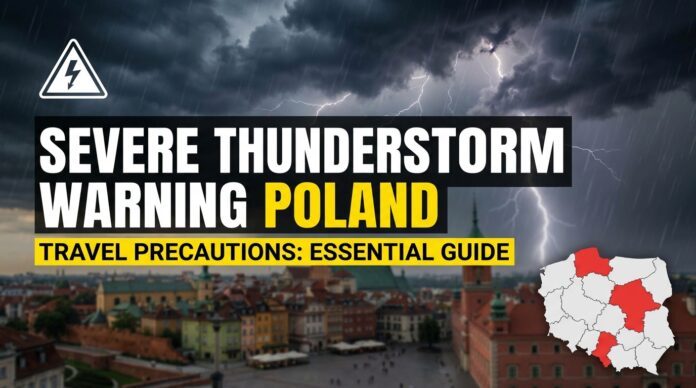
Poland travelers should treat the latest severe thunderstorm warning as a real travel risk, especially near the Baltic coast, Gdańsk Bay, Hel, Puck, Nowy Dwór Gdański, Sopot, Gdynia, and coastal rail routes. Strong wind, heavy rain, hail, rough sea conditions, falling branches, local flooding, and transport delays are the main problems visitors need to plan around today.
A fresh storm system has already caused disruption in northern Poland, with local reporting describing a powerful storm ripping across the region and forcing evacuations. Poland’s weather authority IMGW is also tracking dangerous wind and storm conditions, while Poland’s Government Security Centre, RCB, uses emergency SMS alerts when there is a direct threat to life or health.
Poland Weather Warning Today: What Travelers Need to Know First
The most urgent travel concern is wind along the Baltic coast, not just rain. On July 8, 2026, Polish weather reporting based on IMGW warnings listed red, orange, and yellow alerts for strong wind and thunderstorms. Red third-level warnings were reported for parts of Pomerania, including Puck and Nowy Dwór Gdański counties, with gusts forecast up to 120 km/h, especially along the coast and around the Bay of Gdańsk and Hel.
Thunderstorms are also a risk in northeastern Poland. First-level thunderstorm alerts were reported for parts of Podlaskie and Warmian-Masurian regions, with rainfall totals of 20 to 35 l/m², wind gusts up to 85 km/h, and local hail possible.
Also read – Why Europe’s EES Biometric System is Stranding Travelers …
Is Poland Safe to Travel During a Severe Thunderstorm Warning?
Poland is still travelable, but exposed travel plans should be changed first. City-center hotels, museums, restaurants, and indoor attractions are usually manageable during storms, but beaches, piers, campsites, forest trails, boat trips, open-air festivals, and coastal bike routes become poor choices once wind warnings rise.
Use this simple decision table before leaving your hotel:
| Travel plan | Risk level during storm warning | Smart move |
|---|---|---|
| Beach walk in Hel, Sopot, Gdynia, Gdańsk coast | High | Skip it until warnings expire |
| Ferry, sailing, kayaking, water sports | Very high | Cancel or rebook |
| Train between Gdańsk, Sopot, Gdynia, Hel | Medium to high | Check live updates before leaving |
| Museum, mall, indoor restaurant | Low to medium | Safer backup plan |
| Driving under trees or through forest roads | High | Delay if possible |
| Airport transfer | Medium | Leave earlier and check flight status |
Baltic Coast Storm Warning: Why Hel, Gdańsk Bay and Puck Matter
The Baltic coast is the pressure point because wind behaves differently near open water. IMGW’s marine forecast for July 8, 2026 warned of strong storm conditions in the southeastern Baltic and storm warnings for the southern Baltic, Pomeranian Bay, central coast, and Bay of Gdańsk. For the southeastern Baltic, winds were forecast from the northwest at Beaufort 6 to 8, gusting to 10, with sea state 5 to 6 and possible storms in the east.
For tourists, this means the sea may look dramatic but should not be treated like a photo opportunity. A common travel mistake is walking “just to see the waves.” In strong coastal wind, sand, spray, loose signage, branches, and sudden gusts can turn a short walk into a dangerous situation. Stay back from piers, harbor walls, dunes, and cliff edges.
What Should Tourists Do If They Receive an RCB Alert in Poland?
Follow the SMS immediately because RCB Alerts are not casual weather messages. Poland’s RCB says its alert system is used only in exceptional cases when there is a high likelihood of a direct threat to life or health across a significant area. No sign-up is needed, and alerts are sent through mobile operators to people in the affected area.
If you receive an RCB Alert:
- Stop outdoor plans immediately.
- Move inside a solid building, not a beach shelter or bus stop.
- Secure balcony items if you are in an apartment rental.
- Avoid trees, billboards, construction sites, waterfronts, and metal fences.
- Keep your phone charged and mobile data on.
- Ask your hotel reception if local roads, trains, or beaches are closed.
Also read – Tried & Tested Cheapest Ways to Travel in Europe Right Now …
Severe Thunderstorm Warning Poland: What Not to Do
Do not treat a thunderstorm warning like normal rain. NOAA’s National Severe Storms Laboratory explains that every thunderstorm has lightning, and a storm becomes severe when it includes large hail, damaging wind, or a tornado risk. Thunderstorms can also bring flash flooding, falling trees, downed power lines, and dangerous straight-line winds.
Avoid these traveler mistakes:
- Do not stand under trees while waiting for a taxi.
- Do not shelter beside glass bus stops during strong wind.
- Do not walk on piers during coastal gusts.
- Do not drive through flooded underpasses.
- Do not assume a short ferry or boat trip is safe because it is “local.”
- Do not ignore hotel staff or lifeguard instructions.
Are Trains and Flights in Poland Affected by Thunderstorms?
Trains, flights, and buses can keep running during warnings, but delays become more likely when wind brings down trees or power lines. The most vulnerable routes are coastal and forested corridors, including tourist journeys around Gdańsk, Gdynia, Sopot, Hel, Puck, and regional routes in northern Poland.
Before leaving for a station or airport:
- Check your operator’s live status page.
- Leave earlier for airport transfers.
- Carry water, a power bank, and one extra snack.
- Keep screenshots of tickets in case mobile signal drops.
- Book taxis through apps or hotel desks, not random curbside offers in heavy rain.
A practical taxi tip: confirm the fare estimate before getting in if the app is not being used. Storm delays can make short rides expensive if traffic is gridlocked. Ask: “Approximate price to the airport/station?” and use card payment where possible.
Poland Storm Safety Tips for Hotels, Apartments and Campsites
Your safest plan is to turn your accommodation into a storm base for a few hours. The official IMGW Meteo app provides current weather, forecasts, precipitation radar, storm radar, lightning maps, meteorological and hydrological warnings, and push notifications for hazardous weather.
Use this quick room check:
| If you stay in… | Do this now |
|---|---|
| Hotel | Ask reception about local warnings and transport disruption |
| Apartment rental | Remove balcony items, close windows, charge devices |
| Campsite | Move to a solid shelter if staff advise evacuation |
| Hostel | Keep shoes, passport, card, and phone together |
| Coastal resort | Avoid beach access until warnings are lifted |
Best Travel Plan During Poland Thunderstorm Warning
The best plan is to swap outdoor sightseeing for indoor, flexible stops. In Gdańsk, choose museums, cafés away from the waterfront, shopping centers, or hotel restaurants. In Warsaw or Kraków, avoid parks during active wind warnings and use trams or metro where available instead of long walks under trees.
A good storm-day plan looks like this:
- Morning: Check IMGW or hotel reception.
- Midday: Do indoor sightseeing.
- Afternoon: Recheck alerts before moving cities.
- Evening: Avoid waterfront dining if wind remains strong.
- Night: Keep phone charged in case alerts arrive.
FAQ: Severe Thunderstorm Warning Poland Travel Questions
Should I cancel my Poland trip because of the thunderstorm warning?
Do not cancel the whole trip unless your booking is focused on beaches, sailing, camping, or exposed coastal activities. Adjust the risky parts first and keep indoor plans flexible.
Is Gdańsk safe during the storm warning?
Gdańsk city areas are safer indoors, but the waterfront, beaches, piers, open squares, and coastal transport can be risky during strong wind. Check alerts before going toward the coast.
Can I still visit Hel during the wind warning?
Avoid Hel during active red or orange wind warnings unless travel is essential. The area is exposed, and gusts near the coast can be stronger than inland forecasts suggest.
What is the most reliable Poland weather source for travelers?
IMGW is the key official source for Polish weather warnings. IMGW says its role is to provide meteorological and hydrological protection for Poland, including forecasts, warnings, bulletins, and advisories.
Final Travel Advice: Stay Flexible, Not Fearful
The safest traveler in Poland today is not the one who cancels everything, but the one who changes plans early. Severe thunderstorms and coastal wind warnings move fast. Build your day around indoor stops, keep transport flexible, follow RCB messages, and avoid the Baltic coast during the strongest gusts.
For a reader on the ground, the rule is simple: if the wind is strong enough to move bins, signs, branches, or beach sand sideways, it is strong enough to change your travel plan.

