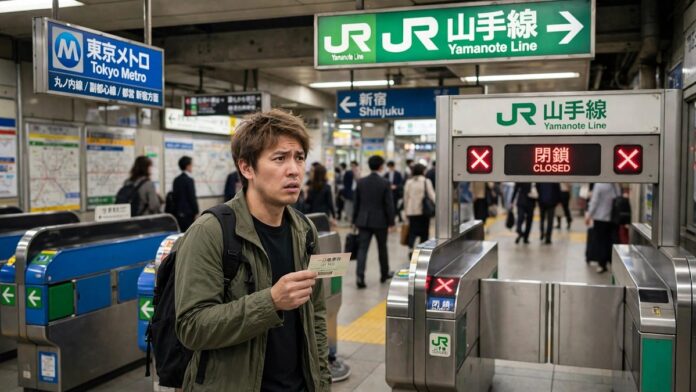
The ¥700 Tokyo Metro pass does not work on JR Yamanote Line trains. The gate stays shut at Shinjuku and Shibuya because the ticket covers Tokyo Metro only, and JR East runs a separate railway with its own fares, gates and ticket system.
That rejection is not a fault in the ticket, a broken gate, or a mistake at the station. The pass is doing exactly what Tokyo Metro sells it to do. The problem is the name. Visitors hear “Tokyo Metro pass” and assume it covers every train in Tokyo. It does not.
The Tokyo Metro 24-hour Ticket costs ¥700 for an adult and ¥350 for a child. It allows unlimited rides on Tokyo Metro for 24 hours from first use, according to Tokyo Metro’s official 1-day ticket page (https://www.tokyometro.jp/en/ticket/1day/index.html). The valid route is listed in plain terms: all Tokyo Metro lines. JR lines are not on that list.
What does the ¥700 Tokyo Metro ticket cover?
The ticket covers nine lines. Those nine lines form the Tokyo Metro network, and nothing else.
The nine lines are the Ginza, Marunouchi, Hibiya, Tozai, Chiyoda, Yurakucho, Hanzomon, Namboku and Fukutoshin lines. Together they reach Asakusa, Ueno, Ginza, Roppongi, Ikebukuro, Shinjuku-sanchome and Shibuya, among many other central Tokyo stops.
The ticket does not cover the four Toei Subway lines. It does not cover JR lines, private railways, airport trains, buses or trams. A same-day paper ticket must be used on the day of purchase, while an advance ticket bought through the online store stays valid for 24 hours after first use within six months of purchase, as Tokyo Metro explains on the same page.
IC and QR versions follow the same coverage rule. The IC version runs for 24 hours from the time of purchase and can be loaded on a PASMO card only, not on Suica. The QR version runs for 24 hours from the travel start time. Price stays the same in every version: ¥700 adult, ¥350 child.
Why does the JR Yamanote Line reject the Tokyo Metro pass?
Tokyo runs on more than one railway company. Tokyo Metro operates the subway lines underground. JR East operates the Yamanote Line and other above-ground commuter lines. Toei operates a second subway network. Each company charges its own fare and controls its own gates.
The Yamanote Line is a JR East loop. It links Shinjuku, Shibuya, Harajuku, Ikebukuro, Ueno, Tokyo and Shinagawa, and JR East lists the Yamanote Line at Shinjuku Station alongside its other conventional lines. A Tokyo Metro ticket holds no JR fare, so a JR gate has nothing to charge and nothing to accept.
The same split applies in reverse. A JR ticket or JR pass does not open a Tokyo Metro gate. A Suica or PASMO card works across both networks only because the card holds stored value that each company can deduct separately. The card is not a pass. It pays each operator in turn.
Why Shinjuku and Shibuya cause the most confusion
Shinjuku and Shibuya are the two stations where the mix-up happens most often. Both names appear on Metro maps and on JR maps, and both stations are huge interchanges where Metro and JR sit in the same complex under different signs.
At Shinjuku, the JR Yamanote Line serves the main JR station, with trains for Ikebukuro and Ueno in one direction and for Shibuya and Shinagawa in the other, as shown in the JR East Shinjuku Station timetable. The Metro lines at Shinjuku, including the Marunouchi and Fukutoshin lines, use separate Metro gates in a different part of the station.
At Shibuya, the pattern repeats. The JR Yamanote Line runs through the JR station, while the Metro Ginza, Hanzomon and Fukutoshin lines use Metro gates elsewhere in the complex. JR East has rebuilt the Shibuya Yamanote platforms in recent years, and the station remains a maze of signs, levels and transfer passages.
The rule for any station is simple. Look for the operator name above the gate, not the station name on the map. A gate marked Tokyo Metro takes Metro tickets. A gate marked JR takes JR tickets and JR passes. A gate marked Toei takes Toei tickets. Walking through the wrong gate is the most common cause of a rejected pass in Tokyo.
Which Tokyo ticket covers what?
| Ticket | Price | Coverage | Duration | JR Yamanote Line? |
|---|---|---|---|---|
| Tokyo Metro 24-hour Ticket | ¥700 | Nine Tokyo Metro lines | 24 hours from first use | No |
| Tokyo Subway Ticket | ¥1,000 for 24 hours | Nine Tokyo Metro lines plus four Toei lines | 24 hours | No |
| Common One-day Ticket | ¥1,100 | Nine Tokyo Metro lines plus four Toei lines | One calendar day | No |
| Tokyo Combination Ticket | ¥1,720 | Metro, Toei, Tokyo Sakura Tram, Toei Bus, Nippori-Toneri Liner and JR lines within Tokyo’s 23 wards | One day | Yes, within the 23 wards |
| Suica or PASMO IC card | Pay per ride | Metro, JR, Toei, buses and most private lines | Charged per ride | Yes, charged per ride |
Prices and coverage come from Tokyo Metro’s official 1-day ticket page. The Tokyo Subway Ticket costs ¥1,000 for 24 hours, ¥1,500 for 48 hours and ¥2,000 for 72 hours, with child fares at half price. Only the Combination Ticket on that page includes JR lines, and only within Tokyo’s 23 wards for one chosen day.
What to do when the gate rejects the Tokyo Metro pass
- Step back from the JR gate and do not force the ticket through again. A second try at the same gate gives the same result.
- Check the sign above the gate. If it says JR, the Metro pass cannot open it.
- Decide the route. For a JR ride, buy a JR ticket at a JR machine or tap a Suica or PASMO card at the JR gate.
- For a Metro ride instead, follow signs for Tokyo Metro and use the Metro gate. The same pass works there without any extra charge.
- For a day that mixes Metro and JR, keep the Metro pass for Metro rides and pay JR rides separately with an IC card. That combination is often cheaper than buying a second pass.
A traveller who has already entered a Metro station on the pass and then needs a JR train should exit through a Metro gate first, so the pass records the exit correctly. Then enter the JR station through a JR gate with a separate ticket or IC card.
Does the ¥700 ticket still save money?
Yes, on a Metro-only day. A short Tokyo Metro ride costs ¥178 by IC card, so four short rides cost ¥712, just above the ¥700 price of the pass. Tokyo Metro itself notes that four rides inside the base-fare zone already save money, as stated on its 1-day ticket page.
The saving disappears when the day leans on JR. A Shinjuku to Shibuya hop on the Yamanote Line, a Harajuku stop and a return to Tokyo Station are all JR rides. None of them count toward the Metro pass. On such a day, a Suica card, charged per ride, is the better tool. The pass is not bad value. It is the wrong tool for a JR-heavy route.
How to choose the right Tokyo pass before buying
- Metro-only day, four or more rides: buy the ¥700 Tokyo Metro 24-hour Ticket.
- Metro plus Toei day, including Skytree or Tsukiji: buy the Tokyo Subway Ticket from ¥1,000.
- Metro, Toei and JR day in central Tokyo: buy the ¥1,720 Tokyo Combination Ticket.
- Mixed day with few rides, or a day built around the Yamanote loop: use a Suica or PASMO card and pay per ride.
- Airport travel: buy a separate airport ticket. No Metro day pass covers the airport trains.
Check the route on a map before buying, and count how many rides fall on each operator. The cheapest pass is the one that matches the lines actually used, not the one with the lowest headline price.
Quick answers
Can the ¥700 pass be used on the Yamanote Line? No. The Yamanote Line is JR East, and the pass covers Tokyo Metro lines only.
Can the pass be used on Toei Subway lines? No. Toei is a separate operator with its own four lines.
Does a Suica card work on both? Yes. Suica pays per ride on Metro, JR and Toei, and JR East confirms the Yamanote Line serves Shinjuku, Shibuya, Tokyo, Ueno and other major stations.
Is there a refund? Unused tickets can be refunded before expiry, with a ¥220 handling fee, according to Tokyo Metro.
The gate at Shinjuku or Shibuya is not rejecting the traveller. It is enforcing a boundary between two railway companies that share station names but not fares. Once that boundary is clear, the fix is quick: use the Metro pass at Metro gates, pay JR separately, and pick a pass that matches the lines on the day’s route.

