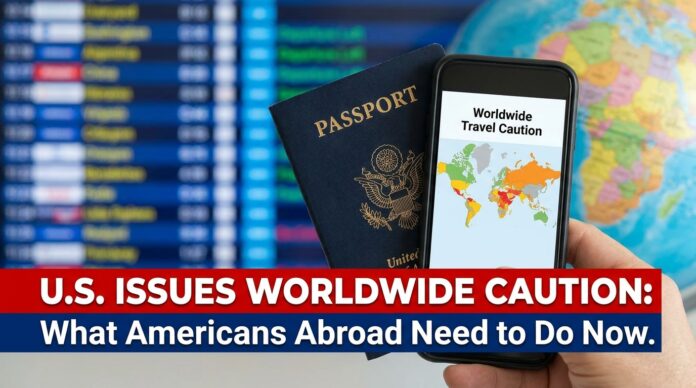
The U.S. State Department is advising Americans worldwide to exercise increased caution as Middle East tensions create security concerns, possible flight cancellations and sudden airspace closures. The July 20, 2026 notice is not a blanket order to cancel every international trip, but travelers should reassess their route and prepare for disruptions before leaving home.
What Does the New U.S. Worldwide Caution Mean?
The worldwide caution means Americans should be more alert wherever they travel, especially in the Middle East or through airports serving the region.
The official State Department worldwide caution says the security situation remains complex and could escalate unexpectedly. Americans in the Middle East are advised to prepare for:
- Flight cancellations
- Periodic airspace closures
- Longer or changed flight routes
- Security restrictions with little notice
- Possible threats involving U.S. interests or American-linked locations
The department also advises Americans outside the Middle East to reconsider travel to or through the region.
Does the Worldwide Caution Mean Americans Must Cancel Their Trips?
No. The notice does not automatically change every country to “Do Not Travel.”
Each destination still has its own rating on the State Department travel advisory list. Travelers should check both the worldwide notice and the advisory for the country they plan to visit.
| Advisory level | What it means | Sensible traveler response |
|---|---|---|
| Level 1 | Exercise normal precautions | Continue planning, but monitor alerts and flight routes |
| Level 2 | Exercise increased caution | Review the stated risks and avoid identified problem areas |
| Level 3 | Reconsider travel | Reassess whether the trip is necessary and whether flexible cancellation is available |
| Level 4 | Do not travel | Do not begin the trip; leave when safely possible if already there |
A beach holiday in a Level 1 country is not treated the same as travel into an active conflict area. However, even a low-risk destination can be affected when the flight connects through restricted airspace.
Which Travelers Should Take Immediate Action?
Travelers entering, leaving or connecting through the Middle East should review their plans first.
Extra preparation is particularly important for:
- Passengers with a Gulf or Middle East connection
- Travelers holding separate flight tickets
- People carrying essential daily medication
- Families traveling with children
- Travelers with limited money for an unexpected hotel stay
- Anyone visiting a Level 3 or Level 4 destination
- Americans staying near demonstrations, diplomatic buildings or military facilities
Also read – New York Travelers Warned as U.S. Issues Worldwide …
A traveler flying from the United States to Asia, for example, may never plan to leave the connecting airport. A regional airspace closure could still cancel the onward flight, change the arrival airport or create an unplanned overnight stay.
That is why the route matters almost as much as the final destination.
What Should Americans Do Before an International Flight?
Check the complete route, save emergency contacts and prepare for at least one unplanned night away from your checked luggage.
Use this six-step travel check
- Review your destination advisory. Look beyond the headline and read the listed risks, restricted areas and embassy alerts.
- Check every transit country. A connection can expose you to different entry, security and airspace rules.
- Confirm the flight directly with the airline. Do not rely only on a booking confirmation issued weeks earlier.
- Keep essential items in your carry-on. Pack medication, charging cables, identification, a change of clothing and basic toiletries.
- Save offline copies of important documents. Keep passport, insurance and itinerary copies in a secure digital folder and with a trusted contact.
- Avoid a tight onward connection. A slightly longer transfer can be more useful than a cheaper ticket with no recovery time.
A practical carry-on rule
Pack as though your checked bag may arrive one day after you do.
That means keeping the following within reach:
- At least several days of essential medicine
- A written prescription or medicine list
- A power bank and charging cable
- Local currency or a backup payment method
- Hotel and airline contact details
- A photocopy of your passport information page
The State Department’s crisis guidance recommends keeping at least five days of medication available and maintaining an emergency kit with travel documents and local currency.
How Does STEP Help Americans Traveling Abroad?
STEP sends local embassy alerts and makes it easier for officials to contact a traveler or their emergency contact during a crisis.
Americans can register a trip through the free Smart Traveler Enrollment Program. STEP messages may include information about demonstrations, curfews, airport disruptions, security incidents and departure assistance.
A useful detail many travelers miss: enroll using an email address you actively monitor abroad. Also check the spam folder because legitimate State Department crisis emails should come from an address ending in @state.gov.
What Should Americans Already Abroad Do Now?
Stay informed, avoid high-profile gatherings and identify a safe route to the airport before conditions worsen.
Travelers currently overseas should:
- Follow alerts from the nearest U.S. embassy or consulate
- Monitor local authorities and trusted local news
- Avoid demonstrations and political gatherings
- Keep phones and power banks charged
- Tell family members where they are staying
- Identify more than one route to the airport
- Confirm whether public transport or roads are operating
- Leave a dangerous area while safe commercial transport remains available
The State Department says travelers should not remain in a dangerous location while waiting for a possible government evacuation. Commercial transportation is generally the preferred way to leave while it remains safe and operational.
Will the U.S. Government Evacuate Americans for Free?
Government-assisted departure is not guaranteed, may not go directly to the United States and is generally not free.
This is one of the most important details to understand before a crisis.
When commercial travel is unavailable, the U.S. government may coordinate transportation to a nearby safe location. Travelers can then be responsible for arranging and paying for:
- Accommodation
- Food
- Medication
- Local transport
- Flights from the safe location
- Other onward travel
Government-coordinated transportation may also have to be repaid. The State Department normally bills travelers after evacuation rather than collecting payment before boarding.
Practical advice: keep an emergency credit limit, accessible savings or suitable travel insurance. Do not assume an embassy will provide a free flight home.
What Should You Do If Your Flight Is Canceled Abroad?
Contact the operating airline first, then protect your accommodation, medication and legal right to remain in the country.
Follow this order:
- Ask the airline for the next confirmed route, not merely a standby listing.
- Check whether the replacement route passes through another restricted country.
- Request written confirmation of the cancellation or delay.
- Ask who is paying for meals, transport and accommodation.
- Save receipts before seeking reimbursement.
- Check your visa or permitted-stay deadline if the delay may keep you in the country longer.
- Contact your insurer before making a costly replacement booking, unless immediate safety requires otherwise.
Avoid buying a second expensive ticket until the first airline confirms whether it will reroute or refund you. Separate tickets can create extra problems because one carrier may not be responsible for a missed flight booked independently.
What Should Travelers Avoid During the Worldwide Caution?
Avoid predictable gathering points, unnecessary political discussion and decisions based on social-media rumors.
Do not:
- Visit protests to watch or take photographs
- Stand near military, government or diplomatic facilities
- Post your live location publicly
- Share unverified airport-closure claims
- Leave your passport in an unlocked bag
- Wait until a crisis peaks before checking transport
- Depend on one bank card or one communication app
- Assume an airport is operating because its website still shows a schedule
A flight number displayed online does not always mean the aircraft will depart. Check the operating airline, the airport and official local alerts.
What Should You Do If Your Passport Is Lost Abroad?
Report the passport immediately and contact the nearest U.S. embassy or consulate for a replacement.
The State Department says an online lost-passport report generally cancels the document within one business day. Once reported, that passport cannot be used for international travel, even if it is later found.
Bring as many of these items as possible to the embassy:
- A passport photograph
- Another form of identification
- Proof of U.S. citizenship
- A copy of the missing passport
- Your travel itinerary
- Details of where and when the passport disappeared
- A police report, when available
A police report is helpful but is not always mandatory. For urgent travel, a consular section may issue a limited-validity emergency passport. Review the official lost or stolen passport abroad instructions before visiting the embassy.
Who Should Americans Call in an Overseas Emergency?
Call local emergency services first when there is an immediate threat to life or safety.
For U.S. consular help:
- From the United States or Canada: 1-888-407-4747
- From another country: +1-202-501-4444
- Local assistance: Contact the nearest U.S. embassy or consulate
The embassy can provide information and certain consular services, but it cannot replace local police, firefighters or emergency medical responders.
The Bottom Line for Americans Traveling Abroad
Do not panic, but do not travel on autopilot.
The July 20 worldwide caution is a clear signal to verify the destination, the transit route and the traveler’s ability to handle a sudden delay. For many low-risk destinations, a trip can continue with sensible preparation. For travel through the Middle East or into a Level 3 or Level 4 destination, the decision requires a more serious review.
The smartest preparation is simple: check official alerts, enroll in STEP, keep documents and medicine accessible, and leave dangerous areas while reliable commercial transport is still available.

