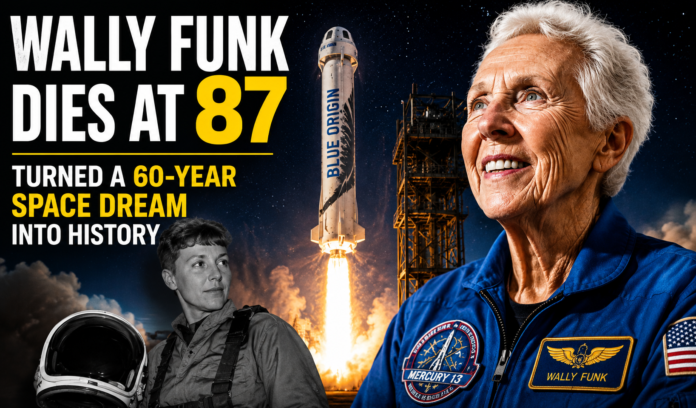
Wally Funk, the aviation pioneer who became the oldest woman to travel into space, has died at 87 in Grapevine, Texas. Her death was announced after a life that stretched from small-plane flight training to the edge of space aboard Blue Origin’s New Shepard in 2021. The Associated Press reported that her caregiver, Grapevine City Councilwoman Duff O’Dell, said Funk had recently suffered falls and a leg infection.
Who was Wally Funk?
Wally Funk was one of America’s most determined pilots and a member of the Mercury 13, the group of women who passed astronaut-style tests in the early 1960s but were not allowed into NASA’s astronaut corps. The overlooked detail is this: Funk’s story was never just about one spaceflight. It was about a woman who kept flying even when the system kept saying no.
| Quick fact | Detail |
|---|---|
| Full name | Mary Wallace “Wally” Funk |
| Age at death | 87 |
| Known for | Mercury 13 pilot, aviation safety leader, oldest woman in space |
| Spaceflight | Blue Origin New Shepard, July 20, 2021 |
| Historic record | Oldest woman to go to space, at 82 years and 169 days |
| Career impact | Trained more than 3,000 pilots and logged more than 19,000 flight hours |
Why was Wally Funk important?
Wally Funk mattered because she had the skill before she had the permission. In the early 1960s, she went through intense physical and psychological testing linked to the privately funded women’s astronaut testing project later known as Mercury 13. The Smithsonian’s National Air and Space Museum notes that the “Mercury 13” name came later and that the project was not an official NASA women’s astronaut program.
That detail is important. Many readers search “Was Wally Funk a NASA astronaut?” The direct answer is: No, she was not selected by NASA as an astronaut, but she passed demanding astronaut-related tests and later reached space commercially. Reuters reported that Funk was excluded from NASA’s early astronaut path because of gender barriers at the time.
When did Wally Funk go to space?
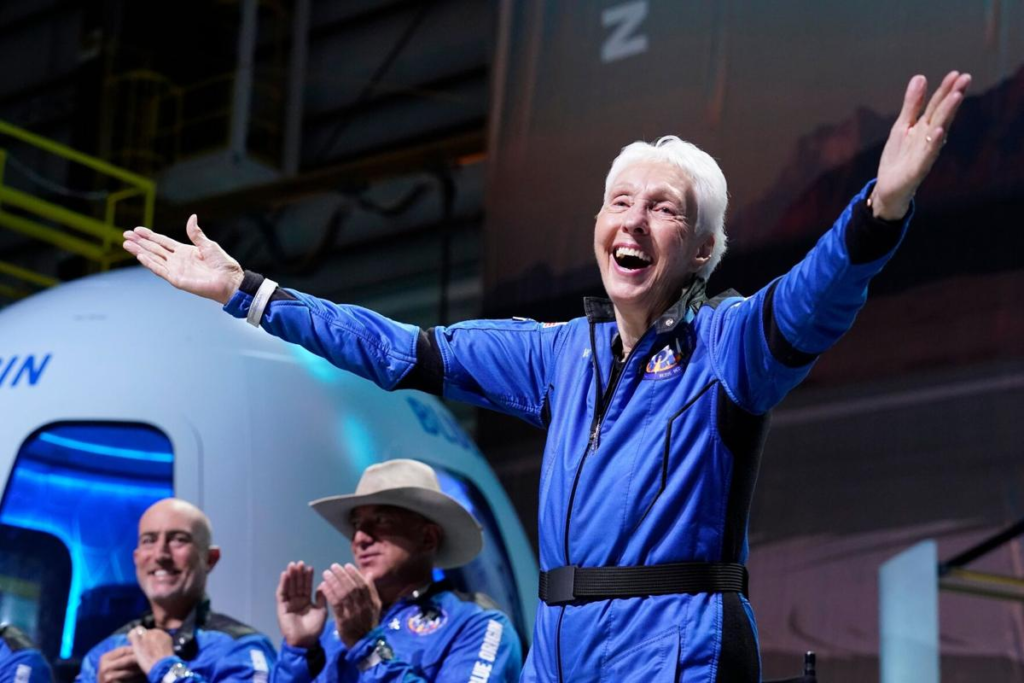
Wally Funk went to space on July 20, 2021, aboard Blue Origin’s first human New Shepard flight. She flew with Jeff Bezos, Mark Bezos and Oliver Daemen, crossing the Kármán line at age 82 years and 169 days, according to Blue Origin’s Guinness World Records announcement.
What made that moment unforgettable was not the billionaire headline. It was the wait. Funk had trained for the possibility of space in 1961. She reached it six decades later. In a flight school, a logbook records hours, landings and qualifications. Funk’s life became a larger kind of logbook, proof that delayed recognition is not the same as defeat.
What was Mercury 13?
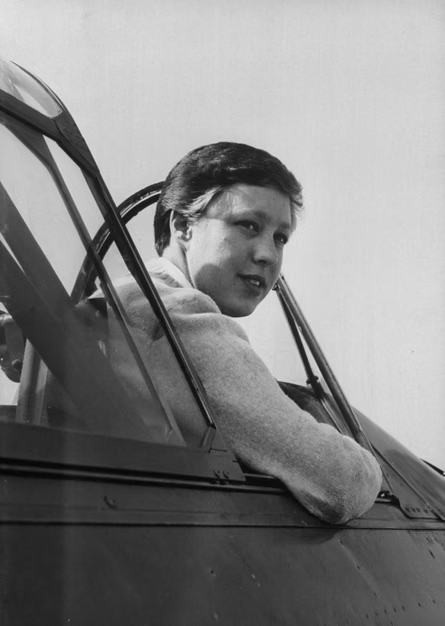
Mercury 13 was the name later given to 13 women pilots who passed many of the same medical and physical screening tests used for male astronaut candidates. Funk was the youngest of the group, and the program was cancelled before the women could move forward together into advanced testing.
For a reader asking “Why didn’t Mercury 13 go to space?”, the answer is clear: the program had no official NASA pathway, and women were blocked from the astronaut corps at the time. Funk eventually became the only Mercury 13 member to make it to space.
What did Wally Funk do besides spaceflight?
Wally Funk built a serious aviation career long before the world saw her in a blue spacesuit. She became the first female inspector for the Federal Aviation Administration and the first female air safety investigator for the National Transportation Safety Board, according to AP.
She also trained more than 3,000 pilots. That number matters because teaching someone to fly is not symbolic work. It means sitting beside nervous students, repeating checklists, correcting small mistakes before they become dangerous ones, and building judgment one flight at a time.
What can readers learn from Wally Funk’s life?
Wally Funk’s lesson is simple: build the skill so strongly that history eventually has to notice. For students, young pilots, parents and anyone chasing a late dream, her life offers practical advice:
- Keep proof of your work. Hours, certificates, training records and projects matter.
- Do not confuse rejection with lack of ability. Funk had ability before she had access.
- Find a real cockpit, classroom or mentor. Inspiration is useful, but training changes your life.
- Stay ready longer than people expect. Funk’s spaceflight came at 82, not 22.
Wally Funk’s legacy, in one line
Wally Funk proved that a dream can be delayed by institutions, but not destroyed by them. She leaves behind a rare aviation legacy: pilot, instructor, safety investigator, Mercury 13 trailblazer and the oldest woman ever to travel into space.

