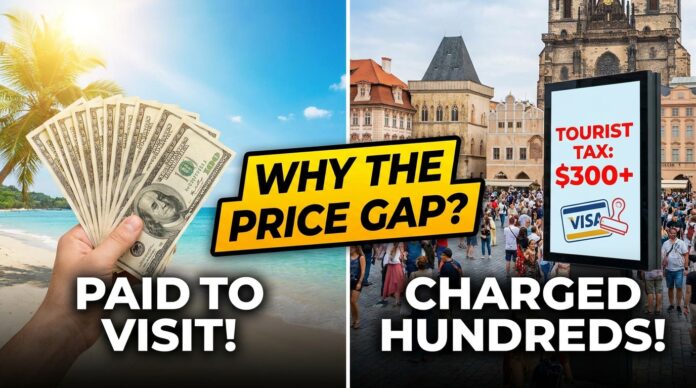
Some countries “pay” tourists because they need more visitors, while others charge high fees because they need fewer, better-managed visitors. That is the simple answer behind one of travel’s strangest trends: one destination offers vouchers, free transport or even free trips, while another asks travelers to pay $100 or $200 before the holiday properly begins.

This is not random. It is tourism strategy.
Why Do Countries Pay Tourists to Visit?
Countries pay or reward tourists when they want to fill hotels, revive quiet regions, promote off-season travel or shift visitors away from overcrowded places. Most of the time, travelers are not handed cash at passport control. The “payment” usually comes as:
- Dining vouchers
- Hotel discounts
- Free public transport
- Free attraction tickets
- Contest-based free trips
- Airport or event perks
Finland recently used this model with its Chill Like a Finn campaign, where Visit Finland invited travelers to apply for a happiness-themed summer experience, with Condé Nast Traveler reporting that six duos would receive a seven-day, all-expenses-paid trip to Finnish Lakeland.

Why Do Some Places Give Tourists Free Transport and Discounts?
Free travel perks are often used to make visitors stay longer and spend money locally. Switzerland is a clear example. Switzerland Tourism says many Swiss destinations give overnight guests a guest card, often including free public transport and discounts on attractions, once they book at least one night.
That small card changes traveler behavior. A visitor who gets free buses in Interlaken or free local transport in Bern is more likely to visit villages, museums, lakeside cafés and mountain areas instead of staying only near the hotel.
| Destination strategy | What tourists get | Why it helps the place |
|---|---|---|
| Free transport | Bus, train or tram access | Spreads visitors beyond the center |
| Dining vouchers | Restaurant discounts | Supports local food businesses |
| Attraction offers | Museum or tour deals | Pushes spending into culture |
| Free-trip campaigns | Limited contest winners | Creates global media attention |
Why Do Countries Charge Tourists Hundreds of Dollars?
High tourist fees are used when destinations want to protect nature, control crowds or make visitors contribute to local costs. Bhutan is the strongest example. Its Sustainable Development Fee is currently US$100 per person per night for most visitors, while Indian tourists pay INR 1,200 per person per night. Bhutan says the funds support infrastructure, services, culture, sustainability, healthcare and education.
Also read – Why Does Bhutan, a Tiny Country, Charge the World’s Highest Tourist Visa Fee?
The Galápagos Islands use a similar protection-first model. International visitors over 12 pay a US$200 entrance fee, according to the official Galápagos government fee page.
Tourist Fee Comparison: Who Charges What?
The biggest difference is whether the destination sees tourism as growth fuel or pressure to manage.
| Place | Visitor charge or reward | Main reason |
| Bhutan | US$100 per night SDF | Protect culture and fund development |
| Galápagos | US$200 entrance fee | Protect fragile islands |
| New Zealand | NZ$100 visitor levy | Fund conservation and tourism systems |
| Bali | IDR 150,000 tourist levy | Support culture and environment |
| Switzerland | Free guest-card benefits in many areas | Encourage longer, wider local travel |
New Zealand’s official International Visitor Conservation and Tourism Levy is NZ$100 for most eligible international visitors, and the government says it helps address tourism and conservation challenges. Bali’s official Love Bali platform lists the foreign tourist levy at IDR 150,000, with the stated aim of protecting Balinese culture and the natural environment.
Is It Better When a Country Pays Tourists or Charges Them?
Neither model is automatically better. The right model depends on the destination’s problem. A city with empty hotels may need deals. A tiny island with endangered wildlife needs limits. A mountain country with sacred monasteries may prefer fewer visitors who stay longer and spend responsibly.
As a traveler, ask one practical question before booking: “Is this fee protecting the place, or is this reward trying to pull me somewhere I might have ignored?”
That question helps you travel smarter.
Smart Traveler Tip: How to Use This Trend
Use incentives for value, but respect fees as part of the destination cost. If a place gives free transport, build your itinerary around local buses or trains. If a place charges a high conservation fee, slow the trip down instead of rushing through it.
A good rule from real travel planning: do not pay Bhutan-level or Galápagos-level fees for a rushed two-day checklist trip. Stay longer, hire good local guides, visit outside peak hours, and spend with small local businesses. That is how the fee becomes part of the experience, not just another line on your card statement.
Final Answer: Why Travel Prices Are Moving in Opposite Directions
Countries pay tourists when they need attention. Countries charge tourists when they need protection. That is why one place offers vouchers and another adds a $200 entry fee.
For travelers, the smartest move is not to chase the cheapest entry. It is to understand the destination’s real reason. Sometimes the best deal is a free guest card. Sometimes the best value is paying more to visit a place that still feels cared for.

