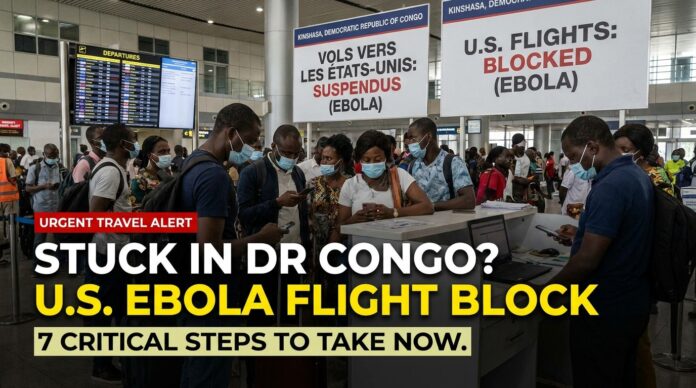
Americans in the Democratic Republic of the Congo should contact the U.S. Embassy or CDC before going to the airport, buying another ticket or choosing a country for a 21-day stay.
A new U.S. measure reportedly places American citizens who are in the DRC, or who recently left, on a public-health Do Not Board list. Affected travelers cannot immediately board commercial flights to the United States and may have to spend at least 21 days in a third country first. The State Department has said it will support affected citizens during the waiting period.
This is not a cancellation of citizenship or a permanent ban on returning home. It is a restriction on commercial air travel introduced as the Ebola outbreak expands.
What Should Americans Stuck in Congo Do First?
Call the U.S. Embassy or CDC and request an Ebola risk assessment before changing your itinerary.
The State Department’s official Ebola assistance process tells U.S. citizens to contact the nearest embassy or call the CDC Emergency Operations Center. A CDC health official may then interview the traveler about locations visited, contact with patients, healthcare work, funerals and possible exposure to body fluids.
Essential contact details
| Contact | Number or address | When to use it |
|---|---|---|
| U.S. Embassy Kinshasa | +243 81 556 0151 | Immediate consular help in the DRC |
| Embassy email | ACSKinshasa@state.gov | Written case details and document trail |
| CDC Emergency Operations Center | +1 770 488 7100 | Ebola exposure assessment |
| State Department from abroad | +1 202 501 4444 | Consular support outside embassy hours |
| State Department from the U.S. or Canada | +1 888 407 4747 | Relatives seeking information |
The embassy has limited capacity outside Kinshasa, particularly in eastern DRC, so travelers should make contact early rather than waiting until the day of departure.
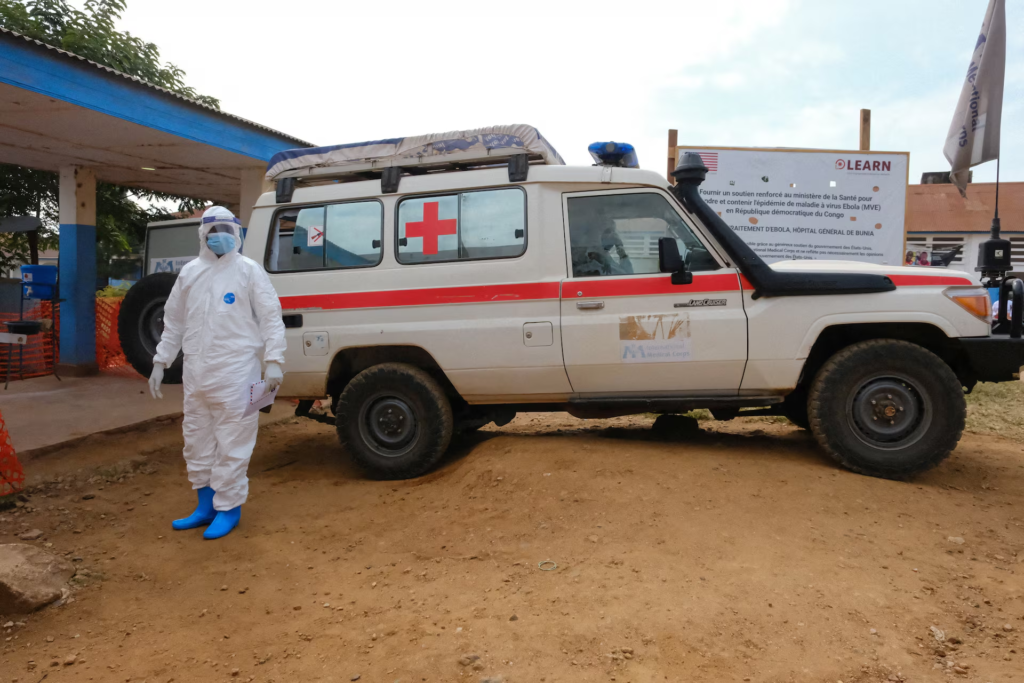
Which Official Pathway Applies to You?
Your symptoms and exposure history determine what assistance may be offered.
| Your situation | What to do immediately | Possible U.S. assistance |
| No symptoms and no known high-risk exposure | Request a CDC risk assessment | Help coordinating departure, local authorities or an emergency loan when available |
| High-risk exposure but no symptoms | Do not travel independently until assessed | Transport to a facility in Kenya may be arranged for a 21-day quarantine |
| Ebola symptoms or a positive test | Isolate and call for medical help | Specialized medical evacuation to an approved treatment location may be arranged |
| Already outside the DRC | Contact the nearest U.S. embassy | Confirm Do Not Board status and the date you may become eligible to travel |
These services are not automatic. The official process is voluntary, and each case is assessed individually.
Also read – CDC Issues Fresh Ebola Travel Rules for Returning Travelers
Seven Exact Steps to Take After Your U.S. Flight Is Blocked
1. Do Not Go to the Airport Without Clearance
Confirm your boarding status before leaving your hotel, residence or work site.
A public-health Do Not Board listing can stop an airline from issuing a boarding pass. It is different from the law-enforcement No Fly List, but the immediate result at check-in can look the same: the passenger cannot board.
Ask the airline and embassy for written confirmation rather than relying only on a call-center agent.
2. Request a CDC Exposure Assessment
Give officials a precise 21-day travel and activity history.
Prepare the following before calling:
- Every province and city visited
- Dates spent in hospitals, clinics or treatment centers
- Contact with sick people or human remains
- Attendance at funerals or burial ceremonies
- Any contact with blood, vomit, diarrhea or other body fluids
- Personal protective equipment used during healthcare or aid work
- Your current temperature and any symptoms
Vague answers can delay a decision. A simple timeline in your phone’s notes app is often easier to follow than trying to remember dates during an urgent interview.
3. Do Not Book a Random Third-Country Stay Yet
Confirm that the proposed country will admit you and that U.S. authorities will recognize the waiting period.
The reported policy requires affected Americans to spend at least 21 days in a third country before commercial travel to the United States. However, travelers should not assume that any destination automatically qualifies.
Before paying, ask:
- Does the destination accept travelers recently present in the DRC?
- Is a visa required?
- Will quarantine or health screening apply?
- Which date starts the 21-day period?
- What proof will remove the Do Not Board restriction?
- Must the embassy approve the itinerary first?
For travelers assessed as having a high-risk exposure, the 21-day health period may be counted from the last exposure, not simply the date the person left the DRC.
4. Keep Proof of Every Date and Movement
Save documents that show exactly when you left the DRC and where you stayed afterward.
Keep digital and paper copies of:
- Boarding passes
- Passport entry and exit stamps
- Airline confirmations
- Hotel invoices
- Visa records
- Daily temperature logs
- Emails from the embassy or CDC
- Written exposure-assessment results
Do not delete a cancelled boarding pass or original itinerary. It may help establish where you were and when the restriction affected you.
5. Prepare for Significant Unexpected Costs
Assume that accommodation, food, transport and medical monitoring may not be fully covered.
A U.S. Embassy health alert warned that travelers could face quarantine outside the United States at their own expense for up to 21 days, that costs could be substantial and that insurance might not cover them.
Before choosing accommodation:
- Ask whether the hotel permits a long health-monitoring stay.
- Get cancellation and extension terms in writing.
- Confirm access to food without frequent public trips.
- Check nearby medical care without visiting a clinic unnecessarily.
- Ask the insurer specifically about government-imposed quarantine and epidemic exclusions.
The State Department may offer an emergency loan in some circumstances, but availability is not guaranteed.
6. Monitor Your Health Without Hiding Symptoms
Take your temperature daily and immediately report fever or illness.
Watch for:
- Fever of 100.4°F or 38°C or higher
- Feeling feverish
- Severe weakness or tiredness
- Headache or body aches
- Sore throat
- Vomiting or diarrhea
- Stomach pain
- Rash
- Unexplained bleeding or bruising
Ebola symptoms can develop during the 21 days after exposure. The CDC advises travelers to separate themselves from others and call health authorities before seeking in-person medical care.
7. Get Written Confirmation Before Rebooking Home
Do not assume the restriction disappears automatically at midnight on day 21.
Ask the embassy or CDC to confirm:
- The date your monitoring period ends
- Whether your Do Not Board listing has been removed
- Whether additional health documents are required
- Which route and airline may be used
- Whether arrival screening still applies
This final check can prevent an expensive journey to the airport followed by another refusal at check-in.
Can Americans Fly Through Canada or Mexico and Enter by Land?
Do not use Canada, Mexico or another border as an improvised workaround.
The Do Not Board list restricts relevant commercial air travel, while a related Public Health Lookout can alert U.S. Customs and Border Protection when a listed traveler attempts entry by air, land or sea. Health officials may then intervene and assess the traveler.
A third country may also have its own Ebola restrictions. Book only after the U.S. embassy and the destination authorities confirm the plan.
Why Official Information May Appear Confusing
Two separate U.S. travel measures are operating, and public webpages may not yet show every new detail.
Existing CDC guidance says U.S. citizens are exempt from the Title 42 entry suspension affecting certain foreign nationals. That guidance also describes enhanced screening at designated U.S. airports.
The newly reported citizen restriction relies on a different transportation authority under Title 49 and uses the Do Not Board system.
As of July 14, public CDC pages had not fully incorporated all operational details of the newly reported rule. That is why direct confirmation from the embassy or CDC is more reliable than using an older screenshot or social media post.
A Practical Example: A Tuesday Flight From Kinshasa
An aid worker with a confirmed Tuesday ticket should not begin by buying another flight.
The safer order is:
- Call the embassy and CDC.
- Complete the exposure assessment.
- Confirm whether the person is listed as Do Not Board.
- Obtain instructions for an approved third-country stay or assisted quarantine.
- Check who pays for lodging and transport.
- Rebook only after the route is approved.
Buying three speculative tickets to different countries may feel productive, but it can produce three non-refundable losses without changing the traveler’s boarding status.
Why Has the U.S. Tightened the Rules?
The restrictions follow rapid expansion of the Bundibugyo Ebola outbreak in the DRC.
Official data cited on July 13 showed 1,926 confirmed cases and 702 deaths. The outbreak has spread across several provinces, and cases have been reported within hours of Kinshasa. Two American humanitarian workers have also been infected during the outbreak and transported to Germany for treatment.
The CDC has confirmed outbreak activity in Haut-Uele, Ituri, North Kivu, South Kivu and Tshopo. It recommends avoiding nonessential travel to affected areas.
The entire DRC remains under a Level 4: Do Not Travel advisory because of Ebola, crime, unrest, kidnapping, terrorism and limited medical support.
What Not to Do While Waiting
Avoid actions that can delay your return or put other people at risk.
- Do not hide recent travel or possible exposure.
- Do not arrive at an airport hoping the airline will make an exception.
- Do not buy another ticket without confirming your status.
- Do not assume travel insurance covers epidemic quarantine.
- Do not visit a crowded clinic without calling first if symptoms begin.
- Do not rely on a friend’s experience because exposure assessments differ.
- Do not discard emails, boarding passes or health records.
The Bottom Line for Americans Stuck in DR Congo
Your fastest route home begins with an official risk assessment, not a new airline booking.
Call the U.S. Embassy or CDC, document your travel and exposure history, confirm whether you are on the Do Not Board list and obtain written instructions for the required waiting period.
Americans with no high-risk exposure may receive help coordinating departure. Those with a high-risk exposure but no symptoms may be offered supervised quarantine in Kenya. Anyone who develops symptoms should isolate immediately and request medical assistance rather than attempting commercial travel.
The rules are disruptive, but they do provide defined pathways. Following the official process is safer and usually less expensive than trying to build a route around the restriction.

