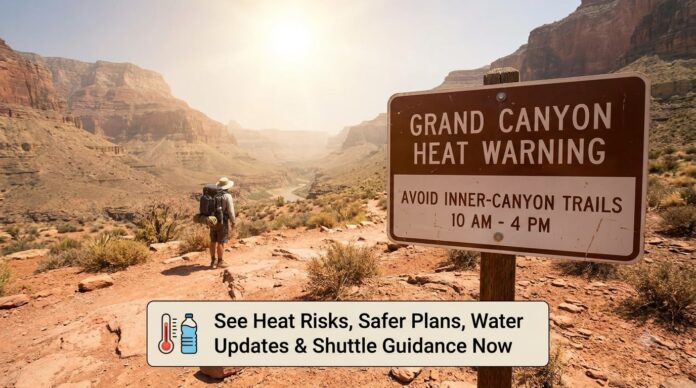
Visitors staying in Grand Canyon Village or nearby Tusayan should avoid strenuous hiking below the rim between 10 a.m. and 4 p.m. The National Park Service says inner-canyon temperatures can reach 109°F, or 43°C, in the shade, with exposed ground and direct sunlight making conditions feel considerably hotter.
This is not a six-hour closure of Grand Canyon National Park. The South Rim remains open, and visitors can still use rim viewpoints, visitor facilities and shuttle services. The warning specifically asks hikers to stay off exposed inner-canyon trails during the most dangerous part of the day.
Is the Grand Canyon closed between 10 a.m. and 4 p.m.?
No, the Grand Canyon is not closed from 10 a.m. to 4 p.m. The six-hour period is a safety restriction hikers should place on themselves.
| Visitor question | Direct answer |
|---|---|
| Is Grand Canyon National Park closed? | No. The South Rim remains open throughout the year. |
| What should hikers avoid? | Strenuous hiking on inner-canyon trails from 10 a.m. to 4 p.m. |
| What is the best time to hike? | Start before sunrise or hike after the strongest afternoon heat has passed. |
| Can visitors stay along the rim? | Yes. Rim walks, viewpoints, museums and shuttle trips remain practical options. |
| Does every trail have drinking water? | No. Water availability differs by trail and can change without notice. |
The park’s current hiking guidance states plainly: “Do not hike between 10 am and 4 pm.” Its Key Hiking Messages page, updated July 30, 2026, also listed the heat risk at Phantom Ranch as extreme.
Why is hiking the Grand Canyon at midday so dangerous?
The temperature rises as hikers descend, while the hardest part of the trip—the climb back to the rim—comes last. Inner-canyon temperatures can be around 30°F, or 17°C, warmer than temperatures on the rims. Direct sunlight may add another 15°F to 20°F beyond the reported shade temperature.
That creates a trap for first-time visitors. The descent may feel comfortable and fast, encouraging people to travel farther than planned. The return is slower, steeper and hotter. According to the park’s hiking guidance, climbing out can take twice as long as descending, and many first-time hikers average only about one mile per hour uphill.
The renewed warning followed several fatal incidents in June 2026. An 18-year-old hiker experiencing heat-related symptoms died during a South Rim-to-river day hike, while three other hikers later died in separate incidents involving apparent heat illness on the South Kaibab and North Kaibab trails.
Which Grand Canyon trails carry the greatest summer heat risk?
South Kaibab Trail is particularly exposed because it has little shade and no water along the trail. The National Park Service also identifies the Tonto Trail between The Tipoff and Havasupai Gardens as a high-risk summer section because it offers very limited shade and no water.
Visitors should be especially cautious on:
- South Kaibab Trail: steep, exposed and without trail-side drinking water.
- Bright Angel Trail: some shade and seasonal water, but still a strenuous inner-canyon route.
- North Kaibab Trail: major elevation change, variable water access and additional post-fire hazards.
- Tonto Trail: long exposed sections with limited shade.
- Rim-to-river routes: the park does not recommend hiking from the rim to the Colorado River and back in one day.
Being fit does not remove the risk. The South Rim is approximately 7,000 feet above sea level, while the North Rim is around 8,000 feet. Heat, altitude, dry air and sustained climbing can overwhelm experienced hikers as well as beginners.

What time should you start hiking the Grand Canyon?
Start early enough to finish the exposed section—or reach a safe planned resting point—before 10 a.m. A 7 a.m. start may still be too late for a long inner-canyon hike.
For South Rim visitors, the summer Hikers’ Express Shuttle supports genuinely early departures:
- Bright Angel Lodge: 4 a.m., 5 a.m. and 6 a.m.
- Backcountry Information Center: 4:10 a.m., 5:10 a.m. and 6:10 a.m.
- Grand Canyon Visitor Center: 4:20 a.m., 5:20 a.m. and 6:20 a.m.
The shuttle takes hikers toward the South Kaibab Trailhead. Private vehicles cannot drive directly to that trailhead.
Also read – UK Travelers Gets Swiss E-Gates and Free Mobile Roaming
A practical Tusayan hiking plan
A visitor staying in Tusayan could take an early shuttle connection, begin a short South Kaibab hike near sunrise and set a fixed turnaround time well before 10 a.m. The midday hours can then be used for the Rim Trail, Yavapai Geology Museum, shaded rest, lunch or a shuttle ride between viewpoints.
This approach also avoids another local problem: weekend traffic. The park warns that vehicles approaching the South Entrance near Tusayan can face waits of up to two hours between 10 a.m. and 4 p.m. During the 2026 summer schedule, the Tusayan Park & Ride shuttle runs approximately every 45 minutes from 8 a.m. to 9 p.m. through September 11.
Where is drinking water available at the Grand Canyon?
Never assume a trail water station is working. Pipeline damage, maintenance and seasonal conditions can interrupt supplies without much warning.
As of the park’s July 30 update:
| Location | Reported status |
| North Rim | Water off |
| North Kaibab Trailhead | Water off |
| Supai Tunnel | Water off |
| Manzanita Day Use Area | Water on |
| Cottonwood Campground | Water on |
| Phantom Ranch | Water on |
| Havasupai Gardens | Water on |
| Bright Angel resthouses | Water on |
| South Kaibab Trailhead | Water on |
These statuses can change suddenly. Hikers should check the official Grand Canyon Key Hiking Messages page on the morning of their trip and carry a treatment method rather than depending entirely on a faucet.
What should you carry for a summer Grand Canyon hike?
Carry equipment for heat, delayed assistance and an unexpectedly late return. Cell service is unreliable, and extreme heat or weather can restrict helicopter operations.
Essential items include:
- Plain water plus an electrolyte source.
- Salty, high-energy food that can be eaten while resting.
- A wide-brimmed hat and sun-protective clothing.
- Sunscreen and a wettable bandana or towel.
- A trail map and a fixed turnaround time.
- A first-aid kit with blister treatment.
- A flashlight with spare batteries.
- A whistle or signal mirror.
- Rain protection during monsoon season.
- Extra food and water beyond the expected hiking time.
A useful detail many visitors miss is that drinking excessive plain water can also be dangerous. The park advises hikers to balance fluids with salty food and electrolytes rather than forcing large quantities of water after symptoms begin.
What should you do if heat illness begins on the trail?
Stop hiking immediately when someone develops nausea, dizziness, unusual exhaustion, headache or confusion. Continuing “just a little farther” can turn a manageable problem into an emergency.
Move the person away from direct sun, cool their body with water, provide appropriate food and fluids, and do not leave them alone when it can be avoided. Confusion, disorientation, seizures or loss of consciousness indicate a life-threatening emergency requiring immediate cooling and emergency assistance.
Emergency phones are located at several corridor-trail facilities, including Havasupai Gardens, Phantom Ranch, the Bright Angel resthouses and the South Kaibab–Tonto trail junction. Immediate rescue, however, is not guaranteed. The park expects inner-canyon hikers to arrive prepared for self-rescue and delayed assistance.
What can visitors do instead between 10 a.m. and 4 p.m.?
Use the hottest hours for rim-level sightseeing rather than descending into the canyon.
Safer alternatives include:
- Walking a manageable section of the Rim Trail.
- Riding the free shuttle between South Rim viewpoints.
- Visiting Yavapai Geology Museum or the South Rim Visitor Center.
- Exploring Desert View and the watchtower area.
- Resting, eating and preparing for a short evening walk.
- Watching current conditions through the park’s official webcams.
A changed itinerary is not a failed Grand Canyon trip. The better decision is the one that leaves enough energy, water and daylight to return safely.
The bottom line for Grand Canyon Village and Tusayan visitors
Do not schedule an inner-canyon hike between 10 a.m. and 4 p.m. during dangerous summer heat. Start before dawn, choose a conservative turnaround point, confirm water availability and move midday activities to the rim.
The six-hour warning is not an inconvenience added to a vacation. It reflects how quickly the canyon’s combination of heat, altitude and steep terrain can turn an ordinary hike into an emergency.

