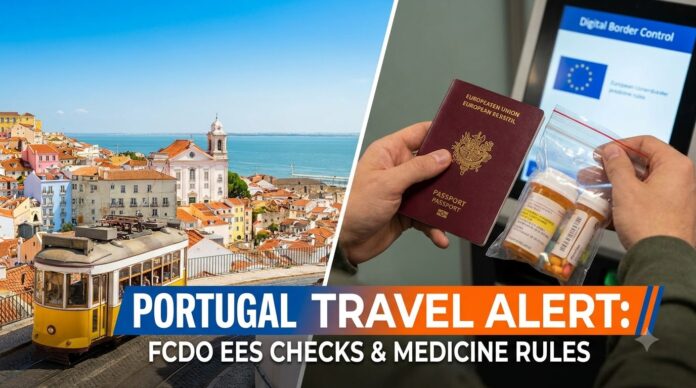
Portugal remains open to travellers, but anyone visiting in summer 2026 should prepare for wildfire disruption, newer Schengen border procedures and stricter practical considerations around prescription medicines. The UK Foreign, Commonwealth & Development Office says its Portugal travel advice remains current as of 10 August 2026, with the latest update published on 17 July 2026 concerning medication.
For most holidaymakers, this does not mean cancelling a Portugal trip. It means checking a few things before leaving home that can prevent a missed flight, an unusable prescription, a wildfire-related road problem or an expensive mistake at the beach.

Is Portugal Safe to Travel to Right Now?
Yes, Portugal is generally accessible to tourists, and the UK government is not advising against normal travel to the country. However, its official advice stresses that no journey can be guaranteed completely safe and specifically highlights wildfires between April and October, street theft, sea conditions, extreme summer temperatures and possible transport disruption.
The important distinction is this: a seasonal risk warning is not the same as a nationwide “do not travel” warning.
Portugal travel advice also covers Madeira, Porto Santo and the Azores, so travellers heading to the islands should not assume that mainland guidance is irrelevant to them.
Portugal travel safety at a glance
| What travellers should check | Why it matters |
|---|---|
| Wildfire risk | Fires can lead to road closures or local evacuations |
| Passport dates | Schengen passport validity rules are strict |
| EES border procedures | Biometric border checks can take additional time |
| Prescription medicines | UK prescriptions are not recognised in Portugal |
| Beach flags | Strong currents and unpredictable waves cause deaths |
| Albufeira conduct rules | Certain public behaviour can lead to significant fines |
| Travel insurance | GHIC/EHIC does not replace comprehensive insurance |
Portugal Wildfire Risk: What Tourists Should Do Before Driving Inland
Portugal has an increased wildfire risk from April to October, especially during hot and dry weather. Fires can occur anywhere in the country, and Portuguese authorities may close roads or evacuate specific areas when conditions become dangerous.
This matters particularly if your trip involves a rental car, rural villa, hiking route or a drive between smaller towns.
A traveller staying entirely in central Lisbon may experience no disruption at all while somebody driving through an inland district on the same day could face a completely different situation.
Before a rural journey:
- Check the official IPMA weather and fire information rather than relying only on a phone weather app.
- Check your route again immediately before leaving.
- Keep the rental vehicle reasonably fuelled rather than waiting until the tank is nearly empty.
- Save your accommodation address offline.
- Follow police or civil-protection instructions immediately if a road is closed.
- Call 112 if you see a fire or face an emergency.
Portugal’s meteorological institute publishes dedicated rural fire danger information, making it much more useful for a road trip than simply looking at the predicted temperature.
Practical tip: Do not treat a navigation app’s suggested detour as authority during a wildfire. A shorter road on Google Maps or another navigation service may lead towards an area local authorities are trying to clear. Follow official closures first.
Also read – Tried & Tested Cheapest Ways to Travel in Europe Right …
Do UK Travellers Need a Visa for Portugal in 2026?
British citizens can normally visit Portugal and the wider Schengen area without a visa for up to 90 days in any 180-day period for tourism and certain other short visits. Time spent in other Schengen countries counts towards the same allowance.
Travellers should also check their passport issue and expiry dates, not simply whether the passport looks valid.
For a standard British citizen passport, Portugal’s Schengen rules require it to:
- have been issued less than 10 years before the date of arrival, and
- expire at least three months after the planned date of leaving the Schengen area.
The passport mistake that catches people out
Imagine your passport expires seven months after your holiday. That sounds comfortably valid.
But if it was issued more than 10 years before your arrival date, it can still fail the Schengen requirement.
Check both dates separately.
Portugal’s border authorities may also request an onward or return ticket and evidence that you have enough money for the trip.
Portugal EES Border Checks: What Has Changed?
Travellers entering the Schengen area may now face digital Entry/Exit System procedures instead of relying on traditional passport stamps. Portugal’s current UK travel guidance warns that visitors may need to register biometric information including a photograph and fingerprints and should allow additional time for border processing.
The European Union describes EES as its automated system for recording short-stay non-EU travellers entering and leaving participating European countries.
For travellers, the practical lesson is simple:
Do not plan an unusually tight airport connection on the assumption that immigration will take exactly as long as it did on an older Portugal trip.
First-time processing can involve:
- passport scanning,
- a facial photograph,
- fingerprint collection where applicable,
- entry information being recorded electronically.
Children aged 11 or younger are not required to have fingerprints scanned, although a photograph may still be required.
The EU also provides official Entry/Exit System information for travellers who want to check the latest procedures.
Taking Medication to Portugal: The Detail Many Travellers Miss
Take enough prescription medicine for your entire stay because UK prescriptions are not recognised in Portugal. This is one of the most useful details in the July 2026 update to the official Portugal travel advice.
Travellers should keep medicines:
- in their original container,
- with the prescription label attached, and
- with a few days’ supply in hand luggage in case checked baggage disappears or arrives late.
Portugal also has strict dispensing rules for certain medicines, including antibiotics.
If you unexpectedly need a repeat prescription, official guidance says you may need to visit a health centre or hospital emergency department, and you may have to pay for the medication.
A smarter packing method
Someone taking daily medication for a seven-night holiday should not put every tablet into the same checked suitcase.
A better setup is:
- main supply in appropriate original packaging,
- several days’ backup in hand luggage,
- prescription or supporting documentation easily accessible,
- insurance details saved on the phone and offline.
That small change solves one of the most common travel problems: your suitcase goes missing, but your medication does not.
Does GHIC Cover Healthcare in Portugal?
A valid GHIC or qualifying EHIC can provide access to medically necessary state healthcare in Portugal, but it is not a replacement for travel insurance.
Travel insurance can cover costs that a health card may not, including:
- repatriation to the UK,
- private treatment,
- disrupted accommodation,
- changed travel arrangements,
- some additional medical expenses.
For a medical emergency in Portugal, dial 112 and ask for an ambulance.
For non-emergency health advice on mainland Portugal, the official guidance lists (+351) 808 24 24 24, with an option to press 9 for English. Different numbers apply in Madeira, Porto Santo and the Azores.
Portugal Beach Safety: What Do Red and Yellow Flags Mean?
A red flag means you must not enter the water, while a yellow flag means you should remain at the water’s edge rather than swimming normally. Portugal’s Atlantic coastline can produce strong currents, undertows and rapidly changing waves even when the beach itself looks calm.
One of the most valuable pieces of official advice concerns rip currents:
Do not exhaust yourself trying to swim directly against the current. Move parallel to the coastline until you escape the flow, then head back towards shore.
Also avoid:
- diving into unfamiliar water,
- standing too close to breaking waves on unsupervised beaches,
- swimming where rivers meet the sea without understanding local conditions,
- ignoring lifeguard instructions.
In the Algarve, cliff erosion is another genuine hazard. Authorities may fine people who ignore warning signs around unstable cliffs.
A photograph beneath a dramatic overhang is not worth standing inside a marked rockfall zone.
Can Tourists Be Fined in Albufeira?
Yes. Albufeira has local rules covering inappropriate behaviour in public places, with on-the-spot fines reported by the UK government at between €150 and €1,800.
This is particularly relevant to visitors booking nightlife-focused holidays in the Algarve.
The sensible approach is to check the municipality’s rules rather than assuming anything tolerated inside a bar is automatically acceptable outside it.
Is Pickpocketing a Problem in Lisbon and Portugal?
Street theft is a realistic tourist risk, particularly around public transport, busy tram stops and crowded areas. Portuguese travel advice warns that thieves can work in teams and use distraction techniques.
Do not respond by becoming paranoid. Change your setup instead.
Better tourist routine:
- Keep your passport separate from your everyday cash.
- Store a digital or paper copy of the passport photo page separately.
- Avoid keeping your phone, wallet and passport in one accessible bag pocket.
- Zip bags before boarding crowded transport.
- At a café, do not leave a phone on the outer edge of the table.
The strongest travel-security habits are usually boring ones. They work because they remove easy opportunities.
What Should Travellers Check 24 Hours Before Flying to Portugal?
Check five things the day before departure rather than relying on research you did when you booked the holiday months earlier.
Portugal pre-departure checklist
- Passport: confirm Schengen issue-date and expiry requirements.
- FCDO advice: review the latest official Portugal travel advice.
- Weather and fire conditions: check IPMA if travelling during hot weather.
- Medication: pack enough for the trip plus an accessible buffer.
- Insurance: confirm the policy actually covers your planned activities.
If you will hike in Madeira or the Azores, check whether your chosen trail is open before leaving the hotel. UK guidance specifically advises travellers to check local access restrictions and choose routes appropriate to their fitness and experience.
Should You Cancel a Portugal Holiday in August 2026?
The current UK travel advice does not give travellers a general reason to cancel holidays throughout Portugal. The more useful decision is to assess your specific destination, dates and activities, especially where wildfire conditions, extreme heat or local disruption could affect an itinerary.
A Lisbon weekend, an Algarve beach holiday, a Madeira hiking trip and a self-drive tour through rural Portugal do not carry identical risks.
That is the key point generic travel-safety articles often miss.
Ask “What could affect my particular trip?” rather than simply “Is Portugal safe?”
For many travellers, the answer is straightforward: keep the holiday, check official information shortly before departure, carry the right documents and medication, and adapt locally when authorities tell you conditions have changed.

