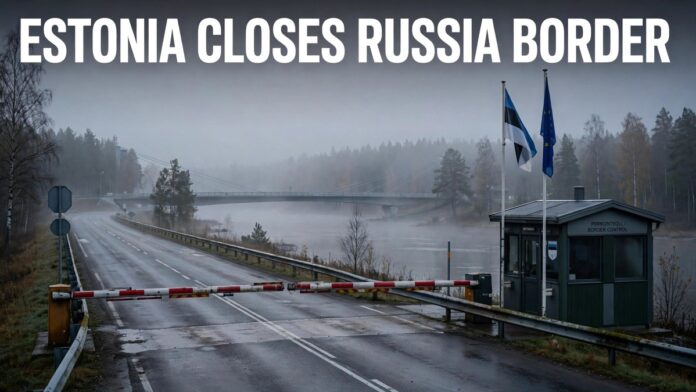
Estonia Russia border crossings close on 1 December 2026. From 07:00 that morning, every road crossing between Estonia and Russia is suspended — for pedestrians as well as vehicles — and the suspension has no fixed end date.
The decision, taken by the Estonian government on 20 November 2026, ends the last overland route between the two countries. It affects families split across the Narva river, cross-border workers, bus passengers heading to St Petersburg and Moscow, and freight moving through the Baltic states.
Anyone with travel planned across this border in December needs to act now: cross before the deadline, cancel, or reroute. This guide sets out exactly which crossings close, who is affected, what still moves, and what travellers must do instead.
Estonia Russia Border Crossings: Which Ones Close on 1 December
All five road border crossing points on the Estonian–Russian border are suspended from 1 December 2026. The Police and Border Guard Board (PPA) names them as follows:
| Crossing point | Where it is | What closes on 1 December |
|---|---|---|
| Narva-1 | Narva, on the Friendship Bridge to Ivangorod | Pedestrian crossing — the busiest foot route on the EU’s eastern border |
| Narva-2 | Narva, Kose street | Already temporarily closed; now formally suspended |
| Koidula | South-east Estonia, towards Pskov | Vehicle crossing, daytime hours only until now |
| Luhamaa | South-east Estonia, towards Pskov | Vehicle crossing, daytime hours only until now |
| Saatse | Setomaa, south-east Estonia | Small crossing, previously limited to Estonian and Russian residents |
The PPA is explicit: “It is not possible to cross the border via these border crossing points on foot or by vehicle.” That sentence matters, because the Narva pedestrian crossing was the last way across for people without a car. Russia closed the Narva crossing to vehicles in February 2024, but walkers could still cross the Friendship Bridge — until now.
In practice, three crossings carried almost all the traffic: Narva-1 for pedestrians, and Luhamaa and Koidula for cars, buses and lorries. All three shut at the same moment. The crossing points themselves are not being dismantled — the PPA says they will remain under state control and their security will be ensured — but nobody will pass through them.
How Long Will the Estonia Russia Border Closure Last?
The suspension has been made for an indefinite period. After six months — around June 2027 — the government will reassess whether the restriction needs to be continued, amended or lifted. Travellers should not plan on a reopening date, because none has been set.
That open-ended wording is deliberate. Earlier measures at this border were time-limited: night-time closures at Luhamaa and Koidula ran for three months from February 2026, and crossing hours were cut step by step through 2024 and 2025. This decision is different in scale. It closes the road border entirely, and it stays closed until the government actively decides otherwise.
Why Estonia Is Closing Its Russia Border Crossings
The government says the suspension was introduced in the interests of national security and to ensure public order. The decision was formally taken on 20 November 2026, and Foreign Minister Margus Tsahkna first announced the move on 15 November.
The timing followed a foiled arson attempt on 14 November 2026 against Threod Systems, an Estonian company that makes reconnaissance and combat drones, in which eight people were detained. Estonian authorities attribute the plot to Russia’s GRU military intelligence service. Foreign Minister Tsahkna has said the closure responds to continuing Russian aggression, sabotage and hybrid operations rather than to a single incident — a point worth noting, because the border had already been tightening for two years before this decision.
What Still Moves: Rail Freight Continues
The suspension covers road border crossings only. Rail freight through Narva continues, subject to existing restrictions and customs controls. That distinction matters for trade, but it is no help to ordinary travellers: there is no passenger rail service to switch to.
Direct bus services are ending too. Lux Express and Ecolines services from Tallinn and Riga to St Petersburg stop running by 30 November at the latest, because every one of those routes crossed through Estonia. The buses do not have an alternative route through Estonia — there is no road left to use.
Who Is Affected by the Estonia Russia Border Closure
The closure hits several groups at once, and each faces a different problem:
- Families across the Narva river. Narva and Ivangorod face each other across the river, and many families have relatives on both sides. The pedestrian crossing was their daily link. From 1 December, visiting relatives means a detour of hundreds of kilometres or a flight.
- Cross-border workers and shoppers. People who crossed regularly for work, shopping or services lose their route entirely.
- Bus and car travellers to St Petersburg and Moscow. The Tallinn–St Petersburg bus was the cheapest way into Russia for many Europeans. That option ends on 30 November.
- Freight and hauliers. Fewer than ten trucks a day were still passing through Luhamaa and Koidula, according to Estonian media, but those loads must now reroute through Latvia or go by other means.
- People currently in Russia. Anyone in Russia planning to return through an Estonian crossing cannot do so while the suspension is in force. Return journeys must be replanned before departure.
Estonian media report that local authorities estimate annual losses of €500,000–€600,000 for Narva and Setomaa, and that the government is preparing a €2 million support package for affected border communities. Around 160 border officials will be freed from the closed crossings, with some redeployed to land-border surveillance and the southern border with Latvia.
Estonia Russia Border: What Travellers Must Do Instead
There are still ways to reach Russia from the Baltic region, but every one of them is longer, more expensive or more restricted than the Narva crossing was. Check each option against current rules before paying for anything, because conditions are changing week by week.
Drive through Latvia
The nearest open road crossings are Terehova (towards Moscow) and Grebņeva (towards Pskov and St Petersburg) in Latvia, roughly 420–470 km from Tallinn. Both are open around the clock, but only for vehicles — crossing on foot is not allowed — and only with a slot booked in advance through Latvia’s electronic queue system at lvborder.lv. The booking costs €9.30 per car and cannot be changed after payment. Cars with Russian licence plates cannot enter the EU.
Fly via a third country
There have been no direct flights between the EU and Russia since 2022. The practical air route is a flight to Istanbul, Belgrade, Baku, Yerevan or Dubai, then onward to Moscow or St Petersburg. Russian e-visas are valid for arrival at approved airports, but travellers must check that their specific airport and visa type match before booking.
Bus and rail options with expiry dates
The Riga–Moscow bus holds a permit only until 9 January 2027, so it is a short-term option at best. Travelling via Belarus needs a regular Russian visa in the passport — the Russian e-visa does not work on that route — and entry rules there are unsettled. Travellers heading for Kaliningrad can cross from Poland or Lithuania and fly onward, as a domestic flight.
One route that does not work: Finland. The Finland–Russia border has been closed since 2023, so driving north is not an alternative. Anyone suggesting it is working from out-of-date information.
Traveller Checklist: Before 1 December 2026
Work through this list now if any trip touches the Estonia–Russia border:
- Cross before 07:00 on 1 December if travel is essential and already planned — after that hour, no road crossing is possible.
- Do not travel to Russia unless it is essential. The Estonian Police and Border Guard Board advises against travelling to Russia, and the Foreign Ministry strongly advises against all travel there.
- Rebook buses now. Tallinn and Riga services to St Petersburg end by 30 November. Check whether the operator offers a refund or a reroute.
- Check the Latvian e-queue early. Slots at Terehova and Grebņeva open 30 days ahead and cannot be changed after payment.
- Verify visa rules for the new route. A Russian e-visa works at some crossings and airports but not on others, including the Belarus route.
- Carry the right documents. Estonia does not recognise non-biometric Russian passports, and Russian citizens need a biometric passport and the right declarations to enter Latvia by land.
- Follow kriis.ee and the PPA website for updates and the official FAQ on the closure, and check the PPA border crossing points page before any journey.
Timeline: How the Estonia Russia Border Reached Full Closure
| Date | What happened |
|---|---|
| February 2024 | Russia closes the Narva crossing to vehicles; pedestrians only from then on |
| May 2024 | Narva crossing closes at night, indefinitely |
| February 2026 | Luhamaa and Koidula close at night for three months; daytime hours 07:00–19:00 |
| 14 November 2026 | Foiled arson attempt against drone maker Threod Systems; eight people detained |
| 15 November 2026 | Foreign Minister Margus Tsahkna first announces the border closure |
| 20 November 2026 | Government formally decides to suspend all road border crossings |
| 1 December 2026, 07:00 | All five road crossings — Narva-1, Narva-2, Koidula, Luhamaa, Saatse — close |
| June 2027 (approx.) | Government review after six months: continue, amend or lift |
The closure is the sharpest restriction any Baltic NATO member has placed on its Russian frontier since the full-scale invasion of Ukraine began. Whether it lasts six months or much longer will depend on the security picture the government reviews in mid-2027 — and travellers should plan as if the border stays shut.
For the latest official position, read the Police and Border Guard Board announcement of 20 November 2026, which lists all five crossings and the review timetable. Border rules elsewhere are shifting just as fast — Canada has announced its own entry restrictions, and India has overhauled its visitor visa system. Also read: Canada Ebola Travel Ban From February 2027: Who Is Affected and India New Visa Rules: Visitor Visa V1 and V2 Guide.

