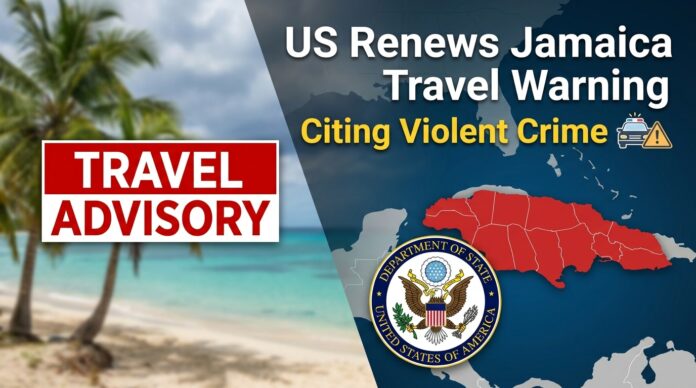
The United States has renewed its Level 2 travel advisory for Jamaica, warning visitors about violent crime, sexual assault and limited medical care. The June 23, 2026 update does not tell Americans to avoid Jamaica entirely, but it identifies several communities where travelers should reconsider visiting.
The advisory level did not increase. The State Department removed the natural-disaster risk indicator and updated its summary, while keeping Jamaica at Level 2: Exercise Increased Caution for crime and health risks.
Jamaica Travel Advisory 2026: What Changed?
| Key question | Direct answer |
|---|---|
| What is Jamaica’s advisory level? | Level 2: Exercise Increased Caution |
| When was it renewed? | June 23, 2026 |
| Did the warning level increase? | No |
| Why was it renewed? | Crime and health risks |
| Is all travel discouraged? | No, but certain communities carry Level 3 guidance |
| Are resort areas exempt from risk? | No, although tourist areas generally record less violent crime |
The update is important because headlines describing a “renewed warning” can sound like an emergency escalation. The official record confirms that the overall advisory remains unchanged.
Is Jamaica Safe to Travel to in 2026?
Jamaica remains open to travelers, but visitors should plan transport and accommodation more carefully than they would for a low-risk destination.
According to the official Jamaica travel advisory, violent crime can occur throughout the country. Tourist areas generally experience lower rates, but armed robberies and sexual assaults remain concerns. The U.S. Embassy has also received reports of sexual assaults involving American visitors at resorts.
A gated entrance or hotel wristband should not create a false sense of security. Keep drinks in sight, verify unexpected room-service visits with reception and avoid meeting newly acquainted people in isolated areas.
Also read – US State Travel Department Fresh Warning for Caibbean …
Which Parts of Jamaica Should Travelers Reconsider Visiting?
The Level 3 warning applies to named communities, not entire tourist cities or parishes.
| Parish or area | Communities covered by the higher warning |
|---|---|
| St. James, including parts of Montego Bay | Salt Spring, Flankers, Rose Heights, Hart Street, Norwood and Mount Salem |
| Kingston and St. Andrew | August Town, Mountain View, Nannyville Gardens, Denham Town, Parade Gardens, Greenwich Town and other listed communities |
| St. Catherine | Central Village, Waterford, March Pen and Grange Lane |
| Westmoreland | Grange Hill and Savanna-la-Mar |
| St. Ann | Steer Town |
| Hanover | Green Island area |
| Clarendon | York Town and Western Park |
| St. Elizabeth | Crawford District and New Town |
| Manchester | Old England, New Hall and Grey Ground |
| St. Thomas | Parts of Seaforth, including Blacksmith Lane and Navarre Lane |
Travelers should compare hotel, rental and excursion addresses with the complete State Department list, rather than relying only on a city name. A property advertised as being “near Montego Bay,” for example, may sit far from the established hotel corridor.
How Can Tourists Reduce Crime Risk in Jamaica?
Pre-arranged transport is one of the most effective precautions. U.S. government employees are prohibited from using public buses or driving between Jamaican cities at night, and American travelers are advised to take the same precautions.
Before leaving the airport or hotel:
- Ask the hotel to identify the driver by name.
- Confirm the total fare before entering the vehicle.
- Use licensed taxis with red-and-white licence plates.
- Avoid public buses, especially with luggage.
- Complete intercity journeys during daylight.
- Share the vehicle registration and route with a companion.
The State Department recommends hotel-arranged transport or licensed taxis. Road lighting can be poor, potholes and missing signs are common, and the fastest GPS route may not be the safest route.
Also read – Canada and Europe Wildfires Put Summer Travel Plans on Hold …
Why Is Health Included in the Jamaica Travel Warning?
Emergency and specialist medical care may be difficult to obtain outside major areas. Ambulances are not always available or staffed by trained emergency personnel, while private hospitals can demand payment before admission.
The State Department estimates that an air ambulance to the United States can cost at least $30,000. Travelers should therefore confirm that their insurance includes:
- Emergency treatment in Jamaica
- Medical evacuation
- Upfront payment assistance
- Coverage for planned activities, including diving or hiking
- Treatment at a hospital not selected by the hotel
Carry enough prescription medication for the entire trip, plus a small delay allowance. Insulin and other common medicines may be difficult to replace locally.
Should Travelers Cancel a Jamaica Vacation?
The renewed advisory alone does not require most travelers to cancel. Level 2 means visitors should understand the named risks and take additional precautions. Level 3 applies only to specific communities listed in the advisory.
Reconsider the trip or change the itinerary when:
- Accommodation is inside a Level 3 community
- Nighttime intercity driving is unavoidable
- Reliable private transport has not been arranged
- Medical evacuation insurance is unavailable
- A traveler needs specialist medical care
- An excursion operator cannot explain its safety procedures
A resort stay with airport transfers, vetted excursions and suitable insurance presents a different risk profile from an unplanned road trip involving nighttime travel and unfamiliar neighborhoods.
Emergency Numbers to Save Before Landing
Store these numbers offline because mobile data may not be available during an emergency:
- Police and air-sea rescue: 119
- Ambulance and fire: 110
- U.S. Embassy Kingston: +876-702-6000
- U.S. Consular Agent in Montego Bay: +876-953-0620
The emergency numbers are published by the Jamaica Tourist Board, while the embassy contacts appear in the U.S. advisory.
The Bottom Line
Jamaica is not under a countrywide “Do Not Travel” warning. The United States continues to place it at Level 2, but travelers should avoid named high-risk communities, skip public buses, complete long drives before dark and carry medical evacuation insurance.
The smartest step is to check the exact location of every hotel, villa and excursion before paying. “Montego Bay” or “Kingston” on a booking page is not precise enough when safety advice changes from one community to the next.

