
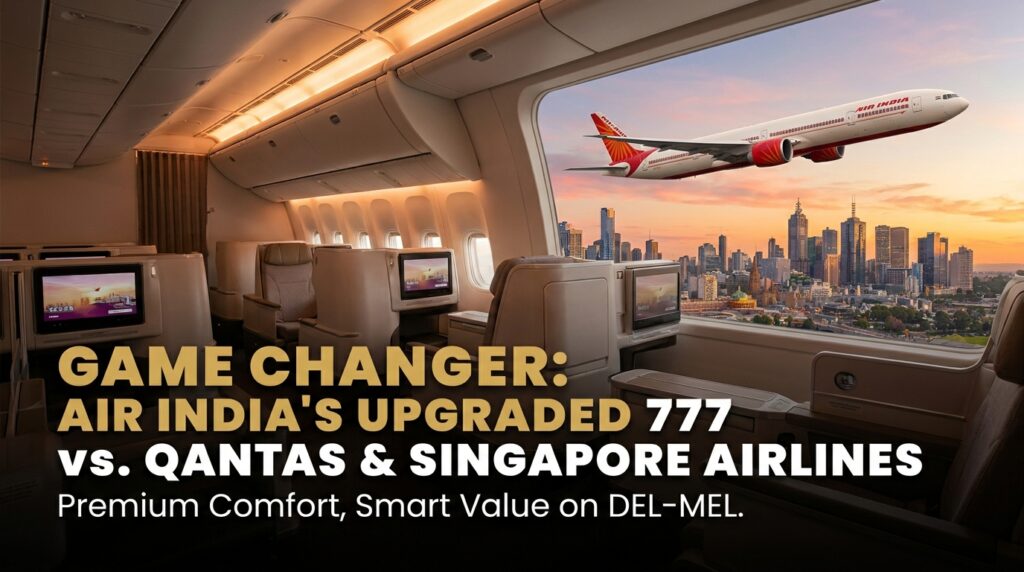
Air India’s upgraded Boeing 777-300ER on the Delhi-Melbourne route is not just a cabin upgrade. It is a direct shot at Qantas and Singapore Airlines for India-Australia flyers who want more comfort without blindly paying the highest premium fare. From 1 July 2026, Air India is deploying the upgraded B777-300ER between Delhi and Melbourne, replacing the earlier B787-8 on the route and introducing First Class for the first time on this sector.
What changed on Air India Delhi-Melbourne from 1 July 2026?
Air India has moved the route from a Boeing 787-8 to a larger, more premium Boeing 777-300ER. The big passenger-facing change is simple: more premium seats, a real First Class cabin, fully flat Business Class beds, Wi-Fi, refreshed food and beverage, and improved inflight entertainment.
| Cabin | Earlier B787-8 | New upgraded B777-300ER | Why it matters |
|---|---|---|---|
| First Class | 0 | 8 suites | First time on Delhi-Melbourne |
| Business Class | 18 | 40 flat-bed seats | More award and cash-seat chances |
| Economy Class | 241 | 280 seats | More total capacity |
| Wi-Fi | Not the route highlight | Added on this route | Better for work and messaging |
| Route frequency | 4 weekly now | 7 weekly from 1 Sept 2026 | Better planning flexibility |
The premium capacity jump is the real story. Air India’s own numbers show Business Class going from 18 seats to 40 seats, while the new First Class cabin adds 8 suites on top. That changes the route from a standard nonstop into a serious premium contender.
Also read – Rotterdam Fire Disrupts London-Amsterdam Trains
Is this Air India’s best long-haul product right now?
For Delhi-Melbourne, this is Air India’s strongest long-haul product because the aircraft brings 1-2-1 First and Business layouts, flat beds, bigger screens, power, USB, and Wi-Fi. Air India’s seat map for this B777-300ER layout shows 8 First seats, 40 Business seats, and 280 Economy seats, with First and Business both in a 1-2-1 configuration.
That matters on a flight of roughly 12 hours. Air India’s route page lists Delhi-Melbourne direct flying time at about 12 hours 10 minutes, while Qantas lists direct Delhi-Melbourne time at around 12 hours 30 minutes. On a flight this long, the seat is not a small detail. It decides whether you land ready for a meeting, a university visit, or a family pickup at Melbourne Airport.
Why this challenges Qantas and Singapore Airlines
Air India now has a clear advantage for travellers who want a nonstop flight with a premium cabin at a sharper price point. Qantas remains a powerful brand for Australia-bound flyers, especially for domestic connections inside Australia, while Singapore Airlines is still one of the strongest one-stop options through Singapore. But Air India now has something both premium travellers care about: nonstop convenience plus more flat-bed seats.
The fare angle is where it gets interesting. Air India’s Delhi-Melbourne page shows Business Class from INR 172,407, while Singapore Airlines’ Delhi-Melbourne premium-class offers show Business fares from around INR 242,842 on selected dates, with fares collected recently and subject to availability. This is not a universal fare rule, but it is a strong live signal for travellers comparing luxury options.
Should premium economy flyers look at Air India Business now?
Yes, premium economy shoppers should now check Air India Business before paying for a one-stop premium cabin. The catch is that this B777-300ER layout does not list a Premium Economy cabin. It has First, Business, and Economy.
That makes the booking strategy different:
- If you want a flat bed, compare Air India Business against Qantas and Singapore Airlines on the same travel dates.
- If you usually book Premium Economy, check whether the fare gap to Air India Business is small enough to justify the upgrade.
- If you want the safest premium experience, compare aircraft, seat map, fare rules, baggage, and arrival time before booking.
- If you are travelling with children or elderly parents, nonstop may beat a polished one-stop itinerary because it removes the stress of changing terminals, reboarding, and waiting during odd hours.
Singapore Airlines still has a strong Premium Economy product with extra space, calf rest, footrest, upgraded meals, and drinks on selected aircraft, so it remains relevant for travellers who do not need a flat bed.
Also read – Australia Issues Blunt Travel Warning For Afghanistan
Best seats to choose on Air India’s upgraded B777-300ER
The best seat choice depends on whether you value privacy, sleep, or travelling together. Air India’s B777-300ER seat map shows First Class rows 1-2, Business Class rows 5-15, and Economy rows 16-46.
| Traveller type | Smart pick | Why |
| Solo business traveller | Window Business seat | More privacy and less aisle movement |
| Couple in Business | Centre pair | Easier to talk, dine, and coordinate |
| First Class traveller | Row 2 if available | Usually feels quieter than the very front |
| Economy couple | Check rear 2-4-2 rows | Better than middle-heavy 3-4-3 rows |
| Family with infant | Bassinet rows 16D, 16F, 35D, 35F | Listed bassinet positions on this layout |
Do not book only because it says “B777”. Check the seat map before payment and again before departure. Aircraft swaps happen across airlines, and both fare pages and schedules can change.
What to do before booking this Air India Melbourne flight
Book this flight only after doing three quick checks. They take five minutes and can save you from paying a premium fare for the wrong cabin experience.
- Check the seat map. Look for 8 First, 40 Business, and 280 Economy seats.
- Compare same-date fares. Do not compare Air India in September with Singapore Airlines in December.
- Check your arrival plan in Melbourne. Qantas notes that SkyBus connects Melbourne Airport to Southern Cross Station in about 30 minutes, while taxis and rideshare are available outside the terminal area.
A real-world example: a Delhi founder flying to Melbourne for investor meetings may choose Air India Business if it saves money and avoids a Singapore stop. A student’s parent may still choose Economy nonstop because one flight is easier than managing a layover with extra bags. A luxury traveller may look at First Class because 8 suites on this route are rare and likely to stay limited.
Final verdict: who should book Air India’s upgraded Delhi-Melbourne 777?
Book Air India’s upgraded B777-300ER if you want the simplest premium path between Delhi and Melbourne. It is best for Business Class travellers, First Class flyers, families who hate layovers, and price-sensitive premium passengers comparing Qantas and Singapore Airlines.
Skip it only if you strongly prefer Premium Economy, Qantas points, Singapore Airlines service consistency, or a specific onward network. For everyone else, this upgrade makes Air India far more competitive than it was on this route.

