DFAT is telling all Australian citizens to stay out of Afghanistan because the security situation is extremely dangerous, fast-changing, and unsafe even in Kabul. The official Australian travel advice for Afghanistan was updated on 29 June 2026 and remains at the highest warning level: Do not travel. The warning applies to everyone, including dual nationals, and includes tourism, cultural trips, family visits, guided tours, and border travel.
What Is The Current DFAT Afghanistan Travel Advice?
The current advice is simple: do not travel to Afghanistan. The Australian Government says Australians have been injured, killed, kidnapped, arbitrarily detained, and targeted by terrorist attacks in Afghanistan. It also says nowhere in Afghanistan is safe, including Kabul.
For readers checking “is Afghanistan safe for Australians in 2026”, the answer is no. This is not a normal travel warning about pickpockets, scams, or airport delays. This is a red-level warning about threats that can become life-threatening quickly.
Why Did Canberra Warn Australians To Stay Out Of Afghanistan?
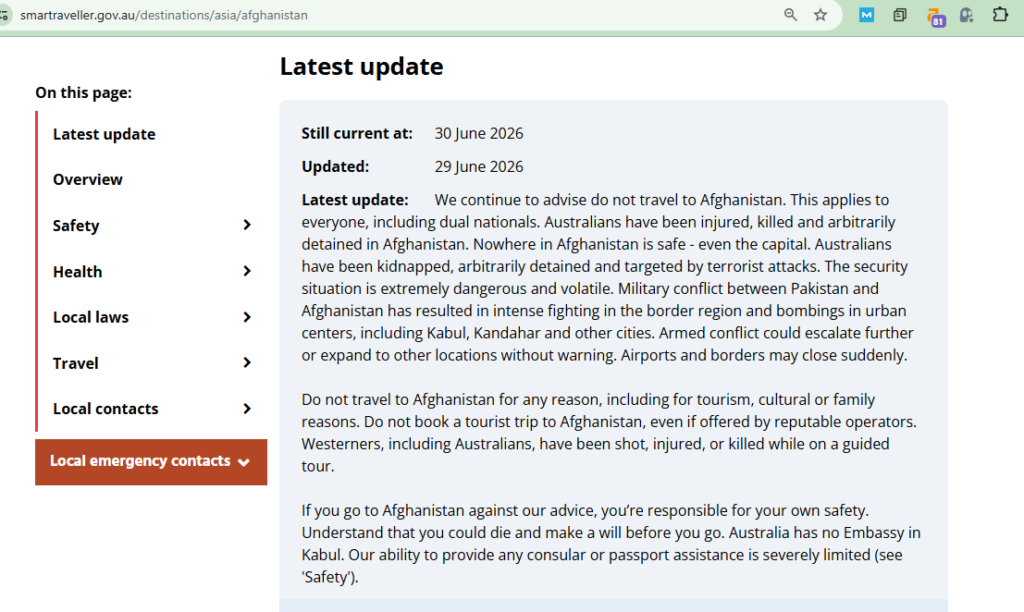
Canberra’s warning is driven by terrorism, kidnapping, arbitrary detention, armed conflict, and limited rescue options. The official advisory points to military conflict between Pakistan and Afghanistan, intense fighting near border areas, and bombings in cities including Kabul and Kandahar. Airports and borders may also close suddenly.
A practical way to understand the risk: in many destinations, a traveller can fix a bad situation by calling the embassy, changing hotels, booking a new flight, or paying for a safer taxi. In Afghanistan, those normal safety nets may not work. Flights can stop, phone or internet services can fail, roads can become unsafe, and border crossings can close without notice.
Also read – Travel Warning: France Govt Bans Alcohol and Cancels …
Afghanistan Travel Warning: Quick Risk Table For Australians
| Question travellers ask | Clear answer |
|---|---|
| Can Australians travel to Afghanistan? | DFAT says do not travel. |
| Is Kabul safer than other areas? | No. The warning says even the capital is not safe. |
| Are guided tours safer? | No. DFAT says not to book tourist trips, even with reputable operators. |
| Can dual nationals go for family reasons? | The warning applies to everyone, including dual nationals. |
| Will travel insurance cover Afghanistan? | Most Australian travel insurance policies will not cover travel to Afghanistan. |
| Is there an Australian Embassy in Kabul? | No. Australia has no embassy operating in Kabul, and consular help is severely limited. |
Are Afghanistan Tours Safe If A Local Operator Arranges Everything?
No, DFAT says Australians should not book tourist trips to Afghanistan, even if the trip is promoted as guided or run by a reputable operator. The advisory specifically warns that Westerners, including Australians, have been shot, injured, or killed while on guided tours.
This matters because Afghanistan has appeared in social media travel content as an “offbeat” or “rare” destination. That is exactly the trap. A video can make a market street look calm for 20 seconds, but it cannot show what happens when a checkpoint changes mood, a road closes, or a foreign traveller is identified as a target.
What Should Australians Already In Afghanistan Do Now?
Australians already in Afghanistan should leave immediately if it is safe to do so. If someone decides to remain, the Australian Government says they are responsible for their own safety and may not be able to leave quickly.
Useful steps for anyone already there:
- Make a realistic exit plan with more than one route, because airports and borders may close.
- Get independent security advice, not just advice from a fixer, driver, or tour contact.
- Keep documents secure, including passport copies stored offline and separately.
- Avoid public attention, especially social media posts showing location, hotel, route, or companions.
- Contact the 24-hour Consular Emergency Centre on +61 2 6261 3305 from overseas or 1300 555 135 from within Australia if emergency help is needed.
Also read – Reagan National July 4 Flight Delays: DCA Warning & …
What If Your Australian Passport Is Lost Or Stolen In Afghanistan?
A lost passport in Afghanistan can become a serious crisis because passport services are severely limited. The advisory says Australia cannot provide in-person consular or passport services in Afghanistan and cannot facilitate passport delivery into the country.
Do this before any high-risk travel decision:
- Keep your passport in a secure place, not in a day bag or coat pocket.
- Carry photocopies separately from the original.
- Store digital copies offline, not only in cloud accounts that need internet.
- If your passport is stolen, notify the Australian Passport Office as soon as possible.
What Not To Do After The DFAT Afghanistan Update
Do not treat Afghanistan as an adventurous gap-year destination, content trip, or “last frontier” holiday. This is the clearest mistake travellers can make.
Avoid:
- Booking a tour because other foreigners posted videos from Afghanistan.
- Assuming a local guide can guarantee safety.
- Travelling near borders to “leave quickly” without professional advice.
- Posting real-time location updates.
- Carrying unusual equipment that could be misunderstood, especially drones, tracking devices, military-style items, or large amounts of cash.
- Assuming dual nationality gives extra protection. The current warning applies to dual nationals too.
Why This Warning Matters More Than A Normal Travel Alert
This warning matters because Australia’s ability to help citizens inside Afghanistan is severely limited. DFAT confirms Australia no longer has a diplomatic mission in Afghanistan, and Australians who make it out should contact the nearest Australian embassy or consulate.
The UK also advises against all travel to Afghanistan, and the US lists Afghanistan as Level 4: Do Not Travel, citing risks including terrorism, kidnapping, wrongful detention, unrest, crime, natural disasters, and limited health facilities.
Bottom Line: Should Australians Travel To Afghanistan In 2026?
No. Australians should not travel to Afghanistan in 2026 for any reason. The safest decision is to cancel or avoid travel plans, subscribe to official updates, check insurance terms, and use official government channels rather than tour marketing or influencer posts.
For the most current information, read the official Australian Afghanistan travel advice, check DFAT’s Afghanistan country page, and review the Australian Government’s Consular Services Charter before making any overseas risk decision.

