Travelers heading to Ontario should check their measles vaccine record before the trip, especially if they are visiting family, attending events, using busy transit, or traveling with children. Public Health Ontario’s latest Measles in Ontario epidemiological summary reports 27 measles cases in Ontario from January 1 to June 23, 2026, with two hospitalizations and no ICU admissions.
This is not a “don’t visit Ontario” story. It is a smart traveler warning. Measles is one of those infections that can turn a normal airport, hotel breakfast room, wedding hall, bus ride, or family gathering into an exposure setting if even one contagious person is nearby.
Is Ontario Seeing Measles Cases in 2026?
Yes, Ontario has reported measles cases in 2026, but Public Health Ontario says no additional cases were reported between its May 26 and June 23 data extractions. The 27 cases were reported across eight public health units: Durham Region, Middlesex-London, Niagara, Ottawa, Peel, South East, Toronto, and York Region.
That matters for travelers because these are not all in one tiny location. A visitor landing in Toronto, driving to Niagara, taking a train to Ottawa, or staying with relatives in Peel or York could be moving through areas where public health teams have tracked cases this year.
Why Should Travelers Care If Ontario’s 2026 Case Count Is Small?
Travelers should care because measles spreads before many people know they are sick. Public Health Ontario notes that measles cases are infectious from four days before rash onset to four days after rash onset, and rash can appear 7 to 21 days after exposure.
That timing is exactly why measles follows travel routes. Someone can fly, attend a family dinner, sit in a clinic waiting room, or take public transit before the rash makes the illness obvious.
A real-life travel example: a person feels tired on Friday, flies on Saturday, develops a cough on Sunday, attends a birthday party on Monday, and only gets the rash later in the week. By then, several places may need contact tracing.
Also read – US Embassy Issues Fresh UAE Travel Advisory & Aerial Threats …
What Does Ontario’s Measles Data Show About Vaccination?
Ontario’s 2026 measles cases were mostly among people without confirmed vaccine protection. Public Health Ontario reports that 66.7% of 2026 cases were unimmunized, 3.7% had two or more doses, and 29.6% had unknown or no proof of immunization.
| Ontario 2026 Measles Detail | What Travelers Should Take From It |
|---|---|
| 27 total cases | Measles is still being detected in Ontario |
| 18 unimmunized cases | Missing vaccines remain the biggest risk signal |
| 8 unknown/no proof cases | Not knowing your vaccine history is a problem |
| 2 hospitalized cases | Measles can become serious |
| 0 ICU admissions and 0 deaths | Good news, but not a reason to ignore prevention |
The quiet lesson is this: “I think I had my shots” is not the same as proof. Before a Canada trip, check your record, pharmacy file, school immunization record, or patient portal.
Canada’s Measles Situation Changed After the 2024-2025 Outbreak
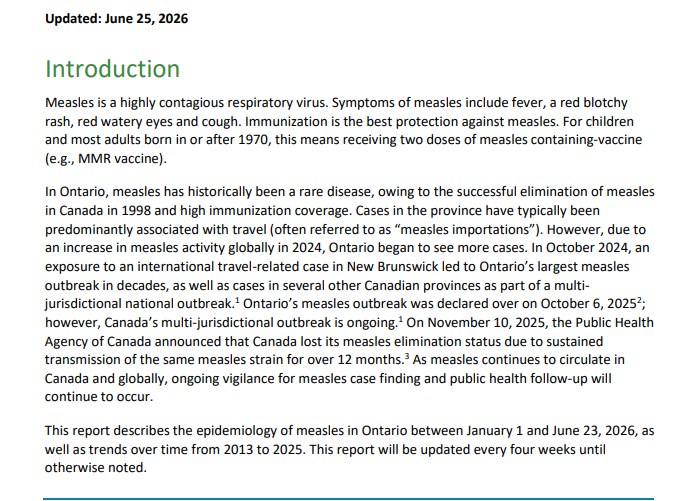
Canada lost its measles elimination status in November 2025 after more than 12 months of transmission across the country. The Public Health Agency of Canada said the outbreak began in October 2024 and involved multiple provinces and territories, with transmission mainly in under-vaccinated communities.
Ontario’s own outbreak was declared over on October 6, 2025, but the story did not end there. Public Health Ontario says the 2024-2025 Ontario outbreak included 2,377 outbreak cases across 26 public health units, and 89.2% of outbreak cases were unimmunized.
That is the travel angle many readers need: Ontario may not be at the peak of the outbreak now, but measles risk is still linked to movement, vaccine gaps, and exposure in crowded places.
Also read – U.S. Embassy Issues Albania Security Alert: How It Actually …
What Are Measles Symptoms Travelers Should Watch For?
Measles often starts like a rough respiratory illness before the rash appears. Public Health Ontario lists symptoms including fever, red blotchy rash, red watery eyes, and cough, while Canada’s measles guidance says infected people can spread measles from four days before to four days after the rash begins.
Watch for:
- Fever
- Cough
- Runny nose
- Red, watery eyes
- Tiredness
- Red blotchy rash
- Recent travel or exposure to someone sick
A practical tip for travelers: if you develop fever, cough, and red eyes after a flight or trip, do not walk into a clinic without calling first. Canada’s measles symptoms and treatment guidance says to isolate, contact a health care provider immediately, and call ahead before visiting a health facility.
Who Needs the Measles Vaccine Before Traveling to Ontario or Canada?
Most travelers born in 1970 or later should have two doses of a measles-containing vaccine, such as MMR. Public Health Ontario says children and most adults born after 1970 should receive two doses, and people traveling within or outside Canada should make sure they are protected before traveling.
Canada’s measles travel health advice gives travelers a simple rule:
| Traveler Group | Measles Vaccine Guidance Before Travel |
| Born before 1970 | Usually 1 dose is recommended before travel if not immune |
| Born in 1970 or later | 2 doses are recommended |
| Children and youth | Should be up to date with provincial or territorial schedules |
| Infants 6 months to under 1 year | Ask a health provider about early MMR if traveling where measles is a concern |
Canada also says travelers should talk to a health care provider or travel clinic preferably six weeks before travel, though even a last-minute appointment is still worthwhile.
Traveling With a Baby? Ask About the Early MMR Dose
Parents traveling with babies aged 6 months to under 12 months should ask a clinician about early measles vaccination if visiting a place where measles is a concern. Canada’s immunization guide says MMR may be given as early as 6 months for children traveling outside Canada where measles is a concern or traveling to locations experiencing outbreaks, but children still need additional doses after 12 months for long-term protection.
This is the detail many travel articles miss. An early baby dose is not simply “one and done.” Parents should ask:
- Does my baby need an early MMR dose for this trip?
- Will this dose count toward the regular schedule?
- When should the next two doses happen?
- What should we do if there is a known exposure?
Also read – Australia Issues Blunt Travel Warning For Afghanistan
What Should Travelers Do If They Feel Sick During or After a Trip?
Travelers with possible measles symptoms should isolate, wear a well-fitting mask or respirator, and contact health care before showing up in person. Canada’s travel health advice says anyone who feels measles symptoms while returning to Canada should limit contact, put on a well-fitting respirator or medical mask, and inform flight, cruise, or border staff as soon as possible.
Do this:
- Call ahead before visiting a clinic.
- Say you may have measles and mention recent travel.
- Avoid public transit, school, work, and group events until advised.
- Make a list of places visited during the last few days.
- Follow local public health instructions.
Do not do this:
- Do not sit in a crowded waiting room without warning staff.
- Do not attend a wedding, conference, class, or tour group while symptomatic.
- Do not assume a rash is “just allergies” if fever and cough came first.
- Do not travel if you have symptoms or were told you may be infectious.
Should Travelers Cancel an Ontario Trip Because of Measles?
Most vaccinated travelers do not need to cancel an Ontario trip because of measles, but unvaccinated travelers should fix the vaccine issue before going. CDC says two doses of measles vaccine are about 97% effective at preventing measles, while one dose is about 93% effective.
The smartest approach is not panic. It is preparation.
Before your trip:
| Step | Why It Matters |
| Check your MMR record | Proof matters more than memory |
| Review Ontario exposure updates | Exposure locations can change quickly |
| Book a travel health visit | Especially useful for infants, pregnant travelers, and immunocompromised travelers |
| Pack masks | Helpful if symptoms appear or an exposure is announced |
| Know who to call | Save local public health and travel insurance numbers |
| Avoid travel if sick | Measles spreads before and after the rash |
Bottom Line for Travelers
Ontario’s measles data is a vaccine-record reminder for travelers, not a reason to panic. The province reported 27 measles cases in 2026 through June 23, most with no confirmed immunization protection, after a much larger 2024-2025 outbreak that was heavily concentrated among unimmunized people.
The best move is simple: check your MMR record before booking or boarding. If you are born in 1970 or later, confirm two doses. If you are traveling with a baby, ask about early MMR. If symptoms appear during or after travel, isolate and call ahead before seeking care.
A small vaccine check before the trip can prevent a large problem after it.

